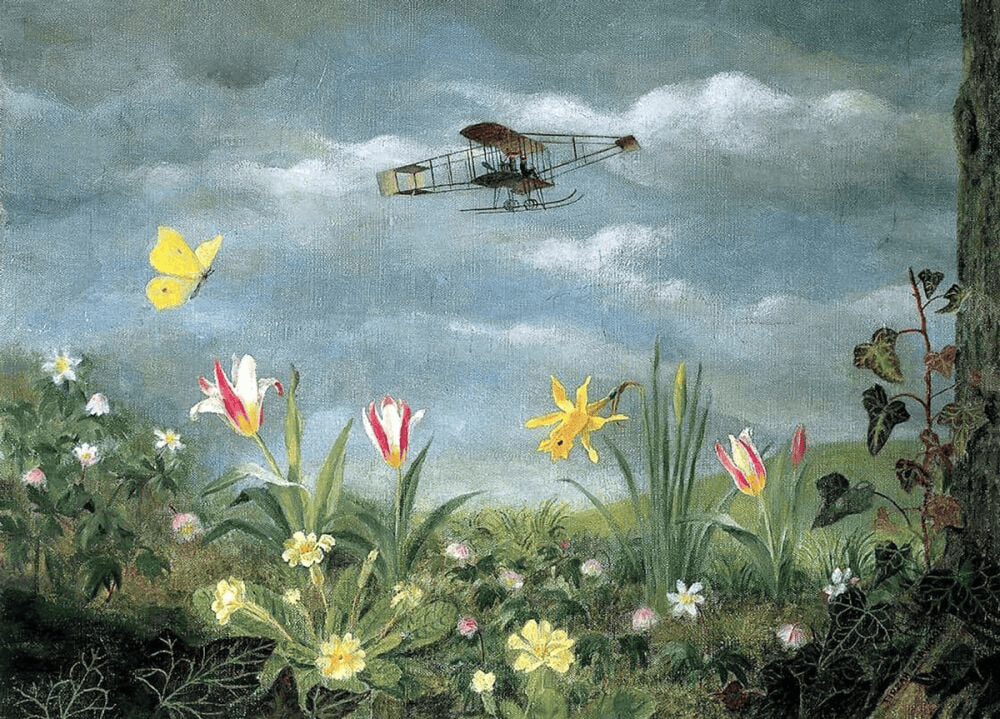
Tirzah Garwood (1908 – 1951), Springtime of Flight, 1950
Kettle’s Yard’s latest exhibition, Handpicked: Painting the Flowers, opens with what is perhaps its most famous artwork: Henri Rousseau’s ‘Bouquet of Flowers’ (1909-10). At first glance, the painting appears to be a straightforward depiction of its subject matter – a white vase holds flat green leaves, chrysanthemums and dark pansies, forget-me-nots and baby’s breath. Behind the bouquet, however, a pink curtain hangs in an uncanny succession of carefully ordered, wave-like folds, the table upon which the vase rests clashing with the same in stolid crimson. This quietly theatrical setting troubles the painting’s impression of realism, betraying the method for which Rousseau is famed – the painting is not a directly-observed still life, but an imagining of a bouquet from memory. This is evident, too, in the unlikely combination of flower varieties depicted, which bloom in different seasons and climates. It is this capacity of flowers to be fancifully conjured, reimagined, and mused upon that Handpicked places at the heart of its curation.
This same capacity governs how we give and receive flowers, leading, most often, with personal or occasional sentiments. The first room of the exhibition moves through depictions of flowers with clear individual or communal significance towards more experimental and uncertain renderings. Christopher Wood’s ‘The White Vase’ (1930), for example, uses bold contours and flattened planes to depict a distinctly lifelike bouquet. A dark poppy anemone holds the eye at its centre, behind which other flowers are evenly arranged. Vanessa Bell’s ‘Still-life of Dahlias, Chrysanthemums and Begonias’ (1912) takes a messier, impressionistic approach. Thick black paint creates shadows in the image, and the flowers are formed using harsh geometric lines and calligraphic brushstrokes. While from a distance it appears plain and unassuming, up close Charles Rennie Mackintosh’s watercolour ‘Fritillaria’ is particularly striking. The flowers’ petals are marked with a minute, chequered pattern – a natural quirk rendered strangely geometric by the former architect’s bold, angular lines.
The exhibition is strongest when flowers are directly implicated in human relationships. Hannah Gluckstein’s glamorous ‘Orchestra’ (1967) portrays the flowers she gifted to a new lover to provoke jealousy in another: the married woman whom she continued, resignedly, to see despite her refusal to leave her husband. ‘Cyclamen and Primula’ (1923), on the other hand, was painted by Winifred Nicholson in Switzerland during a particularly happy winter spent with her husband, the painter and sculptor Ben Nicholson. The artwork presents a pot of cyclamen and primula wrapped in tissue paper and set on a window sill against a backdrop of snow-covered Alpine slopes. Nicholson painted the gift directly where it sat, matching the white paper and pale flowers to the bright winter landscape outside.
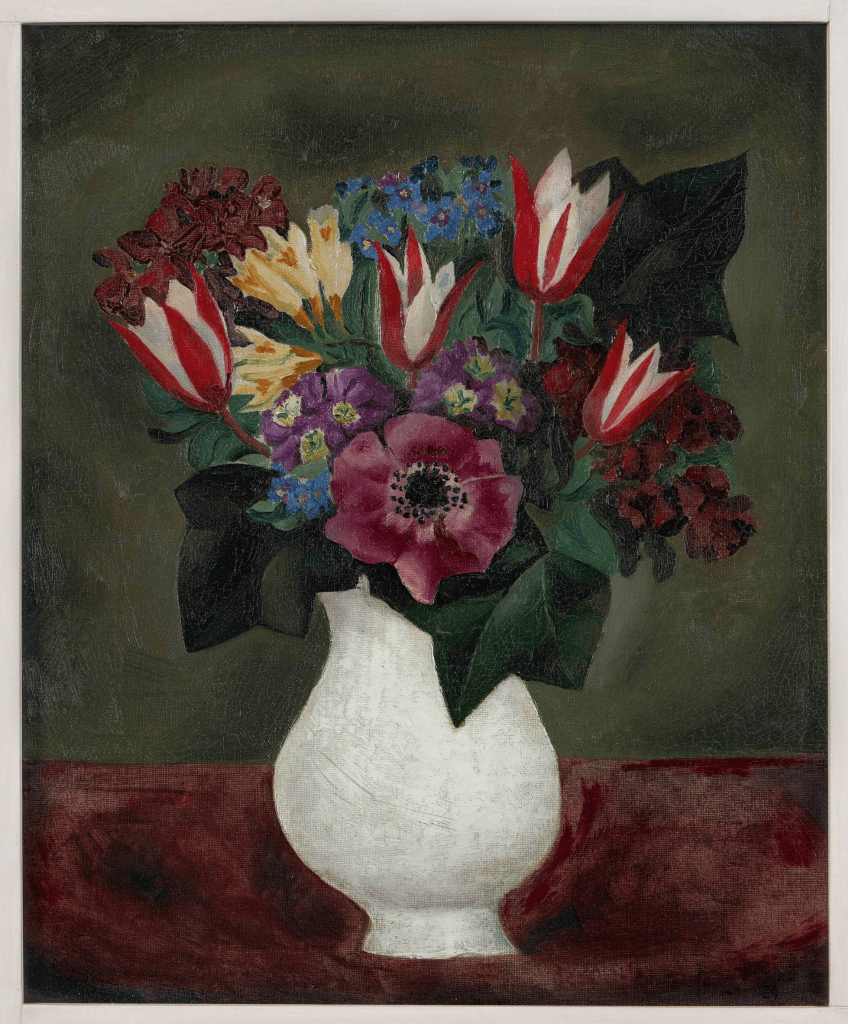
Christopher Wood (1901 – 1930), The White Vase, 1930. Oil on canvas on board. 460 mm x 380 mm. Courtesy Pallant House Gallery, Chichester (Bequeathed by Ian Mylles with Art Fund support 2021). Photo: © Pallant House Gallery, Chichester
Reading the story of Tirzah Garwood and Eric Ravilious lends her painting ‘Springtime of Flight’ (1950) a tragic weight. Painted during the final year of her life after a diagnosis of terminal cancer, the picture sets a spray of bright wildflowers and a single butterfly beneath an overcast sky. A toy aeroplane hovers in the distance – a quiet nod to Ravilious who died on an aviation mission during the war. Only steps away in the gallery is a painting by Ravilious himself, ‘Ironbridge Interior’ (1941), where a vase of flowers is set on a table in a sparse room in the house that he shared with Garwood before he died. Another, seemingly unpolished, painting of flowers is hung on the wall in the room, and between the two bouquets – real and unreal – waits an empty chair, angled towards the table. This emptiness, given Ravilious’ death, acquires an elegiac poignancy, speaking to the symbolic association between flowers and mourning.
The second room is more contemporary, its paintings pushed further into abstraction, alongside deeper political concerns. Chris Ofili’s ‘Untitled’ from Afro Muses (2005) depicts two faces emerging from the dark sepals of a branching stem. His synthesis of human and plant form quietly upends old Western traditions of portraiture and landscape; Black presence occupies the same sacred, fluid space as the flora that surrounds it. Bianca Raffaella’s ‘Waxflower’ (2025) depicts the impression of white flowers against a muted background. Raffaella is registered blind, and her paintings attempt to capture her experience of sight as constant motion. The petals of the flowers in ‘Waxflower’ appear as flickering blots suspended within streams of thinned paint.
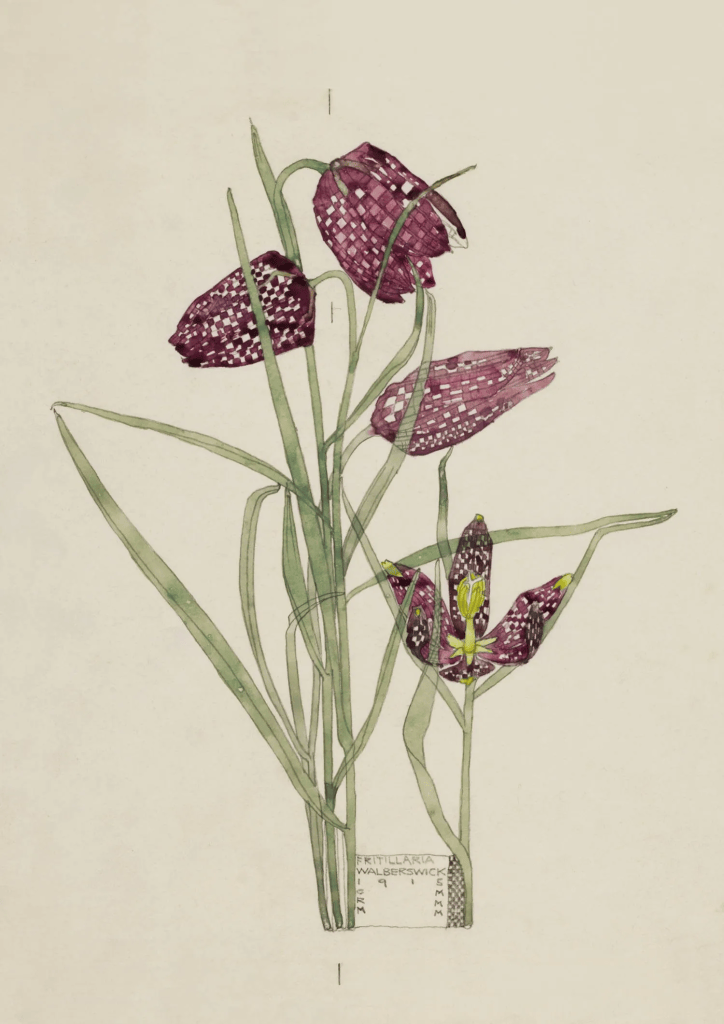
Charles Rennie Mackintosh (1868 – 1928), Fritillaria, 1915
While the careful presentation of – for example – Garwood’s and Ravilious’s paintings together is provocative, there are moments when the exhibition’s curatorial intentions feel perhaps too carefully signposted by the interpretation, pre-empting the viewer’s independent connections between the works. The ‘community opinions’ scattered throughout the gallery, however, are refreshing: short statements of aesthetic response that testify to the affective power of engaging with art in public settings, of conversing about, or debating the same. Most compelling are the ways in which the paintings themselves trouble the familiarity of the flower bouquet. Flowers might constitute a gift but also an attempt at provocation, an expression of desire or one of jealousy, an object of pleasure or a reminder of deep grief and loss. The curation in Handpicked encourages a second look at the most ubiquitous of still-life subjects, revealing how the familiar bouquet might evade sentimental clichés or tropes and instead surprise us with its capacity to signify differently, intractably, or even strangely, according to context.
By Caitlin Kawalek
 The Camera