
Gripping to scaffolding, fighting with rope, the artist Rose Finn-Kelcey precariously releases a message: Here is a Gale Warning. Declarative, and eponymous, the unveiling of this flag, or “wind-dependent object”, above Alexandra Palace signals the concerns of Kettle’s Yard’s latest exhibition. Featuring artists whose work ranges from hand-woven sculptures to photography to performance art, curated by Dr Amy Tobin, Here is a Gale Warning attempts to bridge the disparate crises that emerge, or are made visible, in the wake of climate change. Without resting on easy pessimism, the message of the exhibition is clear: the gale is blowing, we are in its midst.
Pull, struggle, release, repeat. A video of Finn-Kelcey at the top of Alexandra Palace loops in the corner of the first room. Beneath this, a photo of Battersea Power station where, in 1972, two more of Finn-Kelcey’s flags flew, this time bearing the words ‘POWER FOR THE PEOPLE’ – right on! Territorial and precautionary, Finn-Kelcey’s artworks relocalise both power and crisis: London landmarks are forced to give voice to an increasingly disillusioned populace. Clinging to their original shock factor, the mediated presentation of these performances-turned-artworks in this exhibition feels somewhat vacuous. If you’ve ever seen, as an act of protest, a person scale a building to raise a flag, you’ll remember the collective intake of air as the crowd waited for the wind to catch. A breath that these photos and videos struggle to capture.
Though the focus of the exhibition tends towards alarm, there are moments of calm – albeit tempered. Following the gallery walls anticlockwise, we are presented with images of a boxing glove, seemingly loaded, pointing in the direction of a bubble. In one of the images, the boxer strains across the room, ridiculously reaching for a bubble barely visible – a watermark on fibre print, the artist flailing in empty space. In Finn-Kelcey’s Untitled: Boxing Glove and Bubble #1-4 both air and image suspend a fragile bubble keeping it intact, an incoming breeze made threat again.

Rose Finn-Kelcey
Untitled: Boxing Glove and Bubble #1, c. 1970 / 2019
© Estate of Rose Finn-Kelcey. Image Courtesy the Estate and Kate MacGarry, London
At the opposite end of the room, a storm gathers – this time, it is not fabric but metal that flies. Cutting through the air like branches caught in the wind, forked iron rods hang from the ceiling. Lit in a faint purple light, these rods seem to discharge: dangerous yet momentary. Tarek Lakhrissi’s Unfinished Sentence draws on Monique Wittig’s lesbian classic Les Guérillères; not lightning or branches, then, spears. Coupled with a sound collage created by Nadayé Kouagou, the piece is also said to be reminiscent, according to the show description, of a nightclub – a place of queer resistance, a small slice of utopia. Surrounded by the white walls of Kettle’s Yard, light gorgeously streaming in, this image falls short. At least, it does not track with my experiences of the queer underground: curated and polished, no; a strong sense of worry at being struck by falling hardware, maybe.
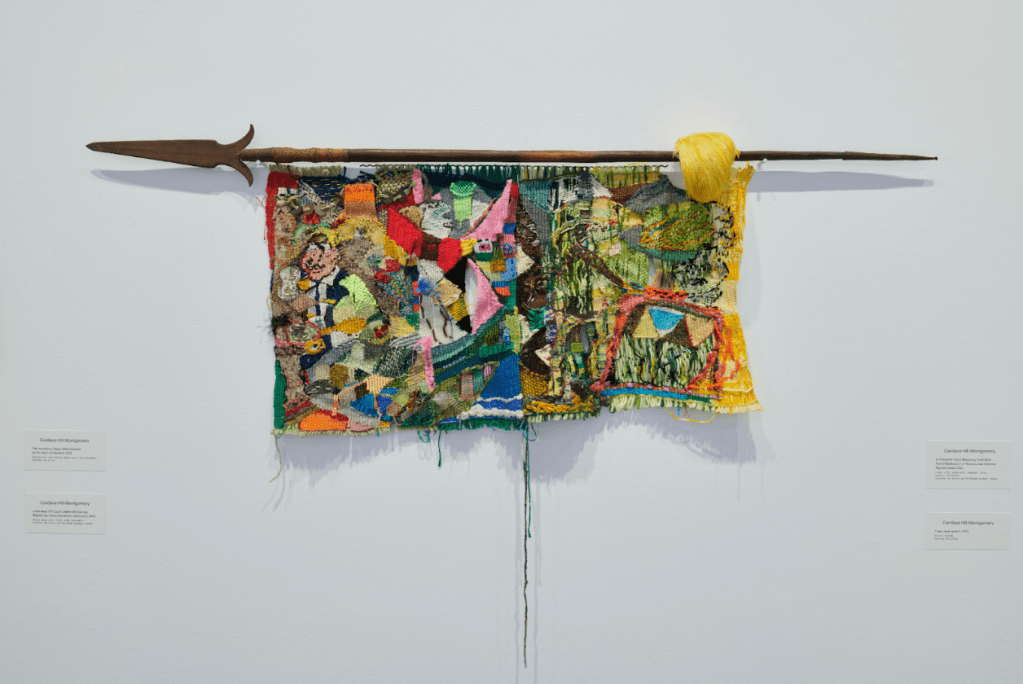
On the intervening wall, Finn-Kelcy’s and Lakrhissi’s works are laced together by a series of Candace Hill-Montgomery’s weaves. Made using a hand loom, these pieces hang from driftwood, shelving brackets, and spears – one piece even drapes across the back of a black panther, made by the artist’s father out of papier-mache. Blending personal and public histories, these weaves knot together fabric and waste to depict various scenes: out of each, a face or house or forest may appear. Apprehending these scenes is difficult with their titles giving only a small hint at their subject: A Thousand Hours Reasoning Troth With Sword Swallowers’ or How is Loves Distance Approximated asks one of the smaller weaves, or Give Attention to Transportation a Thought implores the papier-mache sculpture. In the former, the closed circuit of thread threatens to spool out onto a piece of 3D-printed plastic; once we know the length of this piece of string, we might be closer to an answer. Your guess is as good as mine.
Candace Hill-Montgomery
It Was Never Given?, 2024
Image Courtesy Jo Underhill
Hill-Montgomery’s weaves continue across the hall in the exhibition’s second room. Bound together by a web of lines and knots, this room features work from Tomashi Jackson, Justin Caguiat, Anne Tallentire and Cecilia Vicuña. If the focus in the first room tended atmospheric, then this room is firmly on the ground: crisis is localised, finding voice on beach shores, the gallery floor, and archival stores. Lines, abstract and figural, beat poetic across the pieces.
Tomashi Jackson’s The Talking Drum (Drummer singing and playing in Notting Hill 1976 / Audience at Club Alabam Central Avenue Los Angeles, 1953) paints a striated history of resistance to police brutality. Images are transposed on top of each other: attendees of Notting Hill Carnival meet the audience of Los Angeles’ Club Alabam, a prominent jazz club and fixture on the queer scene. The title’s ‘talking drum’ refers to an instrument, banned on plantations in the United States, that was used to communicate across long distances: a percussive vocality that is said to have seeded the growth of the jazz movement. Polyvocal, these scenes captured in one speak to the civility that marks resistance and asks us about the continuity of state-sanctioned violence, not visible, that requires it.
Nearby, we find Cecilia Vicuña’s Basuritas en Con-cón, The Plastic Vortex which plays with another kind of (in)visibility. What first appears to be a flower blooms into pink, plastic waste; a mess of seaweed becomes a plastic net knotted in the surf. As waste pulses in and out of view, the audience is forced to consider limits of our sight; the border between life and nonlife becoming ever thinner. This is perhaps the exhibition’s most explicit acknowledgement of the intractability of our current ecological crisis.
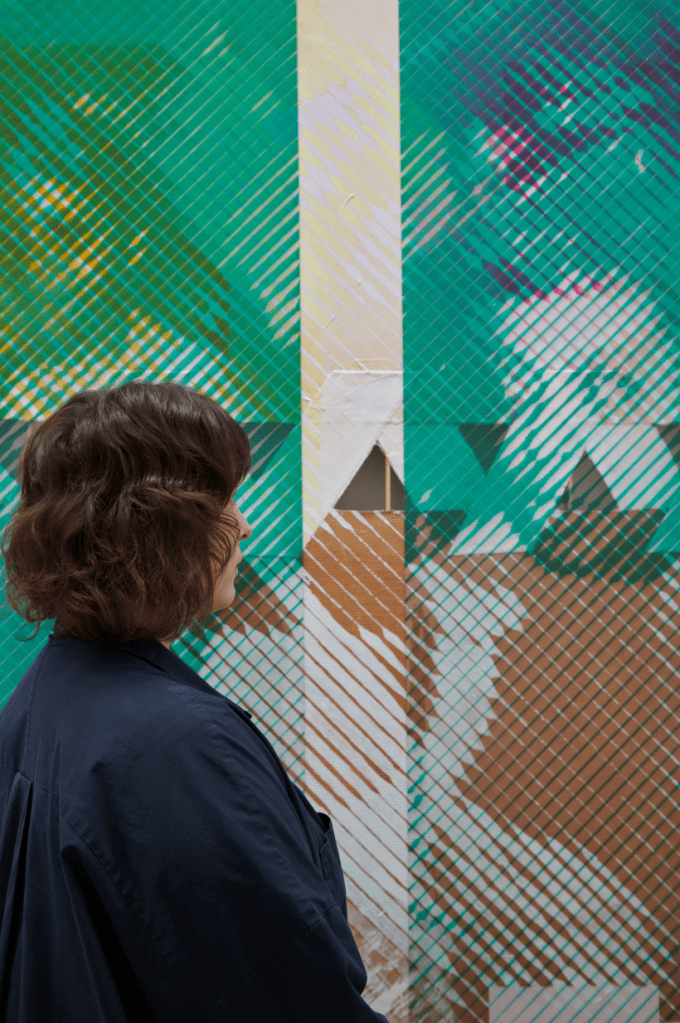
Tomashi Jackson
The Talking Drum (Drummer singing and playing in Notting Hill 1976 / Audience at Club Alabam Central Avenue Los Angeles, 1953), 2024
Image Courtesy Jo Underhill
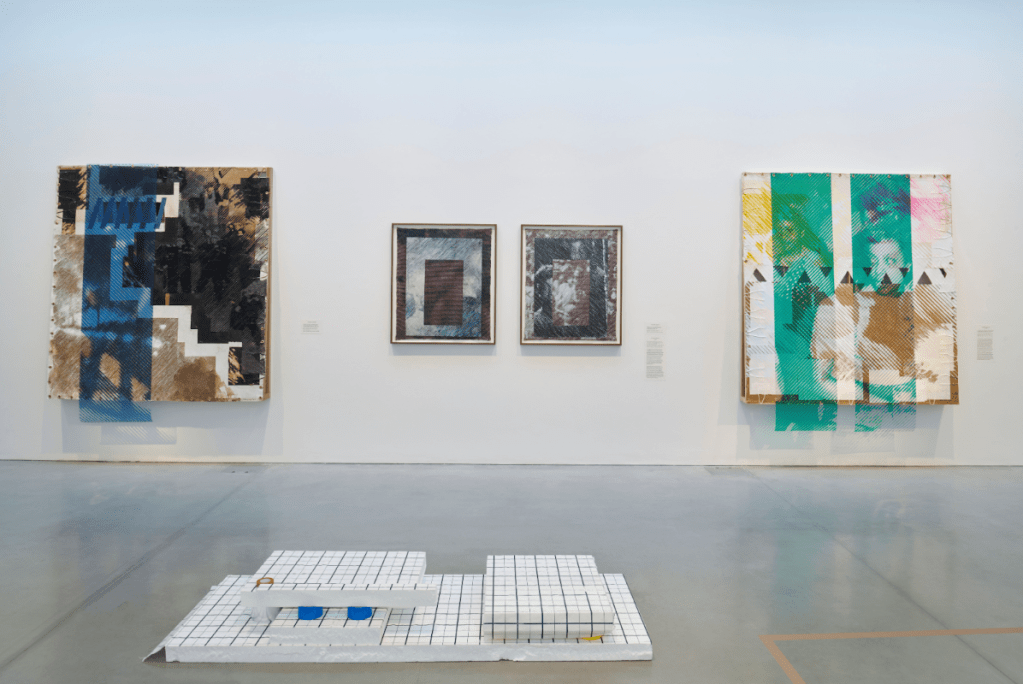
On the floor of the second gallery room, we find Anne Tallentire’s Interspacing 01 and Interspacing 03 – Mondrian-esuqe sculptures of ecoscreed board, an insulating material, and gaffa tape. Interstitial in name and form, both of these artworks are scalar representations of the fixtures and fittings in prison cells and attempt to represent the precarity of prison life. Together, they seek to challenge the appeal of order in the face of the messy and often-complex needs of everyday life. Dignity becomes enclosed in the sculptures neat lines.
We are transported, then, from an exploration of racialized violence to a critique of the prison industrial complex to plastic waste that mounds on our shores daily. Modernity’s detritus accretes, and conceptual disjuncture finds resolution in aesthetic coherence. Flight lines cross paths and grid the exhibition space, yet the entrenched quality of crisis paralyses the space of possibility that these marks seek to create.
The second room of Here is a Gale Warning, featuring the work of Anne Tallentire and Tomashi Jackson.
Image Courtesy Jo Underhill
The second gallery room and the hallway are connected by a map of a room in a local community housing project – a floor plan made literal. The tape on the floor marks doorways, a bedroom, bathroom, and kitchen. Walking over the map, you’re faced with the difficulty of adding a dimension to the 2D design. Yes, this is the size of the bedroom but how would it feel to stand in it? What does it take to transform a representation into reality? Perhaps, this is the point – and limit – of the exhibition: in the midst of a crisis we find ourselves grasping at the inwardness of things, an explanatory interior that continually evades capture. We have the warning, but what do we do now?
By Troy Fielder
 The Camera