

Art by Elliot Blake
Following the zig-zags of the valley cutting up Ferdinand Hodler’s The Kien Valley with the Bluemlisalp Massif, I imagine the rushing stream that must be hiding beneath the thick brush of evergreen branches, then I spit out my toothpaste and rinse my mouth. Since pinning the National Gallery’s postcard of Hodler’s painting next to my sink mirror, I have spent approximately two minutes every morning and every night staring at this alpine valley while I brush my teeth. The postcard first caught my attention in the museum gift shop when I recognised the at once realistic and unbelievable yellow-green colors that I had admired in the Post-Impressionist room. I wondered how Hodler had been put into dialogue with the burnt orange cliffs of Cezanne’s ‘In the Bibémus Quarry’ hung adjacently. Pondering this for 30 seconds, I reentered the flow of museum goers and drifted into the next room to peruse Monet and Pisarro.

Ferdinand Hodler, The Kien Valley with the Bluemlisalp Massif, 1902. Oil on canvas. Image: The National Gallery
Thankfully, my relationship with Hodler’s scene continued beyond our brief National Gallery encounter, and its miniaturized form became part of my diurnal rituals. But what if I had been able to take the painting home with me? What if instead of 4×6 inch matted card stock, I could stand face-to-face with Hodler’s true dimension and textured brush strokes? Such an absurd thought has been made a reality in Cambridge by Kettle’s Yard and several colleges like King’s, Trinity, and Jesus, institutions which lend art from their collections to students to hang up in their rooms for the academic year.
“Something really beautiful happens when you live with art,” says Ane Cornelia Pade, the Art History PhD student who runs the King’s College art loan programme, “it comes to shape our environment, shape our days.” Nearly every year since the famed economist and King’s alum John Maynard Keynes died in 1946 and bequeathed a portion of his large art collection to the students of King’s, these students have had the opportunity to borrow a piece from the collection of what has grown to contain more than 500 paintings, prints, and drawings. The most notable pieces include prints and drawings from Bloomsbury group member Roger Fry and several large original paintings by British pop artist Mark Lancaster. Two loaned Chinese water colors from Keynes’ personal collection hang prominently in Ane Cornelia’s living room, she tells me. Being able to “sit” with the paintings every day changes, enriches, and expands her experience of them. As you “notice tiny little details and quirks in the lines,” art becomes “a form of meditation,” Ane Cornelia says. A protean dialogue between the viewer and the painting seems to develop when the encounter takes place over a long duration. “Pieces look different to you depending on how your day is going. Is it a bright, sunny afternoon? Or is there a winter light? Are you overjoyed? Or dreading your exam?”

Inside Kettle’s Yard Art for Students collection day on October 28th (photo by Kiana Rezakhanlou)
Naomi Polonsky, the Assistant Curator of the Kettle’s Yard house collection and the Director of their loaning scheme, echoes Cornelia’s call to decelerate as we look at a painting, saying, “all art is rewarded by close looking.” But this “close looking” can be at odds with the flood of information and imagery that we are fed in contemporary society. She hopes that the Art for Students programme can help students cultivate a space sheltered from this attentional deluge in their own rooms. Living with paintings and prints from artists like Friz Moser and Elizabeth Scott Kilvert (two of Naomi’s favorite pieces in the collection), might encourage the kind of “visual attentiveness and analysis that is applicable in other parts of life and make us more appreciative of the natural world,” Naomi says, adding, “learning to attend to all our surroundings is a rewarding experience.”
Yet the slow-form attention encouraged by the programme seemed at odds with the mad rush that pulsed through the line of students snaking up Castle Street waiting to get into Kettle’s Yard before the program kicked off. Heightened anticipation and anxiety was palpable in the queue and in the gallery as students raced to secure their allotted two pieces of art. Those at the front of the line said they had been waiting for two and a half hours. After having to turn students away due to the scheme’s popularity, Naomi tells me that next year, students will only be able to borrow one, not two, pieces.

The line for Kettle Yard’s Art for Students on October 28th (photo by Kiana Rezakhanlou)
Art for Students has been a programme at Kettle’s Yard for almost 70 years, since the museum’s founding in 1957 by Jim and Helen Ede who had a vision of helping students learn how to look at and appreciate art in a different way than that possible from a traditional gallery. This philosophy remains at the core of Kettle’s Yard as a gallery, where much of the art is on display as it might be found in a home rather than a museum. Having been an integral part of Cambridge for many years, the scheme has a few notable alumni, including Gonville and Caius’ Stephen Hawking, whose name can be found on the late returns list. Naomi tells me that, outside of some colleges at Cambridge and Oxford, only the Leeds Art Gallery in Yorkshire has an art loan scheme comparable to the scale and quality of Kettle’s Yard. Having participated in a similar scheme as a student at Oxford (she brought home a black and white photo of a woman walking down a street), Naomi says she feels a personal and emotional connection to the programme, especially one with such a long history.
Art loan programmes are relatively rare, but there has been a proliferation of ‘deep’ and ‘slow’ ways of looking at art across artistic disciplines in part as a response to depreciating attention spans caused by social media. Both London’s Tate and National Gallery have published guides to ‘slow looking,’ which, in contrast to the eight seconds that the Tate estimates museum-goers spend glancing at each painting, recommend spending a more lengthy five to fifteen minutes imagining yourself jumping into the painting, taking visual a walk around the scene, or closing your eyes and describing the piece to a friend, to name a few of the techniques proposed.
Harvard Art History Professor Jennifer Roberts takes ‘slow looking’ even further: her students are instructed to spend three hours in a museum looking at a single painting before writing about it. “Immersive attention” is “no longer available ‘in nature,’” Professor Roberts writes. “Every external pressure, social and technological, is pushing students in the other direction, toward immediacy, rapidity, and spontaneity—and against this other kind of opportunity.” By forcing students to spend a painfully long amount of time looking at a painting, Professor Roberts hopes that they “learn in a visceral way … that in any work of art there are details and orders and relationships that take time to perceive.” I, myself have experienced the kind of unfolding and self-revealing quality of art when your relation to it is given room to evolve through time. When I visit a museum, I usually choose one painting with a seat in front of it and sit down to attempt to draw it. In line with Professor Roberts’ theory, I always find that spending a prolonged period of time attending to a painting’s detail (in my case in a mimetic mode) facilitates an unveiling. As I repeatedly look upon the same lines and shades, new relationships between the painting’s forms and its particularities emerge into my consciousness.
Inspired by Professor Roberts’ concept, The New York Times recently began an ongoing series that challenges readers to spend an uninterrupted ten minutes looking at a painting. After reading through a short explanation of the attention-oriented “experiment,” readers click to start the ten-minute timer and the painting fills the screen. In the first piece of the series, James McNeill Whistler’s Nocturne in Blue and Silver is shown. For the first minute, leading questions overlaying the painting ask readers to consider: “What is this? What time of day is this? Where is it?” and then more directly: “Pay attention to the structures, the colors, the lights and shadows.” Nine more minutes pass of continuous looking, after which the NYT provides a gloss of historical context and a note on how Whistler himself conceptualized the scene. Hoping that the painting’s “mysteries” are “revealed upon close inspection,” the article draws the reader back to the painting in several zoomed-in examinations of particularly confusing aspects of Whistler’s work like the doubled and inverted reflection of the skyline in the water. The voice of Kate Smith, the curator at the Harvard Art Museum where the painting is displayed, chimes in, informing the reader that infrared inspection of the painting revealed that its strange reflection may be an artifact of Whistler’s decision to flip the canvas around after already having started to paint.
Pausing for a moment in the jam-packed busyness of my day, I took ten minutes to look at the most recent edition of the NYT series exhibiting Edward Hopper’s Manhattan Bridge Loop. I had seen Hopper’s work before at the Whitney in New York, but even though this rendition was mediated by the smudges on my laptop screen, it somehow hit me more deeply this time. Softening my gaze, I fell into the picture and was slowly enlivened to the geometry of Hopper’s multi-planar scene brought forth in oblique shadows and the vertical tilt of its Manhattan skyline.
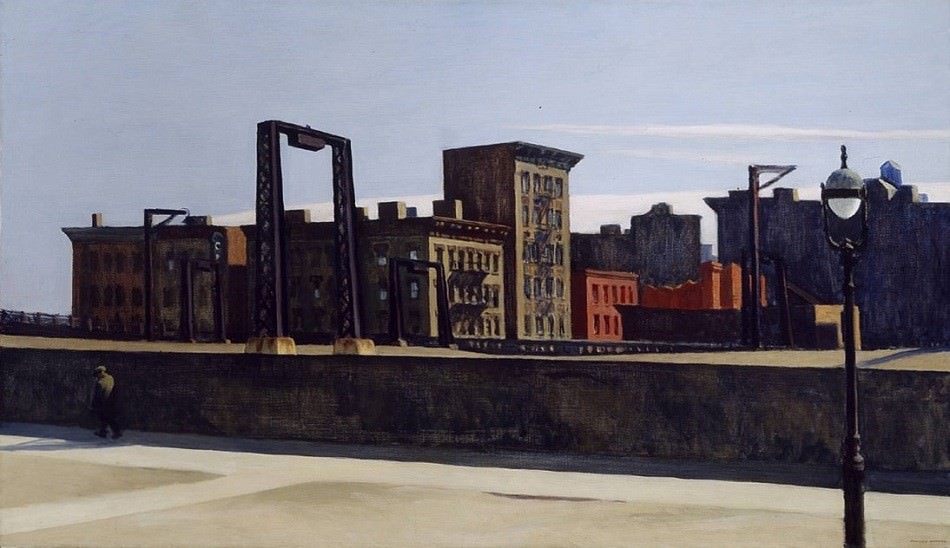
Edward Hopper, Manhattan Loop Bridge, 19028. Oil on canvas. Image: Addison Gallery of American Art, Phillips Academy
‘Slow looking’ in visual art has been accompanied by similar movements in music and reading. Pauline Oliveros, an American composer who coined the term ‘deep listening’ in 1989, draws a distinction between hearing and listening in a 2015 TEDx Talk: “The ear hears, the brain listens, the body senses vibrations,” she says, elaborating: listening with the brain means watching the interplay of momentary conception with remembered experience, which necessitates prolonged engagement. Princeton Professor and founder of the Strother School of Radical Attention D. Graham Burnett spoke on The Ezra Klein Show podcast on 31 May 2024 about how his group practices ‘deep listening’ in an exercise that entails listening to the same piece of music four times, each time with a different way of attending to the piece: First, “just listen.” Second, “recall: what have you heard before?” Third, “discover: what do you hear for the first time?” And forth, “don’t listen. What do you find when you don’t listen?” What unfolds is a multiplicity of experience with the same piece of music and, in Oliveros’ words, an expansion of perception to “include the whole spacetime continuum of sound.”
‘Slow looking’ in visual art has been accompanied by similar movements in music and reading. Pauline Oliveros, an American composer who coined the term ‘deep listening’ in 1989, draws a distinction between hearing and listening in a 2015 TEDx Talk: “The ear hears, the brain listens, the body senses vibrations,” she says, elaborating: listening with the brain means watching the interplay of momentary conception with remembered experience, which necessitates prolonged engagement. Princeton Professor and founder of the Strother School of Radical Attention D. Graham Burnett spoke on The Ezra Klein Show podcast on 31 May 2024 about how his group practices ‘deep listening’ in an exercise that entails listening to the same piece of music four times, each time with a different way of attending to the piece: First, “just listen.” Second, “recall: what have you heard before?” Third, “discover: what do you hear for the first time?” And forth, “don’t listen. What do you find when you don’t listen?” What unfolds is a multiplicity of experience with the same piece of music and, in Oliveros’ words, an expansion of perception to “include the whole spacetime continuum of sound.”
The practice of reading has also been undergoing a critical shift in favor of, in the words of literary critic Sarah Chihaya, “The Slow Burn.” In a series of published letters on Elena Ferrante in 2015, Chihaya, Merve Emre (critic), Katherine Hill (novelist) and Jill Richard (critic) seek to read and critically engage the text differently than how they do in the fast-paced environment of more traditional academia. Chihaya outlines the “slow-form criticism” project as one that aims to explore “readings that happen on the back burner while your mind is mostly elsewhere, that, in their extended simmering, develop a different richness and depth over time from a quick-fired review.” ‘Slow-form criticism’ lets these writers enter into the rhythm of Ferrante’s My Brilliant Friend and engage with it in a more profound, personal, and phenomenological way than they might have otherwise done if they had sprinted through the text to extract a point. Reading and thinking slowly brings Katherine to feel like she is “standing in solidarity” with the novel’s two friends as they race through an onslaught of experiences together.
The potential richness of artistic experience that emerges from “extended simmering” was on my mind when I spoke with Neal Bold, a Medieval History MPhil student at King’s who participated in his College’s art loan scheme. For a little over a month, Neal has shared a room with an oil painting of a Buckingham Palace guard by Mervyn Rowe that was previously owned by E.M. Forster, and may have even hung in the writer’s office. I noticed that Neal already seemed to have developed a complicated and rich emotional relationship with it.

Mervyn Rowe’s painting, hung in Neal’s room
“I don’t like it,” he tells me bluntly, elaborating, “I don’t hate it, I just expect so much of it. One of the great writers of the 21st century bought this.” And yet, if he were forced to return the piece immediately, he says it would ruin his day. “The piece feels like it’s mine now. If anything happens to it, it’s a liability for me. The string is kind of old and goofy, if it snaps… I like it enough to be willing to accept some responsibility for it and that makes me more attached to it.” Neal reflects that spending time with the painting may have fostered this affective dimension of his experience: “the slower you are able to go through a piece of art, the more you have more of an emotional response,” he says.

Neal holds the painting in his King’s accommodation

“The most exciting thing is on the back of it. You know E.M. Forster? He’s in my room,” says Neal.
Like the emergence of new dimensions of the Whistler painting that unfold throughout the NYT’s ten-minute challenge, Neal said that taking the piece home with him clarified his understanding of its subject. “When you see a piece in the context of your own life, you can appreciate it a bit better,” he says. Prolonged looking and the help of a reverse Google search turned what he first saw as “a bunch of blobs” into a guard standing in front of Buckingham Palace. Most of the time Neal looks at the painting, he is lying in his bed. Every morning when he wakes up and every night when he goes to sleep, his eyes find a resting place on the painting: “when I’m looking from my pillow, it kind of orients me.” Amidst what can feel like an increasingly chaotic world, a work of art, especially one woven into your daily routines, can be a grounding force. Postcard, print, or original canvas, Ane Cornelia reminds us that art can re-enchant our worlds by awakening us “the magic and poetry of everyday life.”
By Carmen Vintro
 The Camera