
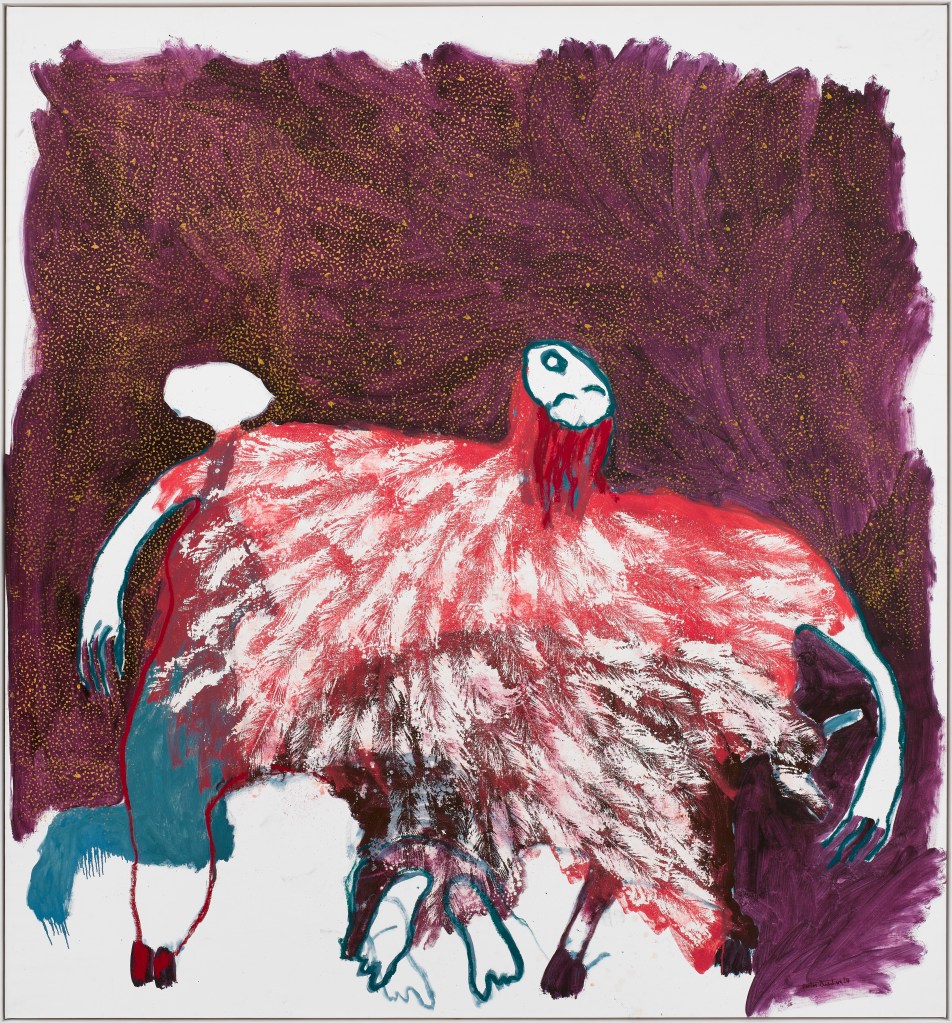
Kudonhedzwa kwevanhu (Fallen People), 2022, by Portia Zvavahera. Courtesy: Stevenson and David Zwirner. Photo: Mario Todeschini
Vivid dreams have featured heavily, and coincidentally, in my life lately. From discussions of Heliodorus’ Aethiopica to my own narrative of being chased through Geneva airport (thankfully only in my sleep), it appears now that dream motif has reached its zenith, in the form of Portia Zvavahera’s paintings, at her first solo exhibition at a European public gallery, no less. Titled Zvakazarurwa, in Zvavahera’s native Shona, it is in this exhibition dreamscape of ‘Revelations’ where I would happily stay.
Fighting Energies 2, 2024, by Portia Zvavahera. Courtesy: Stevenson and David Zwirner. Photo: Jack Hems
Through her delicate marriage of painting and printing, cardboard and oil bar, bombastic colour and its very absence, Zvavahera has, in the words of exhibition curator and Durning Lawrence Professor in History of Art at UCL, Tamar Garb, created her own “personal cosmology and vision.” Each painting is a visual feast in and of itself, every corner and pattern demanding the viewer’s attention; each room too, in Kettle’s Yard, makes for an arresting medley, a metamorphosis of characters and images somehow recognisable from other paintings in the room but transforming, perhaps transgressing, into new shapes, to our confusion and awe. Just as one’s dreams never quite repeat themselves in the same way, but insist on visiting stories which haunt and delight us most, Zvavahera relishes in recalling and reworking from these narratives that which terrifies her, that which promises her meaning, that which perhaps attests to both.
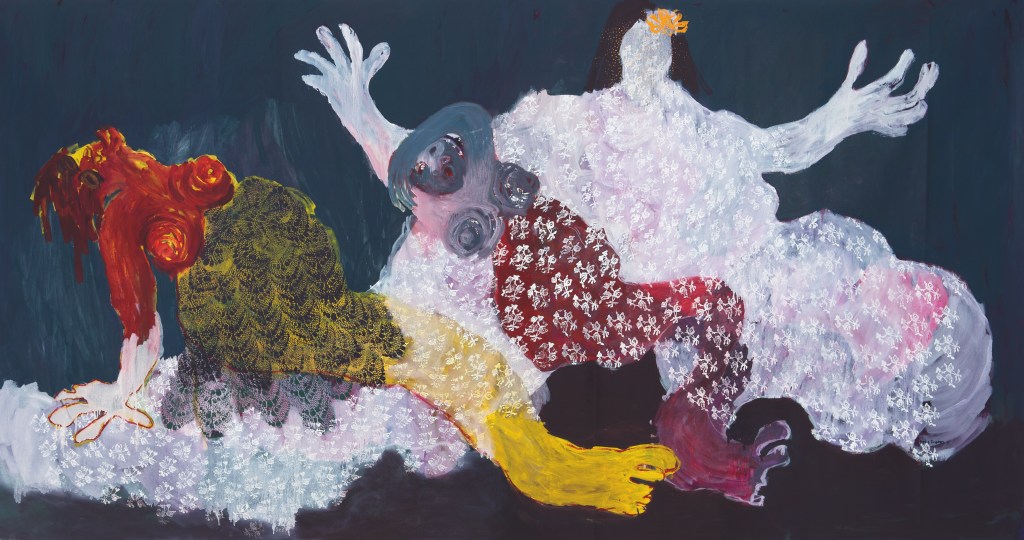
Embraced and Protected in You, 2016, by Portia Zvavahera. Courtesy: Stevenson and David Zwirner. Photo: Mario Todeschini
Rats, imposing figures kept at bay from humankind with material as fragile as lace (as in Hide There (2024)) or with figures as holy as angels (as in Pane rima rakakomba (1) (There’s too much darkness) (2023)), are an integral part, not only of Zvavahera’s dreams-as-visualised, but of the nature and woodland she represents them spurning out of. Zvavahera’s earlier work is equally committed to giving distorted, repeated perspective on vignettes both natural and torturous: Labour Pains (2012) and Labour Ward (2012) are captivating, if raw, tales of birth and motherhood. Devotion and physicality of prayer appear again and again, in pieces like His Presence (2013) and Embraced and Protected by You (2016), where arms that are truly larger-than-life dominate the canvas; no wonder then, that Zvavahera to some extent views her painting, and unleashing of her dreams, as analogous to prayer, her body as this tool of clarity and performance come manifest in her art.
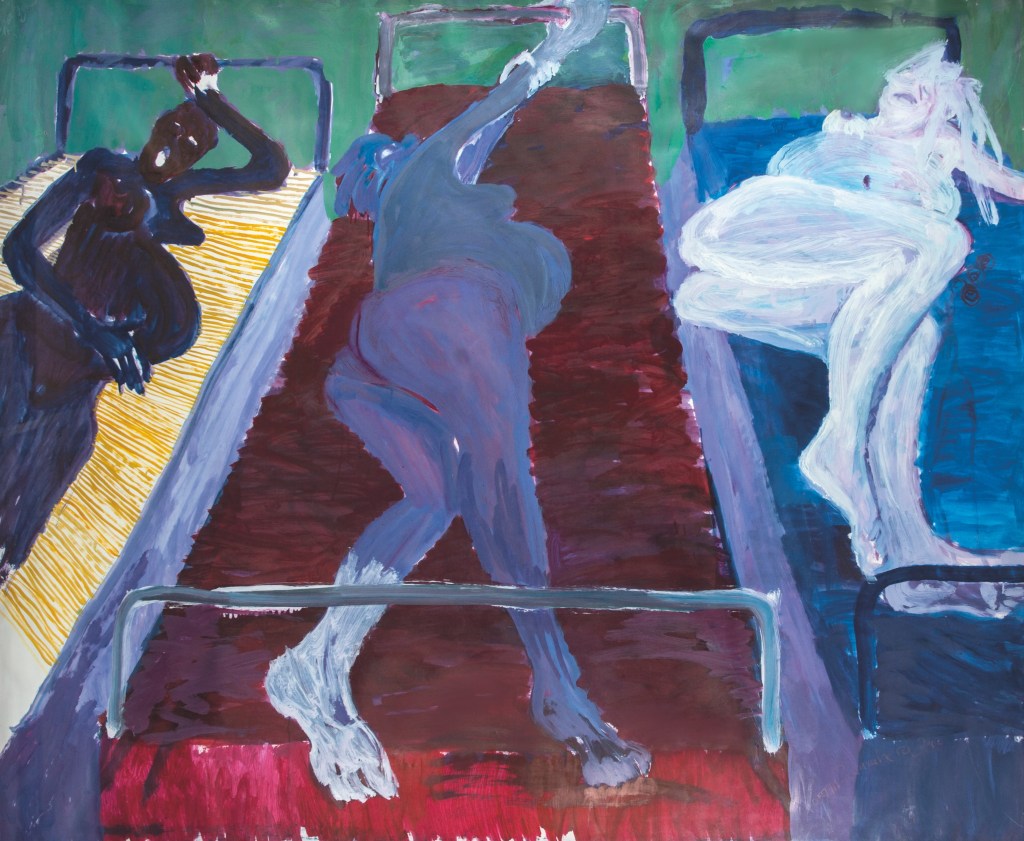
Labour Ward, 2012, by Portia Zvavahera. Courtesy: Stevenson and David Zwirner
Kudonhedzwa kwevanhu (Fallen People) (2022) and Lifted Away (2024) remain my two favourite pieces in the exhibition. They feature amorphous yet beady faces, undetermined in species but unrelenting in their intimidation of the central figure. Fallen People abounds in colour and texture, turning owl-like animals into fish-esque ones and back again; Lifted Away does so too, but hollows out its ‘people,’ letting the canvas’ white, or something akin to it, shine through as a void of dreamlike activity. Allowed to take the full space of Kettle Yard’s walls, these paintings of spectatorship impose their presence on me as much as I assert my gaze on them. They intrigue me just as much as they startle. Zvavahera’s creations are dreams worth opening your eyes for.
By Kiana Rezakhanlou
Portia Zvavahera: Zvakazarurwa is on at Kettle’s Yard until 16 February 2025. The exhibition is organised by Kettle’s Yard in collaboration with Fruitmarket, Edinburgh, where it will travel from 1 March to 25 May 2025.
 The Camera