
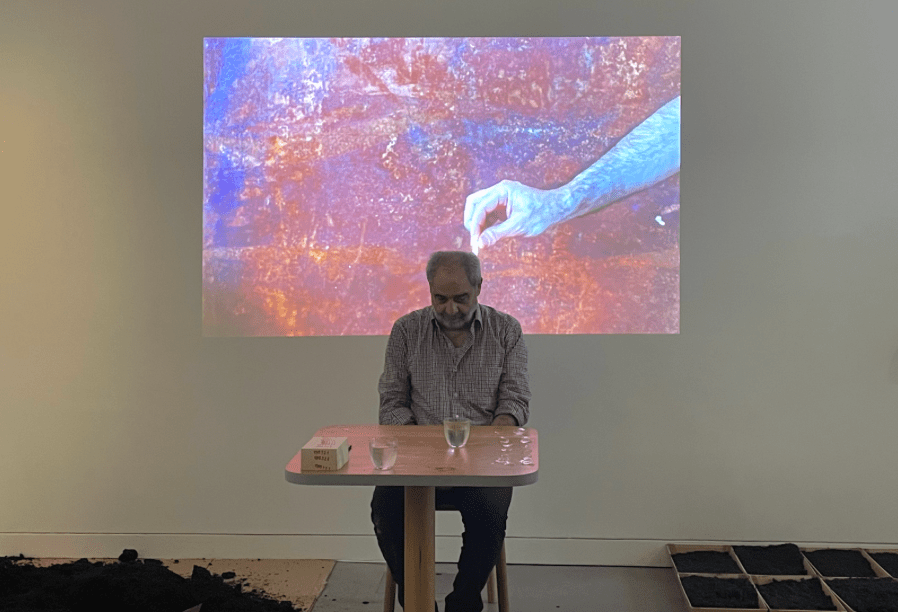
The space between the two exhibition rooms. Issam Kourbaj sits in front of ‘Strike’ (2018) which is projected on the wall behind him. Image: Troy Fielder
On 15th March 2024, 13 years after the ‘Day of Rage’ – generally considered the start of the Syrian uprising against Bashar al-Assad’s Ba’athist dictatorship – Issam Kourbaj crouches in the Kettle’s Yard Gallery and uses a packing knife to rip a short, sharp line through a canvas tent that hangs from the wall. Through the freshly made tear, Kourbaj hooks a string of date stones sewn to a strip of fabric. Now, 4,749 stones – arranged in neat lines – adorn the tent, and one stone will be added to mark each day since the conflict in Syria began. This addition forms the beginning of an almost two-hour-long performance at the artist’s latest exhibition, Urgent Archive.
Following Kourbaj on a journey around the gallery and outside, into St Peter’s Church, the audience watches as he arranges and rearranges pages and books that are scrawled with the names of imprisoned Syrians; frets over how to add a new artwork to ‘Agony: 156 moons and counting…’; and winds and unwinds lists that name hundreds of Syrian women who have been maimed, killed, or disappeared since the start of the conflict. Names and months that have been lost to conflict are made legible and accrue in painful repetition. As he moves, Kourbaj shifts and reanimates his artworks; he undoes the stasis of the archive-gallery, converting an ossified ‘past’ into an ongoing present.
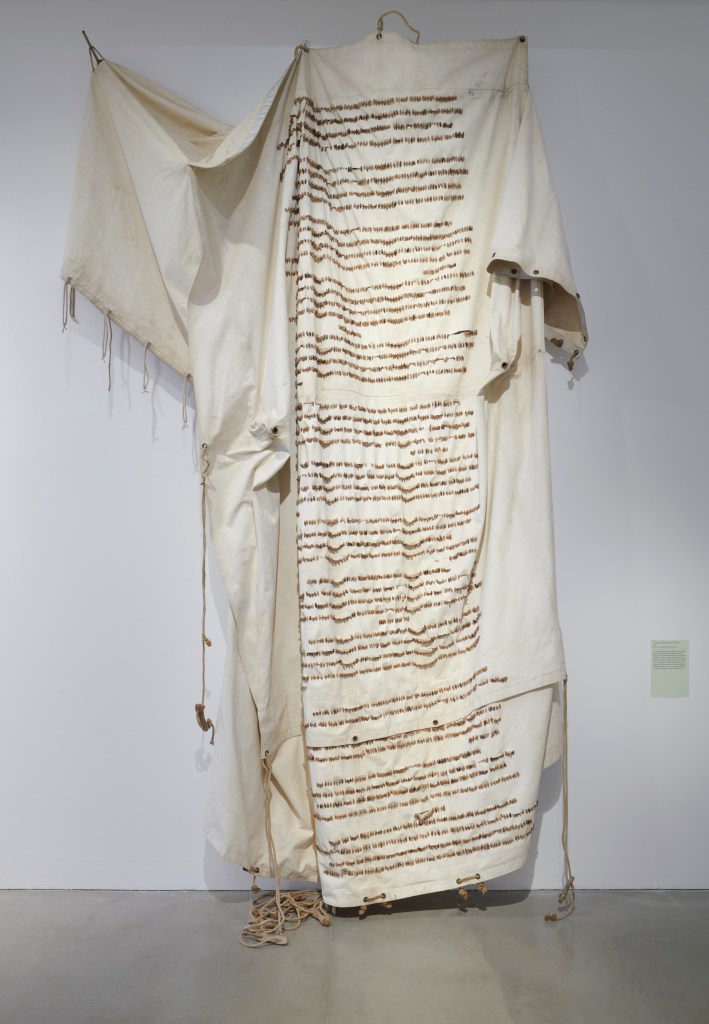
Issam Kourbaj’s Our exile grows a day longer, and a day closer is our return (2024). Image: Jo Underhill.
This recursive movement continues in the space between the two gallery rooms, where soil has been hastily piled on cardboard sheets. Kourbaj spends most of the performance here, filling and refilling shallow containers with soil. In each box, individual letters are drawn and, in some, shards of glass planted. While Kourbaj prepares the boxes, a clip from ‘Strike’ (2018) – which commemorates the 7th anniversary of the Syrian uprising – plays on a loop, projected behind him. The video shows Kourbaj striking and dropping matches, counting each day of conflict. Occasionally, Kourbaj lifts a box to ‘catch’ a falling match; for a while, he sits still, allowing matches to be struck and fall through his head. The containers, and Kourbaj, are seeded with both loss and destruction.
Throughout the exhibition, seeds are foregrounded: they are living archives that can both propagate and nourish. In 2015, the Syrian civil war forced the International Center for Agricultural Research in the Dry Areas (ICARDA) to make the first withdrawal from the Svalbard Global Seed Vault after its headquarters were made inaccessible. This followed successive attempts, starting in 2012, to redistribute seeds from Aleppo across the Fertile Crescent and beyond. A significant locus in the development of international agricultural resilience, ICARDA mobilises seeds as stores of genetic diversity that, when crossbred, can produce new crop varieties that are both high yielding and drought tolerant. Each seed-archive, then, represents hope for a habitable future.
Kourbaj marks this vital potential – and its concomitant peril – by drawing on the work of Palestinian poet Mahmoud Darwish. In ‘Is it from a grain of wheat that the dawn of life bursts out… and also the dawn of war?’ (2023-24), a trio of seeds hang human-sized, lighting a wall; they have been burnt and sent to the Sainsbury Laboratory to be magnified. The wooden grain of their skin is disrupted by charred blisters which, in places, shimmer opalescent. Across the room, the triadic composition is mirrored in a looped, three-channel video of wheat seeds germinating: tentative roots expand and contract through accelerated, and occasionally reversed, time. The seed is reconfigured as both a lively agent and vulnerable being whose performance is dependent on the generosity of others, whether international organisations or individuals in Cambridge laboratories.
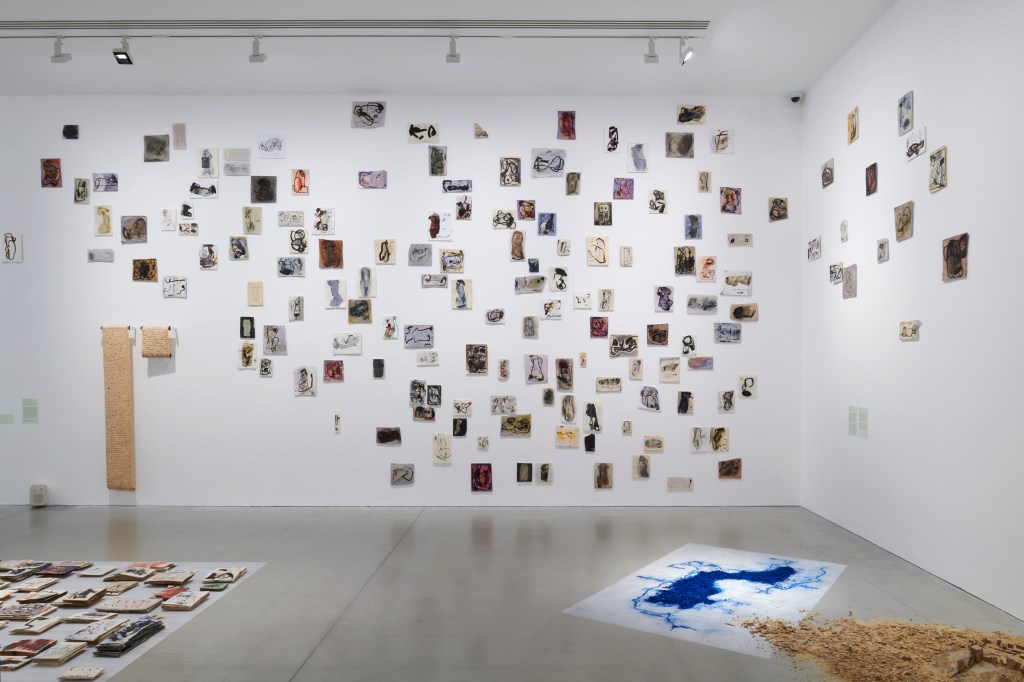
A view inside the first room of the exhibition, ‘DESTRUCTION / MEMORY / RENEWAL’, featuring Issam Kourbaj’s Agony: 156 moons and counting… (2015 – ). Image: Jo Underhill.
Having persuaded audience members to carefully remove each box of soil, Kourbaj’s performance continues as he leads a neat procession to St Peter’s Church, the location of one of his earliest responses to the uprising in Syria, UNEARTHED (2014). Upon returning, the audience is greeted by the boxes of soil which have been arranged to spell out ‘URGENT ARCHIVE’. Kourbaj then uses water from the font to water the outline of each letter. This act of purification is rounded off when a wooden mallet is used to chime a long, metal pipe twelve times – and then, using a second mallet that is marked with red paint, Kourbaj chimes a second metal rod that hangs above the font a single time. The artist exits the church and the performance ends.
At least, that is what the audience is led to believe. Since the exhibition’s opening two weeks prior, however, Kourbaj has been performing. In ‘All But Milk’ (2024), a response to Israel’s ongoing bombardment of Gaza, milk bottles are lined up along thin metal shelves that rest just out of reach. Each bottle contains the detritus of urban life: flakes of paint, cast cement, razor blades, and blood. Many of the bottles have been smashed or melted. Each day a new bottle is added. The performance continues.
Next door, in ‘ACTION / TIME / PERFORMANCE’, Kourbaj continually moves and replaces items on large metal stacks. Guy Haywood, co-curator of the exhibition, explains that these shelves were chosen because they could be moved and re-positioned: their rigid form undone by their malleability. At a smaller scale, a monitor on one of the lower shelves (for now) provides updates from a Facebook page focused on Kourbaj’s birthplace, Suweida. Here, the flexibility of the traditional archival structure is extended into digital space – a place that continually maps, reports, and stores new forms of resistance.

A view inside the second room of the exhibition, ‘ACTION / TIME / PERFORMANCE’. Image: Jo Underhill.
From Facebook pages to containers of soil, the urgency that underlies this exhibition transforms the mundane into a vital carrier for disappeared and disappearing histories: stones of fruit become maps of lives, or burnt matches represent the counting of days. Bodies, too, are manipulated. On the opening night of the exhibition, viewers were encouraged, first, to move anticlockwise – against time – through ‘DESTRUCTION …’ and then, spinning, rotate clockwise through ‘ACTION …’. If so moved, Kourbaj half-joked, we could even dance between rooms.
Motion and performance, action and witness – this is what makes this exhibition not only captivating but timely. Whether dancing, tracing the footsteps of the artist, or distributing soil, visitors to Urgent Archive are brought into both a visual and somatic relationship with the art on display. The gallery becomes a place to move and be moved. By allowing the public to peek inside and experience the making and remaking of an archive, Kourbaj asks us to reconsider how the actions of the present not only reconfigure the past but change the future.
Outside Kettle’s Yard, seeds have been planted and the green shoots of Syrian wheat are beginning to emerge. One day, Kourbaj hopes to make bread from the grains.
Urgent Archive is on at Kettle’s Yard until 26th May.
By Troy Fielder.
 The Camera