Tracey Mullins interviews Tom Littler, Artistic Director and co-CEO, and Julie Weston, Executive Director and co-CEO, of the Orange Tree Theatre, Richmond

Orange Tree Theatre. Published with the permission of the Orange Tree Theatre.
The Orange Tree (OT) is a small producing ‘theatre-in-the-round’ situated in the London Borough of Richmond opposite the Orange Tree pub, the upstairs room of which became the theatre’s first home in the 1970s. With only 180 seats, this renowned local theatre was voted 2025’s ‘Theatre of the Year’ at the annual Stage Awards, the biggest celebration of theatre and theatremakers across the UK. Both upcoming and well-known playwrights, directors and other artists bring their storytelling skills to the OT’s intimate space, where even the tiniest tweak of an actor’s facial expression can be registered by those seated in the back row. Whether showcasing plays by new writers, engaging the community in acting classes or workshops on Shakespeare, or producing innovative stagings of classics such as Strindberg’s The Dance of Death and Goldsmith’s She Stoops to Conquer, the OT’s modus operandi is to challenge those who may underestimate its possibilities as a result of its modest size.
The Theatre’s leadership team, described as ‘visionary’ by the judges of the Stage Awards, are its Artistic Director (AD) and co-CEO, Tom Littler, and Executive Director (ED) and co-CEO, Julie Weston. Prior to joining the OT in 2022, Tom was AD and Executive Producer of the seventy-seat Jermyn Street Theatre in the West End. Here, he produced over forty full-scale productions and won the OffWestEnd Award for Best Artistic Director. Julie joined the OT more recently in 2024 with extensive experience of leading organisations across the non-profit and arts sectors – including a stint as Interim ED at Cardboard Citizens, a charity offering life-changing theatre opportunities for homeless people. Taking time out of their schedules to escape the noise of building works – the foyer of the OT is being redeveloped to make it more accessible – Tom and Julie met with me to discuss, over a pot of tea, how they lead and develop what they call their ‘powerhouse of independent theatre’.
I began by asking them to describe their jobs. Julie said: ‘I don’t have a standard executive director background, so I can only really talk about my role’. ‘EDs,’ she continued, ‘have more of a focus on the internal elements of the business. And less on the outward facing and creative side’. Tom followed that an ‘absolutely classic definition would be that the artistic director programmes and produces the work that happens on the stage, and the executive director runs the organisation and the building that supports that work to happen… but then you’ve got actual real-life humans with skill sets and interests’. He explained he doesn’t know ‘any artistic directors who don’t have a hand in the running of the building. And I don’t know any executive directors who don’t have some hand in the programming and the producing of the work’. He concluded that he and Julie ‘are joint chief execs… where those roles are given parity’.
In 2014, the Arts Council, in line with its approach to many London theatres, cut its grant to the OT in a bid to redistribute funds to theatres in other parts of the country. Now, approximately 60% of the theatre’s charitable funding is provided by individuals. The OT’s robust membership scheme, with benefits such as preferential treatment when it comes to purchasing tickets, provides a significant strand of its funding. Located in one of London’s wealthiest boroughs, the theatre’s renewal rates for membership are ‘very high’ according to Julie, and this provides a predictable income. For many locals like me, the OT is an essential part of Richmond’s social life. If you miss seeing a production that everyone is talking about ‘it’s a feeling of FOMO, fear of missing out,’ Julie laughed, and I agreed. Tom noted that in other parts of the country this situation would be reversed and theatres would receive the largest part of their funding from the Arts Council and other subsidies rather than from members of the public.
When explaining the OT’s programming considerations – which plays are going to be produced over a year, for example, the number of actors required, and whether the OT can afford to pay celebrities who attract large audiences – Julie implied that well-known actors are not drawn to the theatre by the wages it offers. She explained that this is because ‘at the Orange Tree all our actors get paid exactly the same… whether you have ten lines or whether you’ve got 10,000’. What attracts actors to the OT is rather its outstanding reputation. Finance becomes a more significant point of contention when considering how many actors are in a play and the concept or the design of a production. Other considerations, said Tom, include ‘how many people we think might want to see the play and what kind of prices they’re prepared to pay to see it’. It may be more expensive to do a play with two actors that only a few people come to see than it is to do a play with eight actors that sell every seat.
This year’s 250th Anniversary production of Sheridan’s The Rivals directed by Tom using a cast of twelve actors was the largest company of professionals the theatre had employed since their Arts Council grant was cut. Big cast plays are now, according to Tom, ‘a rarer treat, but I think we’re of the belief that sometimes audiences quite like seeing big plays’. He strongly believes that this is part of what theatre does and should be offering to audiences. Some of the most memorable plays I have seen at the OT have had a large cast, such as She Stoops to Conquer, which included a community ensemble in a pub scene. In Tom’s view, staging plays with larger casts ‘opens up the world of the classics, of rediscovered plays, and of bigger new plays. And it all gives your audience a different experience’.
With the OT being a small theatre in-the-round, I wondered whether it was useful to have some production decisions already taken out of the equation due to the restrictions of the size and nature of its stage. Tom agreed: ‘Yes, I think it depends on the play. I think sometimes it’s a very helpful limiting factor that gets you started’. When it comes to what Tom calls ‘a big play’ like King Lear – which he’s staging next spring – he has to consider that he can only have eleven or twelve people in the cast and it has to be possible to stage in the round. A ‘set’ of sorts is possible at the theatre, but not one that relies on walls because this would restrict the visibility of certain sections of the audience. Endless scene changes aren’t practical either, but Tom suggested that these early limiting factors can in fact creatively ‘release plays, particularly period plays that are traditionally seen behind proscenium arches. It makes them feel like you can sense their rough edges and you can get behind the arch and sort of under the skin of the play, in a way that’s hard to do in a presentational setting’. He continued, ‘it can also be a real challenge to stage plays written for a presentational staging… you have to unpick some of that grammar to work out how you do it in the round… you have to move a bit more because you’re not making pictures’. Instead, ‘you’re using a kinetic energy rather than a pictorial thing to tell stories’.
I asked Tom and Julie about how far in advance decisions need to be made about what plays to stage. Tom explained that ‘there isn’t a rule about this. Some people programme very close to the wire,’ and the advantage of this is that ‘you can be very responsive to what’s happening in the world’. With more and more contemporary playwrights responding to current events, I asked Tom and Julie about the OT’s commitment to staging both new writing and the classics, as well as the impact those decisions were having on the theatre’s regular and newer, more diverse audiences. We discussed a new play, You Bury Me, which I saw at the OT in 2023. Written by a writer using the pseudonym Ahlam – winner of the Women’s Prize for Playwriting 2020 – this play, about a group of young people coming of age in post-Arab Spring Cairo, drew a more varied audience.
Commenting on the ratio of new plays to rediscovered/classic ones, Tom said it was, ‘Roughly 50/50 in the time that I’ve been doing the job. But the new versus old is not what defines the audience… you can absolutely do a new play that pitches right to the core audience and you can absolutely do an old play that doesn’t appeal to the core audience at all. So that’s not the defining thing’. I asked him to give me an example of an ‘old’ play that wouldn’t be right for an OT audience. He suggested Cleansed (1998) by Sarah Kane, a play in which characters endure torture. Tom explained, ‘we’d love to do Cleansed,’ but contended that it was a play more suited to the Royal Court, a proponent of the 1990s provocative ‘in-yer-face theatre’ movement, where it was first performed. ‘It’s definitely true that an audience changes according to what you do and according to who’s in it’ he said.
In 2025, another new play which attracted a different audience was Chiara Atik’s Poor Clare (2023), which The Guardian’s Arifa Akbar described as ‘a sassy spin on a medieval saint’ Julie said that actors Arsema Thomas and Freddy Carter enticed new and younger faces to the OT. Thomas had starred in Queen Charlotte: A Bridgerton Story and Carter had starred in the Netflix hit Shadow and Bone. Julie hadn’t previously been aware of either actor, but she said ‘they were very, very, well known to the younger audience. Both [Thomas and Carter] had big social media followers, on Instagram… And that changed the audience… it made a big difference’. Similarly, Tom commenting on the casting of Patricia Allison as Viola in Twelfth Night, who starred in Netflix’s Sex Education, said she may mean nothing to one section of the audience but if you’re in the group that ‘grew up watching Sex Education, that’s a huge part of your cultural world, and you’re more likely to go and see Twelfth Night as a result’. Julie also mentioned that their ‘Under 30 Nights’ with £15 tickets, a free drink and an after-show Q&A session (for this age group, tickets for all productions are £15) have grown in popularity. For the OT to continue to thrive and push its boundaries, its leadership team are acutely aware that a more diverse audience needs to cross the theatre’s threshold.
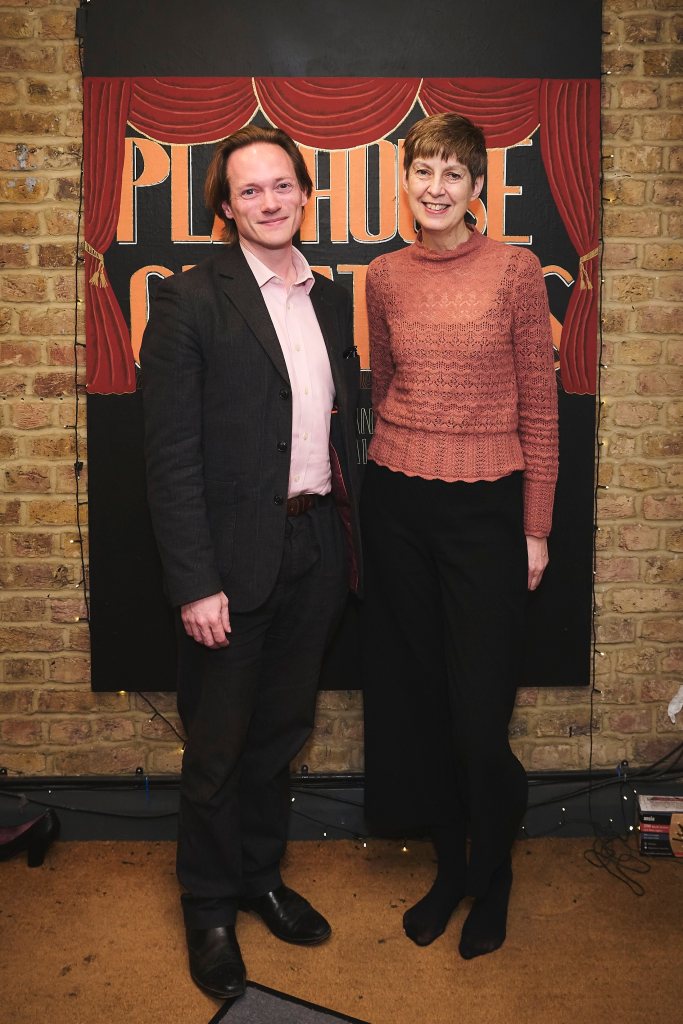
Tom Littler & Julie Weston. Published with the permission of the Orange Tree Theatre.
Tom and Julie are charged with leading the OT at a time when artistic risks need to be calculated more carefully than ever before, since the funding of the arts now relies so heavily on the generosity of the audiences they serve. I was curious about who had influenced this team’s artistic choices and style of leadership. For Tom, it’s Sir Peter Hall (1930-2017) the theatre, opera and film director, described in his obituary in The Times as ‘the most important figure in British Theatre for half a century’. Tom told me that, during his twenties, he was assisting Hall and that ‘Peter is the person who I learned the most from about rehearsal rooms; about how to structure a rehearsal period; about the giving of notes at the right moment… corrections and upgrades at the right time’. Other influences include ‘those people whose work you hugely admire, even though it’s very different from your own’. For Julie, the RSC is her primary inspiration. Having come to Shakespeare later in life, she explained that although she never studied him in school, there was a period in her life when she literally lived at the RSC… ‘I adore Shakespeare’. Among her favourite directors are Richard Eyre, who directed Strindberg’s Dance of Death at the OT in early 2026 when Julie said she acted like ‘a total fan girl’, as well as, of course, Tom ‘obviously!’ When asked what play they would bring if they could only take one to read on a desert island, neither individual could contemplate life without Shakespeare. Julie chose Hamlet, even though she considered it might offer more introspection than required when alone on an island, and Tom chose King Lear because it would give him time to do his homework – ‘a busman’s holiday’ – for his production in 2027.
We ended our discussion by returning to the roles Tom and Julie both serve within their leadership of the OT. They agreed that leadership was a process of continual learning and Tom felt that one of the best things about his job was engaging with people who could do things that he couldn’t do and whose work was not like his. He concluded, ‘one of the wonderful things about our jobs is that you connect the work of the artists you admire with the audience that you serve, and you serve as the connecting force between those two clients. …You care about the artists, you care about the audience, and you put them together’.
By Tracey Mullins

