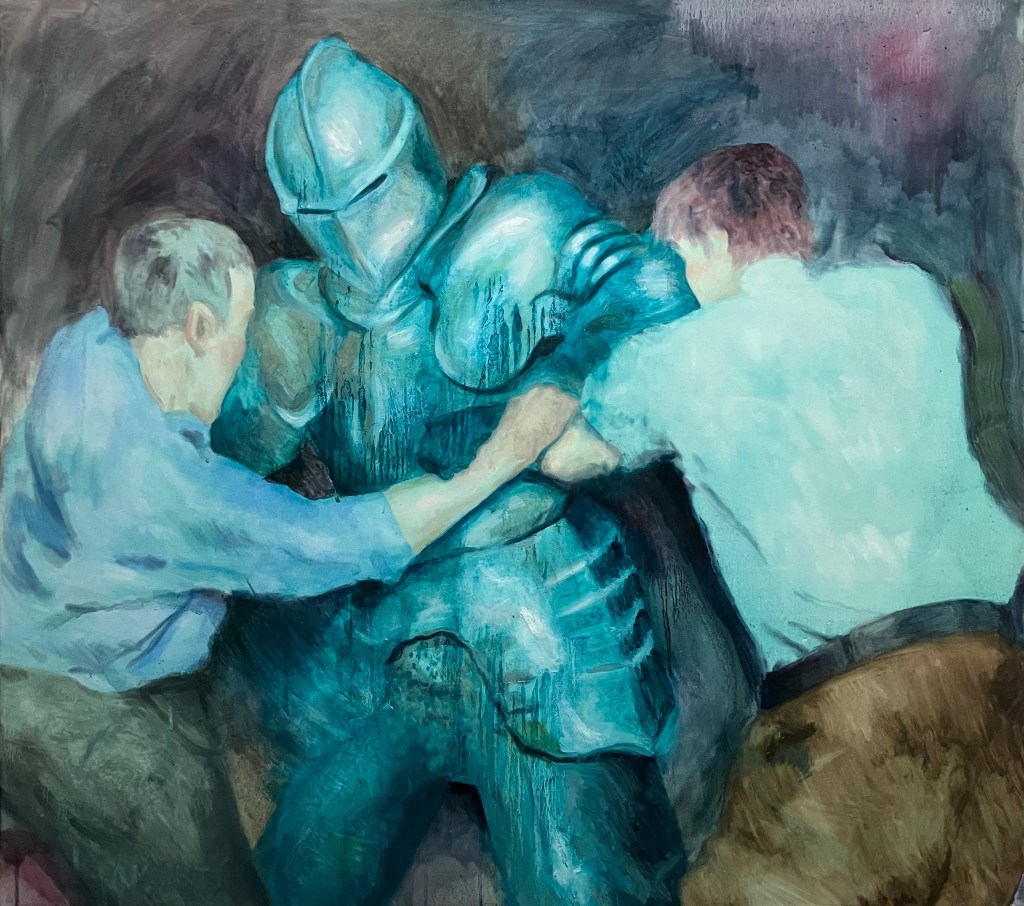
Artwork by Alan Martí
Sean Sanford, a student at Liberty University’s Liberty Champion, recently asked the question: ‘Is Chivalry Dead?’. Sanford’s question speaks to an increasingly vitriolic question surrounding the nature of chivalry – what is it, and does it still matter? Scottish poet Walther Scott pointed out that the word, derived from French chevalier, denotes ‘cavalry, or a body of soldiers serving on horseback’. Scott states, however, that it has developed the following sense: a ‘cause which has produced such general and permanent difference betwixt the ancients and the moderns’. Writing in the late-nineteenth century, Scott saw chivalry, which emerged in the twelfth century, as an epoch-defining entity, essential to the formulation of the modern Western ethos.
A century-and-a-half later, third wave feminism, the civil rights movement, and manifold post-isms have called into question the alleged centrality of chivalry to Western civilisation. In contrast to Scott’s laudation of the concept, Lisa Elmusa in 2016 defined chivalry as an outdated set of gendered expectations as to how men ought to behave towards women, such as opening doors and paying for meals. On such grounds, she defines it as an unnecessary concept, saying that she can open her own doors and would not go out were she incapable of paying for dinner.
Perhaps the hallmark of recent definitions on chivalry has been Letitia Baldridge’s chapter ‘Chivalry Isn’t Dead. It’s Just No Longer Gender-Based’ in her monograph New Complete Guide to Executive Manners. Baldridge defines chivalry as synonymous with ‘civility’. Commenting upon Baldridge’s definition, Candace Smith asserts that if we equate chivalry with civility, ‘it isn’t dead at all’.
The abovementioned summary of criticism – in the sense of critical discourse – highlights how defining chivalry remains a vexing issue for social commentators. Yet for all the vitriolic rhetoric, such disagreement over the definition of chivalry is not new. During the inter-war and post-war periods, two of the most eminent literati of the age (both men) – J. R. R. Tolkien and C. S. Lewis – equally debated the meaning of the term, contemplating its significance in an age which, like ours, was a time of crisis and transition.
As an author who is often labelled – whether by his adulators or detractors – as a preserver of ‘the true tradition’ of the Middle Ages, Tolkien’s views are very much worthy of discussion in our time. Indeed, Peter Jackson’s cinematic trilogy celebrated its twenty-fifth anniversary this year, an event which was met with mixed reactions from fans.
To begin, it is useful to discuss Lewis’ conception of chivalry in order for us to understand the view against which Tolkien was reacting. Lewis defines the knight – the chivalric figure par excellence – thus:
a man of blood and iron, a man familiar with the sight of smashed faces and the rugged stumps of lopped-off limbs; he is also a demure, almost a maidenlike, guest in hall, a gentle, modest, unobtrusive man. He is not a compromise or happy mean between ferocity and meekness: he is fear to the nth and meek to the nth. When Lancelot heard himself pronounced the best knight in the world, “he wept as he had been a child that had been beaten”.
In Lewis’ view chivalry was essential to the very survival of civilisation precisely because it brought together two concepts – meekness and might. Yet if Lewis’ description of chivalry is utterly laudatory, Tolkien’s is more critical. Tolkien most clearly sets forth his opinion in Letter 43, addressed to his son Michael with the subtitle, ‘On the subject of marriage and relations between sexes’. Tolkien believes the chivalric tradition to still be strong in the West, but thinks that it has failed in its claim to be ‘wholly true’ and ‘theocentric’. Tolkien concedes that in its idealisation of love, it does – in a positive sense – enjoin the virtues of ‘fidelity, … self-denial, ‘service’, courtesy, honour, and courage’. Tolkien claimed that the weakness of chivalry lies in its contrived nature: it emerged unnaturally as a jocular courtly habit during the High Middle Ages (c. 1000-1300) as ‘a way of enjoying love for its own sake without reference to (and indeed contrary to) matrimony’. The point of veneration is not God, but imaginary deities such as Love and the Lady, the latter of whom, although fallen, becomes a divine figure unto whom he devotes his affection and soul. The knight himself – the central figure of chivalric romance – is not, as Lewis suggests, the perfect union between might and meekness; rather, he becomes a licentious figure who gives in to his baser libidinal hungers.
The knight is of course the key figure of chivalric literature. Indeed, the word has such cultural connotations in the Anglo-American world that the mere mention of it is enough to evoke the world of Camelot. The word knight appears in Tolkien’s novels extensively as Ben Reinhard has demonstrated:
Éowyn tells her brother to make Merry “a knight of the Riddermark” (The Lord of the Rings [LotR] V.8.868) in the Houses of Healing, and Merry and Pippin are eager to be recognized as “knights of the City and of the Mark” (VI.4.955) at the Field of Cormallen … The knights of Dol Amroth man the walls of Minas Tirith, ride out on sorties, and quite literally wear shining armor: they appear as “knights in full harness” as they arrive in Minas Tirith (V.1.771); later, Imrahil uses his “bright-burnished vambrace” to detect Éowyn’s breath on the Pelennor Fields (V.6.845).
Several of the names for the knights here have knightly associations from an historical perspective. The names Pippin and Merry are of French, or at least Frankish, origin. Pippin is derived from Pépin, the name of Charlemagne’s father who ruled Frankia between 714 and 768 A.D. Pippin’s father is named Paladin, a term which has both a specific meaning – ‘any of the twelve peers of Charlemagne’s court’ – and a generic one – ‘a knight renowned for heroism and chivalry’. The name Meriadoc is equally of French origin, referring to a hero of an Arthurian romance of the thirteenth century.
Despite the ethnic differences between the men of Rohan and Gondor – the former being of the folk of the Northmen; the latter being of the folk of the Dúnedain – Tolkien makes no distinction between the cavalry regiments of either people: they are knights (VI.4.955). Indeed, the one other term Tolkien uses prolifically for the cavalry regiments of Rohan is Rider. As Reinhard has pointed out, the term Rider is ‘strongly redolent of traditional chivalry’. It is cognate with Middle High German ritter and Old Norse riddari. Both terms literally mean ‘the one who rides’, corresponding semantically to the Latin eques (‘the one on horse’). They are typically translated into English, however, as knight.
Two of the knightliest characters in the work – even though they are never called knights – are Faramir and Aragorn. Reinhard has persuasively illustrated that ‘[t]he vocabulary and imagery of chivalry hang thick about the young hero’. He is described as courteous, merciful, wise, grave, gentle, and pious. Indeed, he exhibits pietas in its original Latin sense of devotion to one’s country and father. Faramir, moreover, is critical of Tolkien’s conception of chivalry as a synonym of heroic excess, bewailing the fact that love of glory spurs men beyond the necessities of heroism: ‘I do not love the bright sword for its sharpness, nor the arrow for its swiftness, nor the warrior for his glory. I love only that which they defend’ (LotR IV.5.679). In rejecting heroic ‘glory for its own sake’, he ‘transcends the Northern heroic ethos’ that Tolkien describes in Beowulf: the Monsters and the Critics and which is embodied by Boromir and the men of Rohan in The Lord of the Rings: ‘[m]ore like to the swift son of Eorl than to the grave men of Gondor’.
Yet Faramir is decidedly not a knight: he is a ranger. He wears no armour and he fights the Southrons, the traditional enemy of chivalric romance, through decidedly unchivalric guerilla warfare. After defeating the Southrons, there is no return to a resplendent court: the rangers return to their bivouac of Henneth Annûn. The rangers of Ithilien in several ways are imitative of the knight’s binary opposite: the Medieval outlaw.
Aragorn is arguably the quintessential hero of chivalric romance: he proves himself through ‘errantries’, he seeks the love of a woman of vastly superior social standing to himself, and he is the heir to the throne of a mighty kingdom. Yet like Faramir, Aragorn does not exhibit the features of the courtly knight: he, like Faramir, is a ranger. Tom Shippey has pointed out that this occurs even at the level of lexis: whilst Aragorn-the-heir is capable of erudition, his wilderland counterpart Strider-the-ranger fundamentally speaks in language that is befitting of a hobbit.
Tolkien’s romance then is a romance bereft of its central chivalric figure. Yet into the void left by the knight steps the ranger. And ironically, the ranger as a figure exhibits even greater knightliness than Lewis’ archetype: he is more warlike because he fights with nothing but naked courage, bereft of the comforts of a castle and the protection of armour; he is meeker because he must endure contempt and scorn, rather than praise, for his deeds.
Tolkien’s faith is highly prominent in this conception. Tolkien’s creative works are imbued with a sense of fatalism: whilst the moral superiority of good is never in doubt, the final and decisive triumph of good seems forever in doubt in a world in which the might of evil seems inexorable and irresistible. Tolkien himself says in Letter 195: ‘I do not expect ‘history’ to be anything but a ‘long defeat’ – though it contains (and in a legend may contain more clearly and movingly) some samples or glimpses of final ‘victory’’. The knight of chivalric romance is himself a product of a Christendom whose existence is never really in doubt, and whose moral confidence is untried. Indeed, Lancelot is for Lewis the strongest and meekest of men, and his final victory is consequently never in doubt, nor is the degree to which he surpasses all other men.
Tolkien thus creates a new kind of knighthood that is fitting for an age that is less secure and less confident than that of universal Christendom. Tolkien’s new knight is not merely a philological excursus into the depths of the primordial Germanic wilderness or the fens of Anglo-Saxon England; he is a negotiation between a Christian ethos and the increasingly post-Christian age in which Tolkien deemed himself to be living Chivalry did not perish in the trenches of the First World War, but it was irrevocably transformed. Much as the certainties of the Victorian Age were dispelled, so too did chivalry as heroic excess and vainglory die, to be replaced by a chivalry that was truly a natural (not artistic) union between might and meekness. Sanford of course asked whether chivalry is dead in the twenty-first century, but we can assert that it is not; rather, it survives in a transformed state, bereft of the trappings of medieval knightly regalia.
By Sam Lewis

