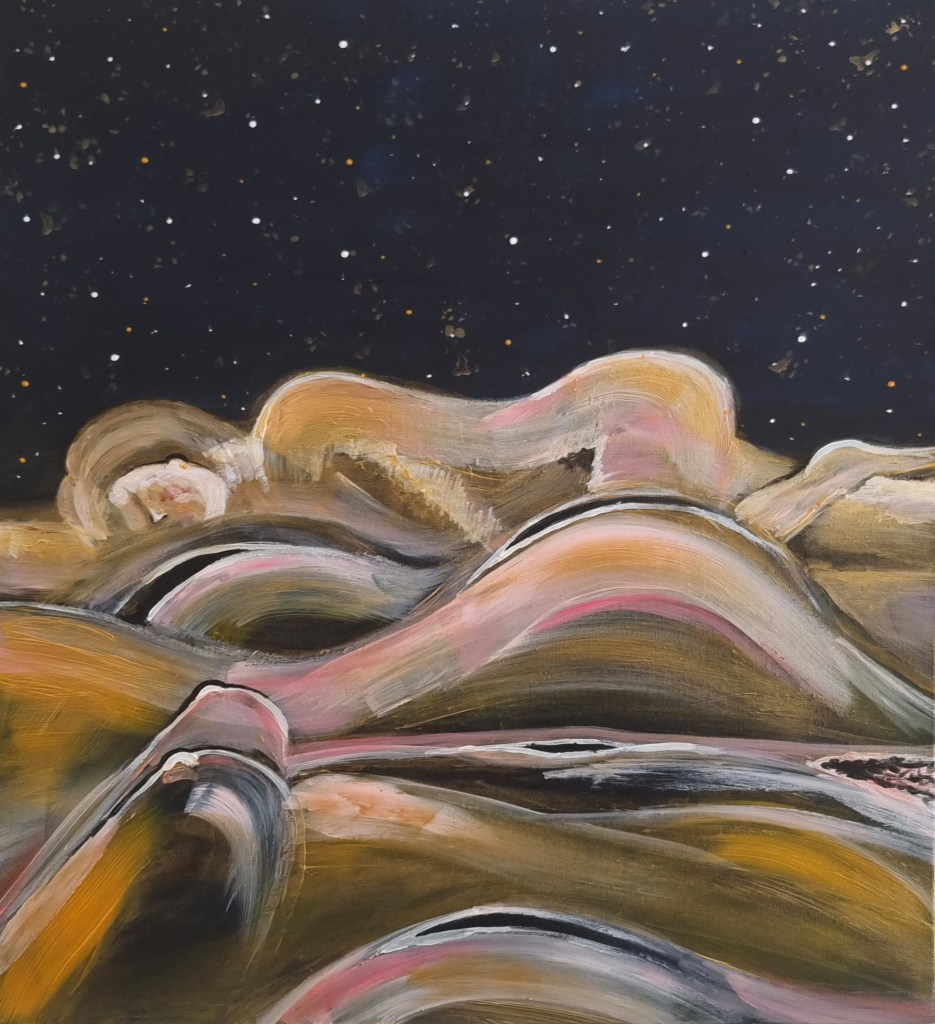
Artwork by Antonio De Lorenzi
The central thread running through Oliver Laxe’s Sirāt (2025) is absence. Winner of the 2025 Jury Prize in Cannes and nominated for Best International Feature Film at the 2026 Oscars, the film follows Luis (Sergi López), accompanied by his son, Esteban (Bruno Núñez Arjona), as he searches for his daughter who has disappeared at a desert rave. The initial scenes establish the film’s underpinning motifs: the Moroccan desert—a disorienting landscape of horizon and distance—and an intangible, spectral soundscape.
I went to the Arts Picturehouse during the Cambridge Film Festival in October 2025 to see Sirāt with some apprehension. I knew little about the film but was certain that being in a cinema in the UK would not feel so different from being in one in Rio or São Paulo, where I am from. The cinema is, after all, a space I know well, and each small rite of its liturgy is natural to me—entering with a ticket, drifting among the walls of posters, breathing in the smell of popcorn, noticing the crushed kernels on the carpeted floor,standing in a queue, proceeding into the semi-dark room, before the lights go out and your body is plunged into darkness.
In Sirāt’s opening sequence, people dance—anonymous figures suspended in motion. Their sunburnt bodies bear the marks of rich and complicated lives: scars, missing limbs, tattoos and other idiosyncrasies. Yet despite the opening’s visual intensity, sound resists subordination to the image. Rather, what we see appears to be the effect of what we hear. Kangding Ray’s bass-heavy soundtrack foregrounds the immaterial force of music as one of the film’s primary agents. But how might this sound be defined? Sirāt reinforces the elusiveness of the soundtrack through a layering of other structural absences in the film’s narrative—the mysterious dancers, the missing daughter, the desert landscape.
For the duration of the film in the cinema, the silence of the audience is imperative. Do not stir too much. Do not speak. Do not cough. Laugh softly. Defer all conversation until the end. Do not sleep. Muffle the rustle of popcorn against itself. Become nothing except your senses. The aim is for the collectivized body to dissolve into flickering shadows. The objective is to register every sonic and visual sign that carries the meaning of each scene.
Father and son enter Sirāt’s rave as the displaced unit of a ‘normal’ family. As Luis’s desperate search for his daughter begins, the object of his pursuit appears to be less a tangible, living individual than a ghostly figure, one who may have once been real. Who is this disappeared daughter? What does she look like? Could her father recognize her in the crowd? Was she ever there at all? These questions linger without easy resolution. Entranced and magnetized by the music, clusters of ravers are absorbed in their own rhythms, only intermittently attentive to the familial struggle. The photograph the father carries around with him circulates without recognition: no one can confirm the girl’s existence. Then suddenly, and without clear explanation, the rave is dispersed by a military operation. A soldier announces that the country is in a state of political emergency and orders everyone to leave. Bereft and directionless, the father and son attach themselves to a troupe of ravers, following the faint promise that the next gathering—another desert rave, somewhere ahead—might bring them closer to the girl who they are looking for.
What does it mean to experience cinema in a country not your own? In Brasil, my language and my way of being go unnoticed. The Rio cinema may resemble the one in Cambridge. Yet, in a strange way, it feels to me as though the lights go out in Portuguese, that the popcorn wears ‘havaianas’ and that the amalgamated laughs reverberate clearer in the humid heat. In the UK, every utterance, every choice of clothing, and every glance directed toward me is marked by the blunt fact of coming from another place. The point here is not whether I should be treated differently, but rather how this intense awareness of my difference reshapes the audiovisual experience.
From this point on, the film transitions into a road movie: father, son, and a troupe of rave-goers embark on a car journey across the desert. Initially marked by suspicion, the relationship between the group gradually softens into something resembling a friendship. Midway through this section an undercurrent of anxiety takes hold as the expectation of impending catastrophe builds. Finally, the catastrophe occurs: in an accidental turn of events, Esteban, and his dog Pipa, are killed in Luis’s van as it rolls off a cliff. This event sets off a chain of tragedies which culminates in a scene where the characters must navigate a deadly minefield. This sequence is marked by a sense of arbitrariness that pushes the events toward dark comedy. One feels shock but is not moved by it: the proliferation of tragedy has a numbing effect.
For me, the audiovisual experience in the UK takes on an unexpectedly delicate form—a fragile and temporary suspension of difference. Watching Sirāt, I was struck by the subtle shifts produced by context—the small but telling differences of encountering it as a Brazilian in a Cambridge cinema. In the darkness, I merged into a collective body with people who do not know me, people who are stranger than the strangers I encounter daily in of my home city. Perhaps someone in that shared darkness might be interested in Brasil—in its art or politics, its climate, its beaches, itsenvironmental issues. Perhaps someone might even take an interest in me: in how I live, how I respond to the world, how I think, how I write, and so on. For the duration of the screening, these differences do not disappear but recede. We focus on processing the story, the recurring motifs, the whispers between lines, the hidden citations, the meaning of what unfolds in front of us. My position within the audience mirrors Sirāt’s story—difference persists at the same time as being absorbed into a wider collective. In the film, the father’s search becomes more confusing and difficult as the backdrop of political conflict deepens, reflecting how personal stories become one of many in times of crisis.
Another difficulty lies in the film’s construction of an uncertain political space. Why is does the military intervene in the rave? What territory is being contested? The lack of clear answers to these questions becomes an obstacle for interpretation rather than a productive ambiguity. Although the film introduces concrete signs of conflict—soldiers dispersing the rave, car-radio reports of a building war, the sudden presence of minefields in the scene—it withholds any sense of who is fighting or what is at stake. By invoking geopolitical conflict as a driving force without properly situating it, the film points to a contemporary reality of conflict and displacement that it does not fully articulate. The result is the depiction of the desert as a space that is neither entirely fictional nor readily intelligible. The region becomes an aesthetic background rather than a set of political or historical realities. Within this context, the father’s search for his daughter is unmoored, its urgency diluted by a world in which personal loss is absorbed into an indistinct field of global conflict.
What would I have perceived differently if I had watched the film in São Paulo or Rio? Projected onto the pyramids of Giza; in the first lunar cinema; or as part an intercontinental underwater screening, the projector resting on one tectonic plate, the image trembling across another? In any of these imagined situations, the collectivized body of the cinema would absorb me. We participate in this shared experience, at once close to the other spectators, and at the same time, different and distanced. Watching Sirāt at the Cambridge Film Festival defamiliarized the common rituals of the cinema for me—a reminder of how our environment and place in the world constitute crucial parts of the experience of a film, and in many ways, are inseparable from it.
By Pedro Pastor

