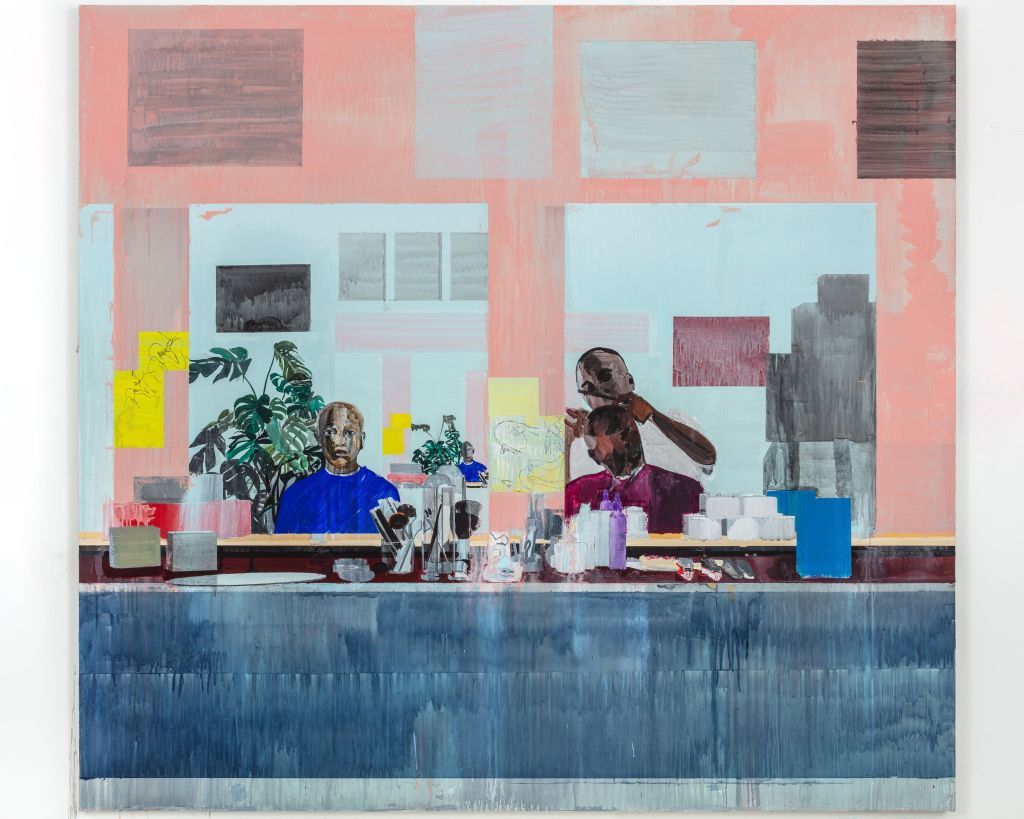
Shear Cut, 2024. (c) Hurvin Anderson. Courtesy the artist and Thomas Dane Gallery. Photo: Richard Ivey
Hurvin Anderson’s (b.1965) first major solo show at Tate Britain opens with a series of works based on the artist’s memory of friends on Handsworth Common in Birmingham. In Ball Watching (1997) the paint is layered and scraped to create a misty, ethereal effect: there is already a sense that these boys, kept at a distance in the painting, occupy an in-between place. As Anderson says of his later work: ‘[i]n order to observe, for me at least, I have to sit slightly outside of things’.
Many of Anderson’s paintings use landscape to explore experiences of diaspora, the legacies of colonialism, and the relationship of place to history and memory. The Tate description explains how, as the youngest of eight children, he was the only one born in Birmingham after his family moved from Jamaica to the UK in the 1960s. Anderson’s vision of Jamaica, he comments, is a form of ‘struggle’ with the ‘romance’ of the place. Accordingly, several of his paintings depict Jamaican beaches or abandoned hotels, layered with a feeling of London greyness. There is something minimalist about his limited palettes and tones, matte surfaces, silhouetted figures and careful clean lines. The paint is smooth, precise; the effect is a feeling of stillness and distance. At the same time, elements in his work can be extraordinarily expressive – trees, for instance, often carry political associations. Ashanti Blood (2021), part of a series of paintings the artist made on a visit to Trinidad and Tobago, depicts ‘an evergreen shrub with scarlet flowers’, whose colour memorialises the massacred during the Jamaican slave rebellion of 1760-61. In the final room hang four paintings created specifically for the show. These have a more ethereal quality, with a greater focus on the figure than the sublime landscapes of Jamaica in Anderson’s earlier critiques of postcard images.
By working with received images and grids, Anderson’s work actively investigates and questions the relationship of painting to photography. Anderson’s pictures often use the grid to structure and measure his strong vertical and horizontal forms – as something both to draw on and to work against. The grid – a classical pictorial device which looks back to Alberti and is concerned with compositional organisation and control – is a common motif, appearing behind the organic gesture of a tree canopy, an area of foliage, invoked by the rectangular posters on the barbershop wall and resurrected in the series of ‘country club’ paintings that look through patterned red security grilles, gates, beaded curtains, and chicken wire.
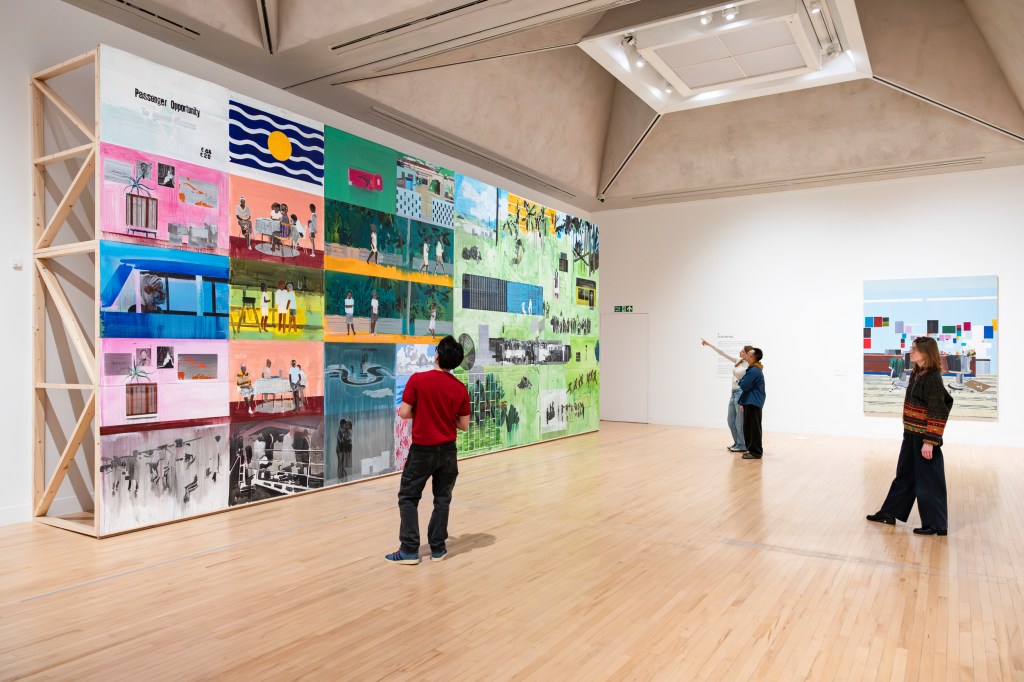
Hurvin Anderson at Tate Britain Installation View. Photo: Tate Photography (Larina Annora Fernandes)
The exhibition includes a paint-stained photographic collage Anderson assembled as the source material for his Audition (1998), which depicts a vast swimming pool with tiny figures crowded on the upper diving board. Others, waiting by the pool, are suggested by dark outlines, while rippling water is intimated by a calculated, web-like pattern on the surface. The palette is cold: greys, shocks of light blue, white splashes as someone jumps in. Anderson uses the photo collage to create a believable interior space, but exaggerates the interior’s scale for dramatic effect. On the subject of scale, the largest painting in the exhibition, Passenger Opportunity (2024-25), spans the side of multiple crates stacked the length of the room, and juxtaposes histories of violence with scenes of ordinary life in black communities, portraying a parade of slaves, people having dinner, a man waiting in a car, a couple embracing.
By far the most powerful representation of black spaces and community is found in Anderson’s paintings of barbershop interiors. This series shows the artist’s fascination with posters, photographs and received images, multiple frames within frames. In Is It Ok To Be Black? (2015), posters of Malcolm X and Martin Luther King on the barbershop walls recall Rauschenberg’s pop-culture collages but focus on histories of black power and resistance. In Skiffle (2023) – the title taken from a black-and-white list of different haircuts available (‘fade / flat top / high top / side part / trim / shave / skiffle’) – the barbershop mirrors are covered with more images of black cultural and political consciousness, such as the 1968 Olympics black power salute or NFL players taking the knee. Combs, brushes, scissors, razors, a fan and a red bull can are arranged in a line next to the mirror and shaped like a city skyline. A figure covered in a cape sits waiting for a haircut, and another waits behind. Is this the barber, taking a break, or another customer? Is it the figure of the artist? Whichever the case, both portraits are framed by the mirror, creating another frame-within-a-frame. Yet another mirror hangs on the wall behind them, meaning the figure on the left is reflected for a second and third time. This double portrait, which includes a cipher of the artist, participates in a tradition that includes The Arnolfini Portrait, Las Meninas, and, most importantly, A Bar at the Folies-Bergère.
This is an artist at the height of his powers, whose body of work, which includes landscapes, portraits, figures and interiors, is able to combine the meticulous and the expressive. His retrospective at Tate Britain confirms him as one of the most important British painters working today.
By George Adams
Hurvin Anderson is on at Tate Britain until 23 August 2026.
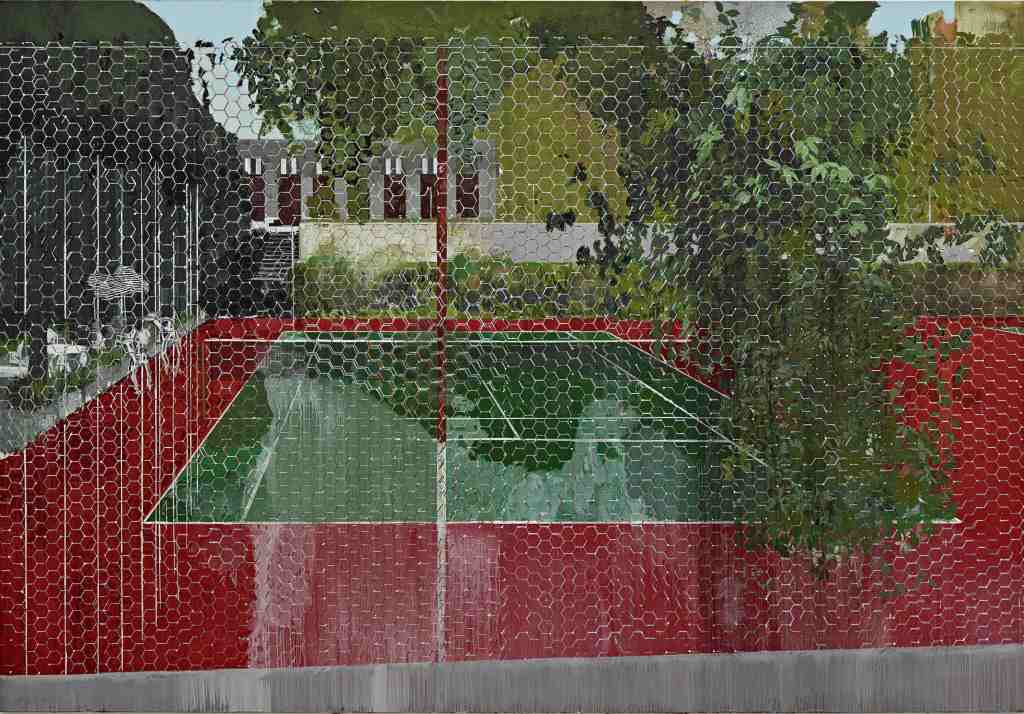
Country Club Chicken Wire. 2008. (c) Hurvin Anderson. Courtesy the artist and Thomas Dane Gallery. Photo: Richard Ivey
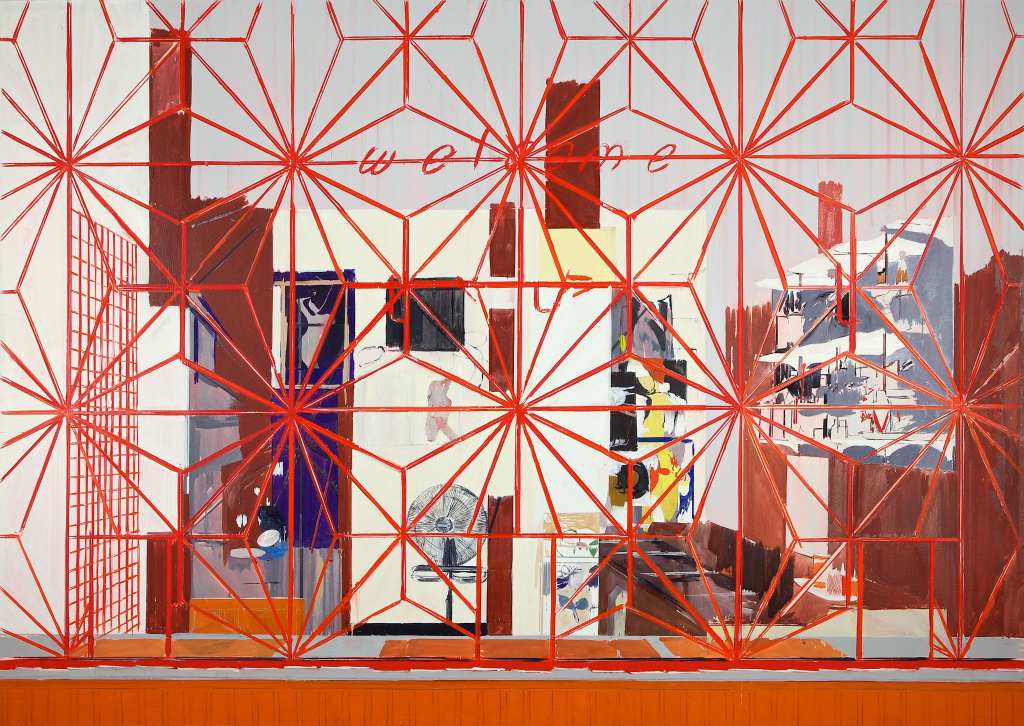
Welcome Carib, 2005. © Hurvin Anderson. Courtesy the artist and Thomas Dane Gallery. Photo: Richard Ivey

