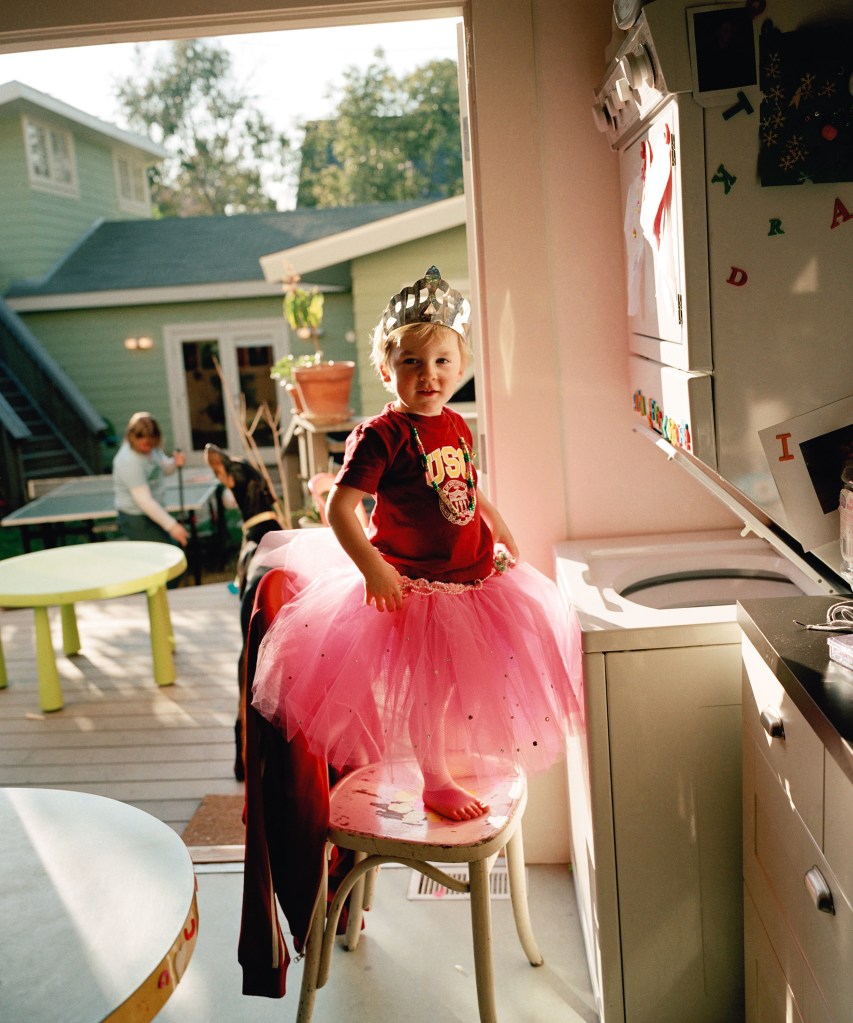
Oliver in a Tutu by Catherine Opie. 2004 © Catherine Opie. Courtesy: Regen Projects, Los Angeles; Lehmann Maupin, New York, Hong Kong, London, and Seoul; Thomas Dane Gallery
The National Portrait Gallery’s latest exhibition, To Be Seen, covers the work of renowned, queer American photographer Catherine Opie. Through a masterfully curated exploration of identity in all of its complexity – gendered, racialised, sexualised, and erased – To Be Seen asks viewers what it takes to be seen? Is it merely a question of opacity, an intervention in the course of a photon, or does it require something more profound? How can a camera, with its tendency to flatten, help us to see more deeply? Boldly intimate, Opie’s work can be seen as a documentary of marginalized lives and bodies in both public and private. A child stands in a tutu before a washing machine; a woman gazes down a lens at Obama’s inauguration; Opie turns her back to us, bleeding an image of idealised, queer domesticity.
The exhibition opens with Self-portrait (1970) – one of the first images that Opie created. Standing slightly left of frame, arms raised and muscles flexing, Opie squints down the lens. In the black-and-white image, she is only 8-years-old and yet, amidst the frame’s ordered grid, we find the glimmer of Opie’s later fascination with subverting gendered norms. Perhaps this is a generous reading of a child’s photo, but the curation of this exhibition encourages it. To our right, a full-length photo of Opie stands, now older, dressed in a plaid vest and jeans as her alter ego Bo (1994); 24-years later and an almost cartoon-ish, black moustache has ‘grown’ over Opie’s, or Bo’s, lip. Together, these works tell a story of undermined gender expectations and the complexity of growing-up queer or othered.
To the left of Self-portrait (1970), down a tight corridor, we are presented with a series of colourful images of children – as if taken on photo day at a particularly liberal primary school – and, opposite these, a far more austere series entitled Girlfriends (1989-99). In each set of portraits, Opie finds ways to press pause, momentarily, on life: the writhing complexity of a child is stilled, the quiet moment of a lover turning towards their partner is caught. In doing so, we are challenged to consider what these hairbreadth images might have to tell us about the personhood of their subjects. What exactly is it that a photo allows us to see? A child sits on a chair reversed, arms hanging over the wooden back with hands cupping each other – a cool but tense posture. An adult slacks in bed, swathed in a dressing gown, surrounded by a half-finished breakfast – an easy, unmade moment. As the images converse across the hallway, the gaily coloured backgrounds meet their match in the relaxed postures of adults; the easy confidence of grown-ups falters in the steady gaze of children. Both young and older reflect in each other – personalities temporarily moored in print becoming complicated in curation. Being seen, here, requires the reciprocal action of seeing with pasts and potentialities together: a child looks at a future self, an adult turns towards a memory.
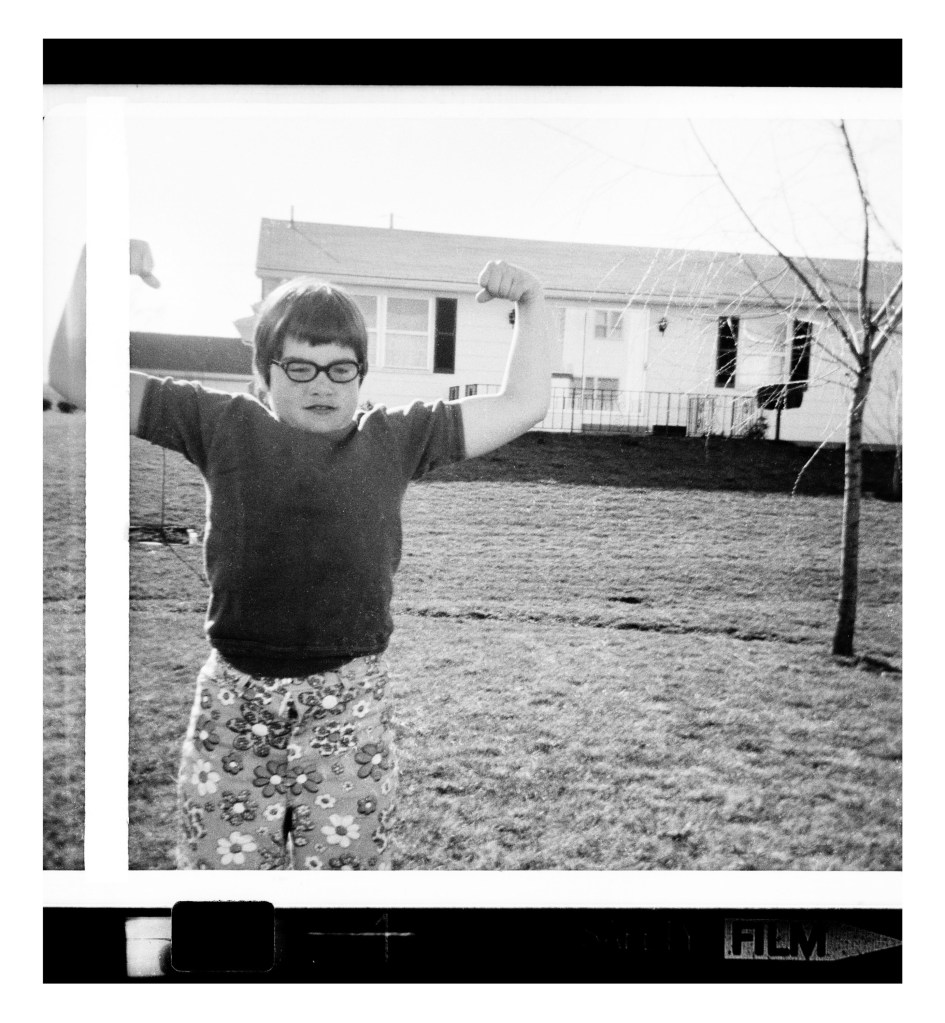
Self-portrait By Catherine Opie, 1970 © Catherine Opie. Courtesy Regen Projects, Los Angeles; Lehmann Maupin, New York, Hong Kong, London, and Seoul; Thomas Dane Gallery
Sliding through this transgenerational gaze, we arrive at a set of photos that appear to take themselves more seriously. Deploying a painterly chiaroscuro – faces lightened by wrapping figures’ bodies in black velvet – Opie plays with staging to draw out the personalities of her sitters. A person rests with their back to us, face lit by the white glow of an open book. A bride whispers in the ear of an embroiderer as their needle aims towards blood stitched as a single drop. A child turns their gaze away, their hand comforting a pet mouse in their breast pocket. Standing tall amongst the darkened figures, we find a photo of the aptly-named Diana Nyad – the third person to have swum across the Florida Strait (though this was never ratified). The ‘photogram’ of Nyad’s back stands testament to hours spent swimming outdoors. Opposite Diana (2012) is Opie’s only landscape in the exhibition: an out of focus image of the White Cliffs of Dover (Untitled #15, 2017). Across the hallway, in another room, we find an image of four surfers suspended between the near blue of water and sky (Untitled #10 (Surfers), 2003): a transect is created. As viewers, we are moved from land to sea through the body of a lone swimmer. Nyad’s body is made pivot – literally standing between cliffs and sea – for stories that bridge a fear of rising nationalism, the quiet of a person in water alone, and littoral communities that form around the ocean’s churn.
Across To Be Seen, Opie draws together people, bodies, and places to engage viewers in a politicised aesthetic. In photographing children, Opie provokes questions about access and vulnerability: what role does a child play in determining how they are portrayed? How much can a photo really say about a person? In photographing past lovers and celebrity figures, we wonder about the acceptable reach of the camera’s lens: which moments are too intimate to share? When does public image give way to private reality? Some of the most triumphant photos of the exhibition turn this questioning gaze towards the stalwart of American masculinity – the college football player. From 2007 and 2009, Opie photographed football players across multiple states in the US producing a set of vulnerable and deeply moving images. Variously camp, goofy and heartwarming, these photos undermine the toughened image of the ‘young, male athlete’. A player flexes towards the camera in a Superman-themed crop top, the red ‘S’ matching the colour of their mouthguard. Three players stand in line with their red, white and blue base layers peaking out underneath their team shirts – one smiles, another stares down the lens, and the third crosses their arms whilst sporting a slow growing grin. By moving away from her typical subjects, Opie brings granularity to an area of public life that is far too often wrapped in bravado and cliche. Through the lens, she de-romanticises her subjects and presents them as they are: young men, often teenagers, trying to make a name for themselves in a deeply competitive and highly scrutinised industry.
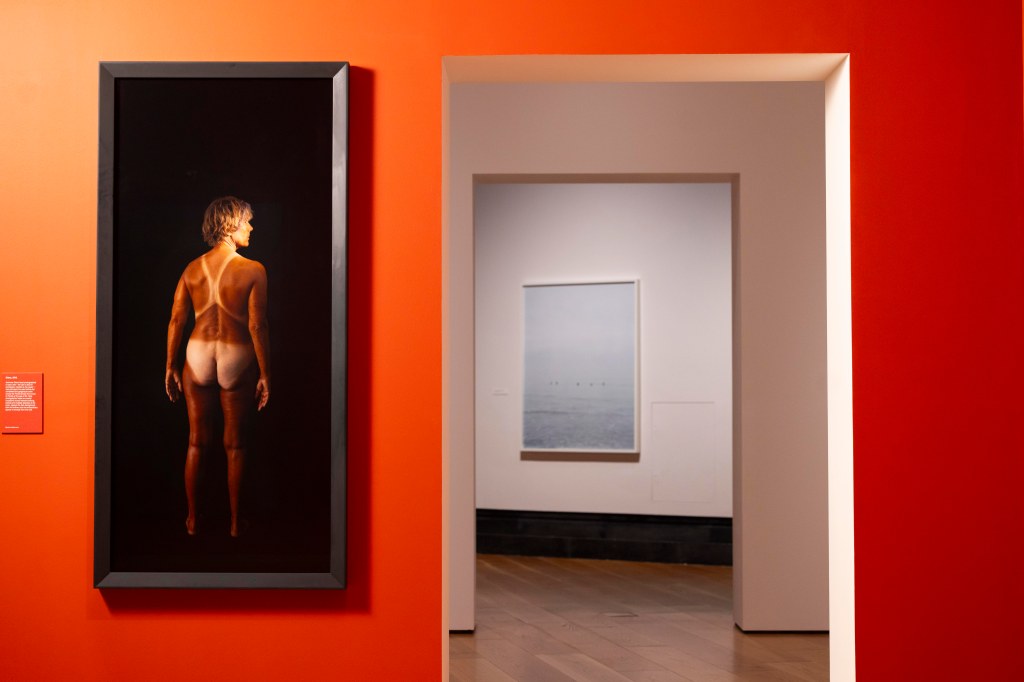
Installation view of the exhibition Catherine Opie: To Be Seen at the National Portrait Gallery. Photo copyright © David Parry
Despite its retrospective focus, To Be Seen retains a contemporary potency that is commendable. In the wake of Trumpian political rhetoric and a rapidly growing Far Right, the politics of visibility seems like an overdone attempt to hold onto the post-2008 neoliberal social order – as if visibility alone equates to physical and legal safety – but Opie’s radical telling of the body as a site of contestation makes a persuasive case for a renewed focus on visibility’s potential. Through bodies, those scarred and put to work and defined anew, policies of alienation can be resisted and new stories may be told. A body becomes testament to not only complex identity but also the labour of making and remaking oneself in spite of political and social constraints. Through the photographic lens, Opie offers an opportunity for thinking about seeing and being seen anew.
By Troy Fielder
Catherine Opie: To Be Seen is showing at the National Portrait Gallery until 31st May.
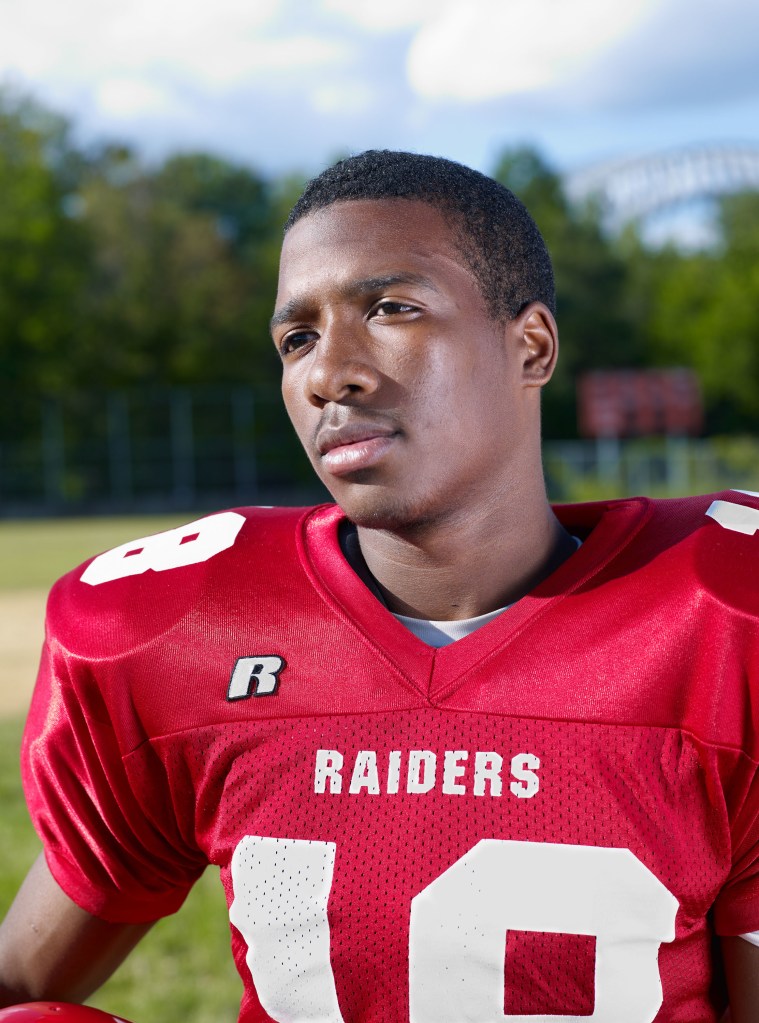
Abdul by Catherine Opie, 2008 © Catherine Opie. Courtesy Regen Projects, Los Angeles; Lehmann Maupin, New York, Hong Kong, London, and Seoul; Thomas Dane Gallery

