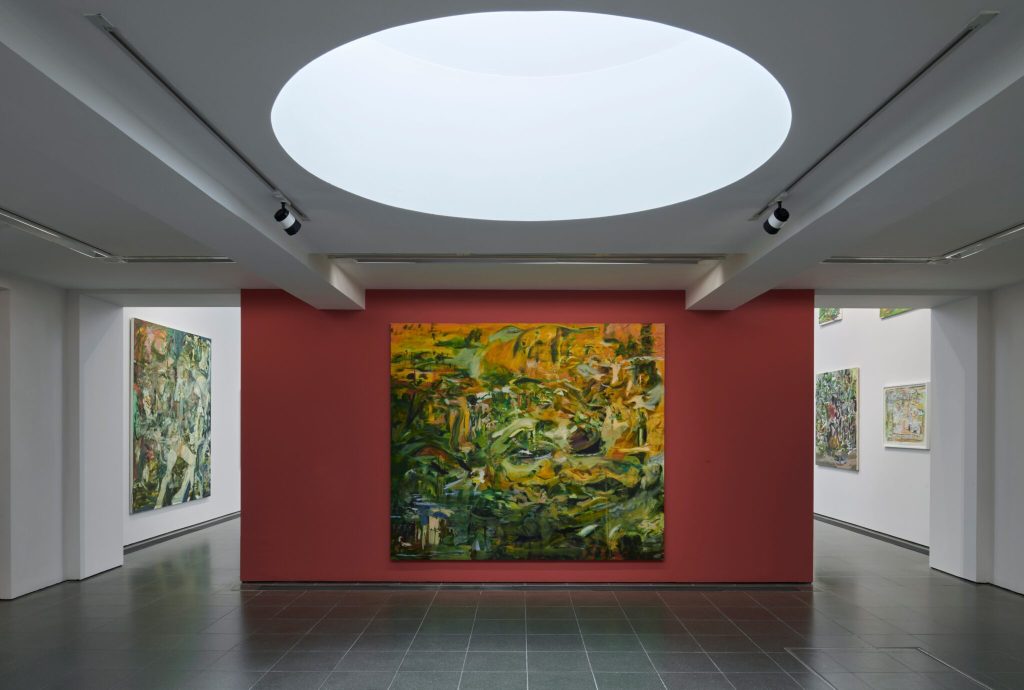
Image: Cecily Brown: Picture Making, installation view, Serpentine South, 2026. © Cecily Brown. Photo: © Jo Underhill
Cecily Brown’s new exhibition at Serpentine South, her first UK solo exhibition for over twenty years, represents a ‘homecoming’ for the British-born, New-York based artist. As well as a selection of key paintings dating back to 2001, Brown is showing a body of new work made over the last few years. In these paintings, the captions inform us, her physical mark-making explores the limits and possibilities of painting itself.
Many of Brown’s new paintings are entitled ‘nature walk’ and based on a jigsaw-puzzle illustration depicting a log lying across a river. These newer works feel messier, more cluttered, and less lyrical and unified than her older, better-known pictures, characterised by more chromatic, even jarring colours. There are many versions of ‘nature walk’ throughout the different rooms of the exhibition, including several smaller studies in the atrium space at the centre of the gallery. As a result, the curation appears a little jumbled, as if not enough deliberation went into the selection. Some of the smaller studies feel dashed off to a deadline, and a painting with a yellow ground entitled Serpentine Picture (2024) comes across as underworked opposite Brown’s earlier masterpieces.
In Brown’s recent abstract paintings the paint is more opaque, meaning these pictures feel flatter, with less nuance, depth and ambiguity than her earlier work. A vitrine displays Brown’s recent pen and ink drawings that resemble illustrations to children’s nursery rhymes, where animal characters feature in countryside settings. There are also several coloured-pencil monoprints, including an intriguing composition entitled Hunt (2020) that features an amorphous, screaming deer at its centre. This represents a recent interest in showing the artist’s drawing practices, elevating the studies that might accompany more ‘finished’ works.
The overall effect is a show of extraordinarily uneven quality – try as they might, these newer works, especially the drawings, cannot hold their own against the confidence and power of Brown’s pre-lockdown pictures. The Last Shipwreck (2018), for instance, updates the tradition of Géricault to Brown’s distinctive all-over compositions, where streaks of white, orange and blue are suggestive of a pile of limbs. The composition manages to hold chaos in a kind of coherence, as a mass of body parts are layered in different transparencies of paint, showing how Brown has both extended and drawn on de Kooning’s palette and his attention to how the figure relates to each corner of the canvas. Canopy (2004) is a more detailed, semi-observational painting that gives us the impression we are looking at a specific plot of overgrown ground. Foliage is rendered by flying marks, branches crisscrossing, a scribbly thickness to the mark-making. The adjacent picture, Couple (2003-4), displays Brown’s mastery of the sexual content of pastoral. Here, two figures, a man and a woman in a crimson dress, embrace and kiss in a forest, the pale sky beautifully layered in thick blue-white paint.
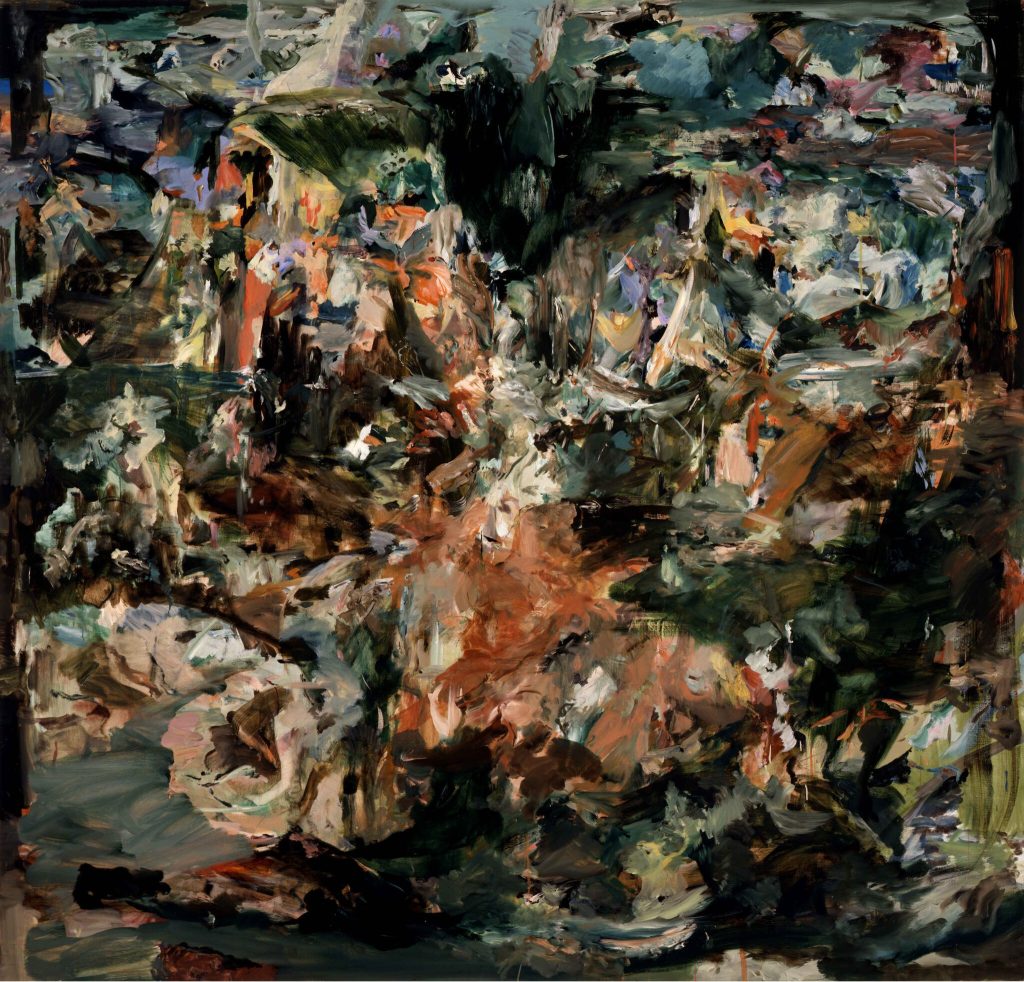
Cecily Brown Study for Sarn Mere 3, 2008, Oil on linen 215.9 x 226.06 cm (85 x 89 in.) Private Collection, Switzerland © Cecily Brown, 2026. Photo: Courtesy Gagosian
Sick Mood at Sunset (2016-17) is another all-over composition of interlocking oranges, greens and whites. Looking at these larger paintings, you get the sense that Brown’s bigger work is better because of its more confident relation of canvas to body, the scale of the mark to the movement of the hand, arm and shoulder. Rather than an immediately legible scene, as in the ‘nature walk’ series, this earlier work features a more uncertain and tensile relation to figuration, with aspects of figure and landscape emerging more slowly, and the viewing experience being therefore more difficult. In these paintings, a single subject has been deconstructed, and the relationship between the disassembled parts is one of unity rather than mess. Colour is lyrical and rhythmic rather than clashing. In The Baptism (2015) a pair of pale legs emerge from transparent, dirtier pinks and oranges, watery blues. In some places, marks bleed wet into wet; in others, the surface pigment has been scraped away to reveal a shining white ground.
Bacchanal (2001) is representative of an even earlier stage of Brown’s painting career, closer to the inheritance of Renaissance pastoral (Poussin is one obvious link) than abstract expressionism. Here, the surface is glossier, with more intricate jinking marks than veils of paint. Like the paintings of her contemporary Jenny Saville, Brown emphases how paint can resemble flesh. Yet, unlike Saville, Brown’s bodies are always situated in a tangible environment, and they are much more porous – you are never sure where a body begins and another ends. In this early work, non-naturalistic colour and an imaginary composition drawn from her extensive art-historical knowledge are consummately brought together. In contrast, Brown’s recent interest in a ‘return to nature’, jigsaw puzzles, and children’s illustrations feels like a turn away from greatness.
By George Adams
Picture Making is showing at Serpentine South until 6 September 2026
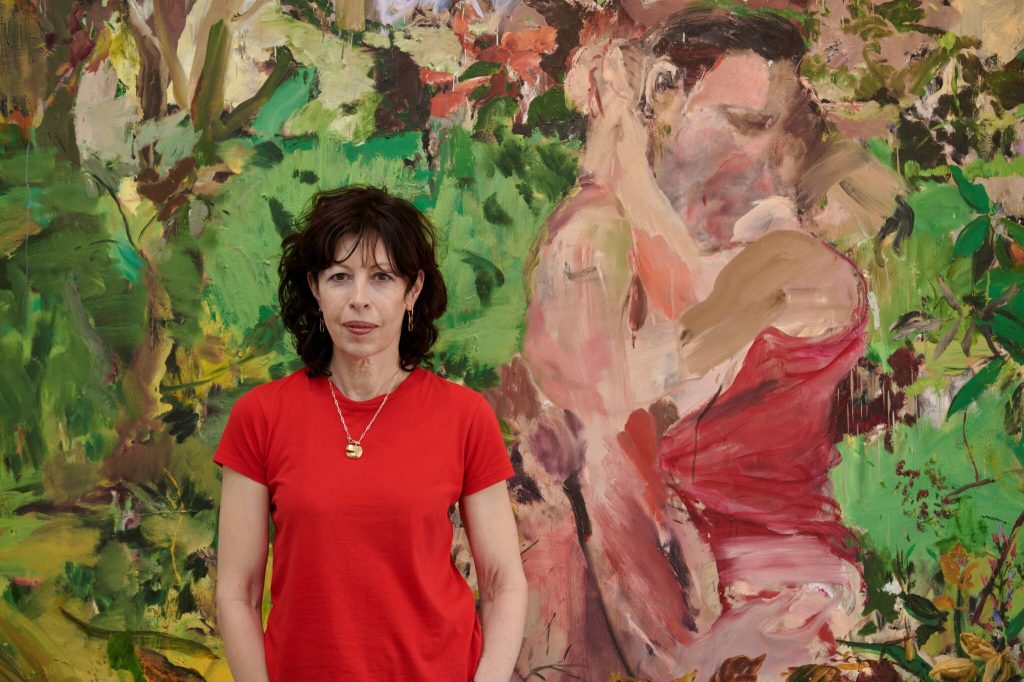
Image: Cecily Brown: Picture Making, Serpentine South, 2026. © Cecily Brown. Photo: © Jo Underhill

