Installation view of The Long Now: Saatchi Gallery at 40 (2026). Photography by Matt Chung. Courtesy of Saatchi Gallery, London.
Last year, the Saatchi Gallery turned 40. To mark its anniversary, the gallery’s latest exhibition, The Long Now, consists of a selection of historic pieces shown alongside new work by contemporary artists. Paintings, sculptures, videos and installations are organised around a series of capacious themes: ‘lyrical abstraction’, ‘mark making’, ‘reverb’, ‘inner landscape’, ‘expose’, ‘refraction’ and ‘post human’, allowing for an extraordinary variety and range of approaches across two floors and nine exhibition spaces.
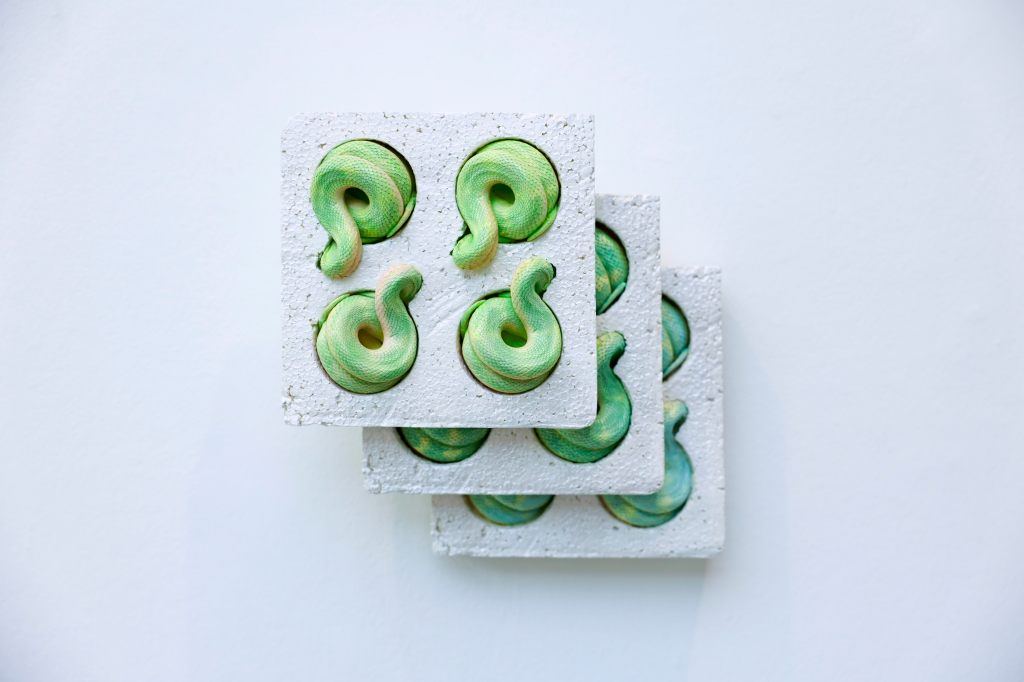
Standout pieces in the first few rooms include Polly Morgan’s (b.1980) blue, green and orange taxidermy snakes coiled up in polystyrene containers and Jenny Saville’s (b.1970) monumental painting Passage (2004) that depicts a ‘transvestite’ nude, their twisting body and defiant expression both confrontational and vulnerable. On the adjacent wall, Tim Noble’s (b.1966) five-panel wall relief Imaginary Beings (2018-2021) depicts the process of fertilization in a style that recalls Bosch’s Garden of Earthly Delights—fallopian tubes and intestines float through space, bodies are unzipped, distended, dissected, conjoined, merged with unicycles, and sucked into whirlpools. Whereas Saville’s work emphasises the size and fleshiness of the entire body, Noble represents the body as grotesque, slippery, and divisible.
Rather than a mere miscellany of different works, the strength of this exhibition relies on thematic connections and juxtapositions of cultural histories and materials. Upstairs, Rafael Gómezbarros’s (b. 1972) sculpture Casa Tomada (House Taken) (2019) is a swarm of colossal ants, their bodies constructed from casts of human skulls and t-shirts commonly worn by Columbia farm workers, their legs from branches of the fragrant Jasmine tree, whose smell, the description informs us, was used to cover the stench of corpses in the Columbian civil war. Unlike Morgan’s snakes that take the shape of their fragile containers, Gómezbarros’s ants crawl outward as if on a mission to infest the other work in the room.
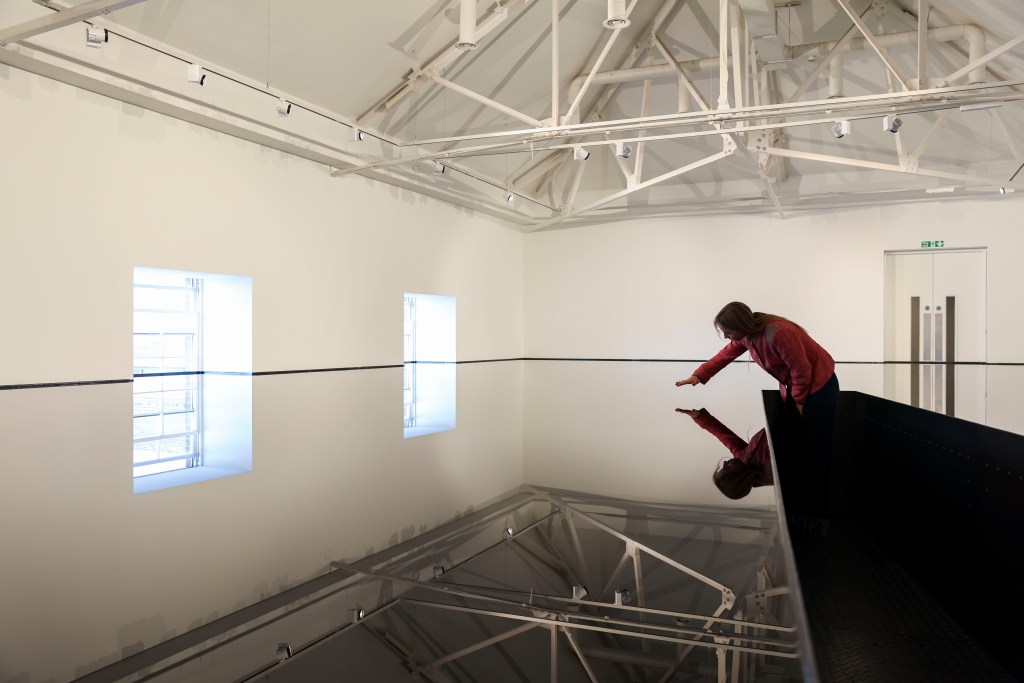
The most striking installation is Richard Wilson’s (b.1953) infamous 20:50 (1987): a room half-filled with recycled engine oil. Its highly reflective, glossy black surface mirrors the ceiling, windows and door. In the centre of the room stretches a sheltered walkway. The political significance of this installation, not only for the commercial gallery, but the contemporary geopolitical climate, is starkly apparent. A vision of a post-apocalyptic future, one where the greed for oil is potentially unchecked, is represented in Matt Collinshaw’s (b.1966) film Aftermaths (2025), where the camera follows long-tailed, amphibious creatures that flow through an underwater post-industrial world of fibrous coral and sea snakes to the elegiac tolling bell of Arvo Pärt’s Cantus in Memory of Benjamin Britten.
Installation view of The Long Now: Saatchi Gallery at 40 (2026). Photography by Matt Chung. Courtesy of Saatchi Gallery, London.
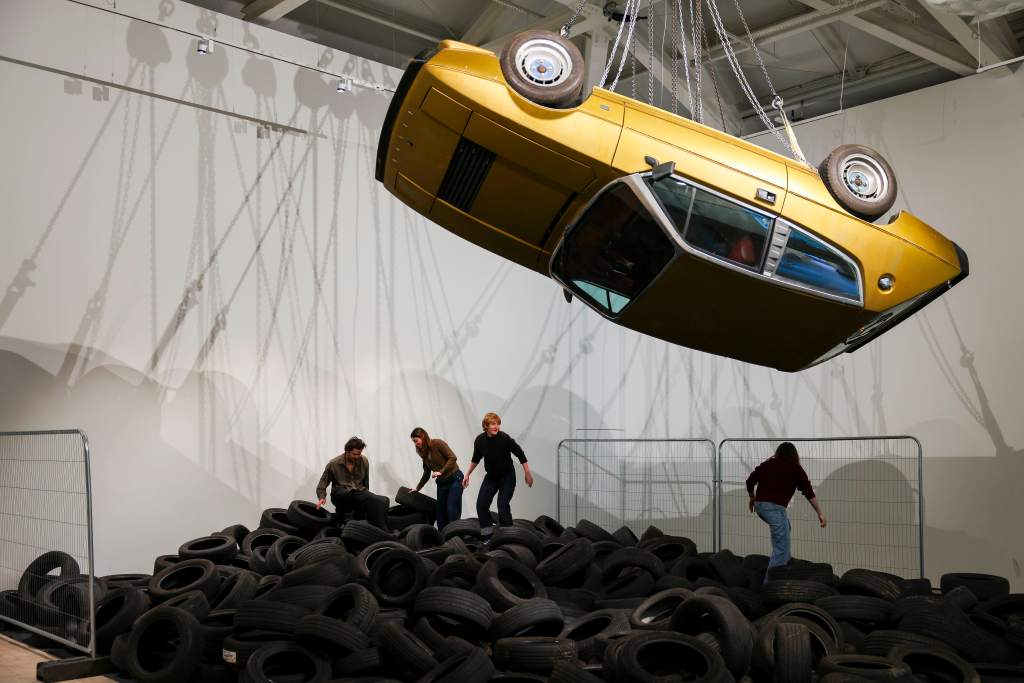
Passing through Gavin Turk’s (b.1967) installation Bardo (2025), a maze of splintered, tarnished glass, we reach the final room of the exhibition, where a 1980s golden supercar rotates upside down to the sound of techno music. This is Conrad Shawcross’s (b.1977) Golden Lotus (Inverted) (2019), exhibited above Allan Kaprow’s (b.1927) Yard (1961): a pile of tyres contained by wire fences where students clamber and take videos and selfies. There is a tremendous synergy between these works, conjuring a strangely oppressive urban environment that nonetheless encourages forms of playfulness and self-expression.
The only other artwork in the room is Christopher Le Brun’s (b.1951) painting Tristan (1988), inspired by Wagner’s opera Tristan and Isolde. Most of the painting is dark to the point of inscrutability. Glimpses of light in the corners clues us into a scene of towering cypresses over a river. Dabbing marks alternate between matte and glossy blacks in patterns that trace the rhythms of Wagner’s tragic opera. The surface is crisscrossed with hairline cracks, evidence that the paint has been applied wet-on-wet. The painting is thick-skinned: an extra layer of canvas has been applied to the right-hand section. Tristan’s presence in the room is mostly ignored by visitors, and the sound of the techno music drowns out the quieter rhythms of the picture. It is a strange decision to place Shawcross’s instillation, a commentary on contemporary consumer culture, next to something so solemn and funereal. Perhaps this bears witness to how longer histories of culture (represented by Le Brun’s painting) are ignored or sidelined during the contemporary moment.
And yet, the success of The Long Now is to stage these encounters between longer traditions and contemporary fashions. This is the paradox of the exhibition’s title, which might be a surprise for a gallery whose profits rely on investing in current art market trends. The most powerful dialogues within the exhibition are between newer and historic work, such as 20:50, whose power and relevance for political critique is only heightened in our contemporary context. Or, to take Tristan as an example, other work may resist the fashions of the day to recover something more permanent. Which of the gallery’s newer pieces might take on these resonances in future exhibitions? And will historic work continue to hold the same power in the decades to come? What is the responsibility (if any) of the commercial art gallery today? And what is the timeframe of the contemporary? Though The Long Now poses these questions without offering easy answers, at the same time it reminds us of the power of contemporary art as a site of critique and resistance, both to the current political and cultural climate, and to the model of the commercial gallery itself.
By George Adams
The Long Now is showing at the Saatchi Gallery until 26 April 2026.
Installation view of The Long Now: Saatchi Gallery at 40 (2026). Photography by Matt Chung. Courtesy of Saatchi Gallery, London.

