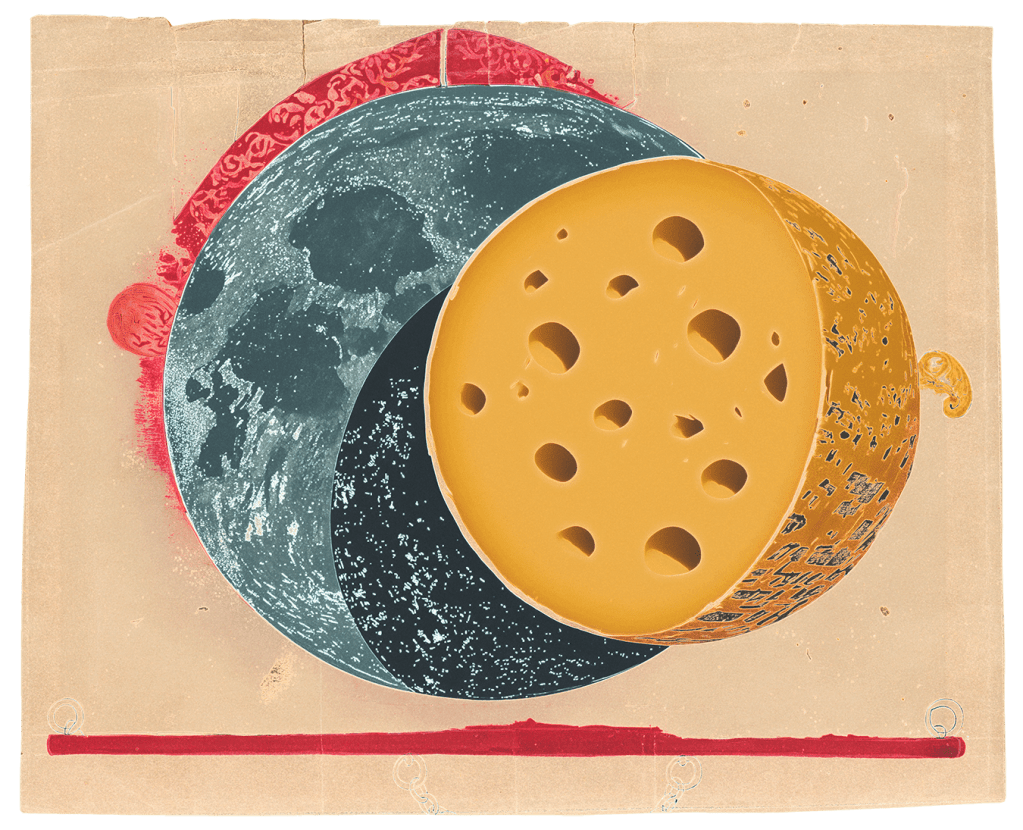
Artwork by Felipe de Silva (2026)
“Supernatural, perhaps. Baloney…perhaps not,” reads the epigraph of Thomas Pynchon’s new novel Shadow Ticket. Taken from the 1934 horror film The Black Cat, the quote speaks to the peculiarity of Pynchon’s style, which tends to tread the line between the metaphysical and the absurd. His novels are philosophical, yet entirely nonsense. But the last of Pynchon’s output is more ‘baloney’ than it would make itself out to be.
Set in Milwaukee during the heave of the Great Depression, Shadow Ticket follows the farcical investigations of private eye Hick McTaggart. The central plot, if there can be said to be one, involves Hick’s mission to track down the missing heiress to a cheese empire. Dorothy Airmont, daughter of ‘the Alcapone of Cheese’, has run off with Hop Wingdale, clarinettist for the swing band, The Klezmopolitans. Led to Europe on a wild-goose chase, Hick stumbles across a whole host of peculiar individuals, from Zbig Dubinsky, associate at the detective agency, to Dr. Zoltán von Kiss, a European apportist.
Pynchon clearly has a chuckle when it comes to naming his characters. Cheese being about as wacky a subject matter as it gets, Pynchon tries the reader’s patience when he pauses his narrative halfway to consider whether dairy is a sentient being: “Cheese, oh to be sure, cheese is alive. Self-aware, actually, maybe not exactly the way we are, but still more than some clever simulation”. If this is a world in which “cheese has feelings”, then perhaps it is also one in which pigs can fly. If the novel possesses the possibility of praise, it is for the sheer idiosyncrasy of its outcomes.
Pynchon has always done idiosyncrasy well. He has long been lauded for the ‘zaniness’ of his novels; his writing seems to embody Sianne Ngai’s definition of the term, constructing an aesthetic which confuses the boundaries of work and play, humour and concern. Nevertheless, at times, Shadow Ticket’s humour seems maximalist for maximalism’s sake.
Narrative jumpstarts with ‘changes in the wind, Prohibition repeal just around the corner, Big Al in the federal pokey in Atlanta’. Yet, despite being set almost a century prior, Pynchon’s satire of Americanism seems a bitterly accurate representation of the country in its present landscape. The creeping shadow of fascism he sketches in his 1930s’ setting seems to have returned once again, but now in a silhouette that looks all too much like the shape of Donald Trump.
But Pynchon never confines his novel’s world to the singular setting in which it starts. Shadow Ticket breaks out of the American echo chamber and jumps ship over to Eastern Europe, where Pynchon’s protagonist, Hick, finds himself deep in Nazi waters. Nevertheless, the process of shifting location seems different in this last of his novels – it is no longer focused on the journey, but on the destination. Having eliminated the space of the intermediary ‘road’, Pynchon struggles to integrate his protagonist each time he arrives at a new setting. Characters are transplanted from one place to another, yet description only starts once they have already reached their terminus. In fact, there is little description altogether in the novel, which is highly dialogue heavy. Whilst this allows for a faster paced narrative, transportation between countries occurs so quickly that the movement almost seems that of a teleportic shift. With the process of journeying elided, topographical transitions lose their smoothness. The shift between settings is achieved with a serrated cut.
Where Pynchon does well on his critique of American nationalism, he struggles to translate this for other countries where nationalism is equally prevalent. Hick spends a considerable portion of his time in Hungary, but the country’s political history is almost elided; it becomes merely a stage for American exchanges. While the nebulous clouds of fascism pass over the novel’s landscape, their effect on the political climate is confined to the background, when it concerns other countries. Pynchon does not make more than a jolly rumour out of inter-war troubles.
Where previously Pynchon has displayed a talent of managing both humour and ideological scrutiny within one novel, here he teases the possibility of addressing political conflict, yet never arrives at serious inspection. And though his aim is to satirise, to draw the absurd out of a serious period of conflict, he seems to swap historical realism for hazy mystique. The novel’s fogged vision seems more the result of an unfocused eye than intentional obfuscation of explicit political content. Absurdity has long been the blade of Pynchon’s social criticism. Yet, even for a mock-detective novel, Shadow Ticket is lacking in interrogation. Because Pynchon cannot cut through the surface of his comedic skin, the novel’s political content remains unexamined.
The detective novel makes use of red herrings to confuse its reader – the one continual red herring throughout Pynchon’s novel is that true danger might be present at all. Paranoia lingers throughout. Hick seems to sense that ‘everybody is looking at everybody else like they’re all in on something. Beyond familiarity or indifference, some deep mischief is at work.’ Faulting the genre’s conventions, Pynchon produces a spoof of crime and misdemeanours. Knee-deep in mishap, Hick’s job working for the Unamalgamated Ops detective agency sees him repeatedly entangled in close calls, conspiracy plots created by nefarious organisations, and a lucky escape from an attempted assassination against him. Yet the reader cannot help but laugh, for the bomb which threatens his life is cleverly concealed in the form of a gift-wrapped present. Pynchon’s endings always promise a foolish bust-up that seems straight out of a Charlie Chaplin scene.
The Pynchonian sentence resembles the consciousness of REM state: syntax follows the patterns of rapid eye movement, and brain activity is always on high-speed. Nauseatingly over-saturated with adjectives, densely obscure, and exhausting in their juxtaposition of jargon, they read like bizarre dream-visions. “Rogue nuns in civilian gear two-stepping with bomb-rolling Marxist guerrillas” is a phrase so absurd it could only be from a Pynchon novel. Shadow Ticket is entirely generated from this species of sentencing.
However, in some ways, the effects of Pynchonian prose feel watered-down by the novel’s excess of information. In The Crying of Lot 49, linguistic excess accentuates the sense of technological and material growth at the height of 1960s’ consumerism. But where in this and other previous works Pynchon’s many references to political and social titbits carried critical meaning, in Shadow Ticket they come across as fads.
The novel produces the illusion of historical depth, but mostly doesn’t substantiate it. Already on page one, four of five sentences are the length of entire paragraphs. Squeezing as much referential juice out as possible, they reel out strings of information in surplus. Paragraphs overflow with superfluous content and characters though there is no particular need for them. Where The Crying of Lot 49 plays with inverted action, or delayed surprise in syntactical order, Shadow Ticket’s sentences are a long stream of linearity. Pynchon seems to have become less flexible in his maturity, his sentences now beginning to creak at the joints.
Potentially the last of his output, considering his impressive age of 88, Shadow Ticket produces a softened blow compared to the outrageous punch of the author’s previous oeuvre. One wonders whether the excessive humour that once propelled Pynchon’s novels might now be his downfall.
By Mia Apfel
 The Camera