
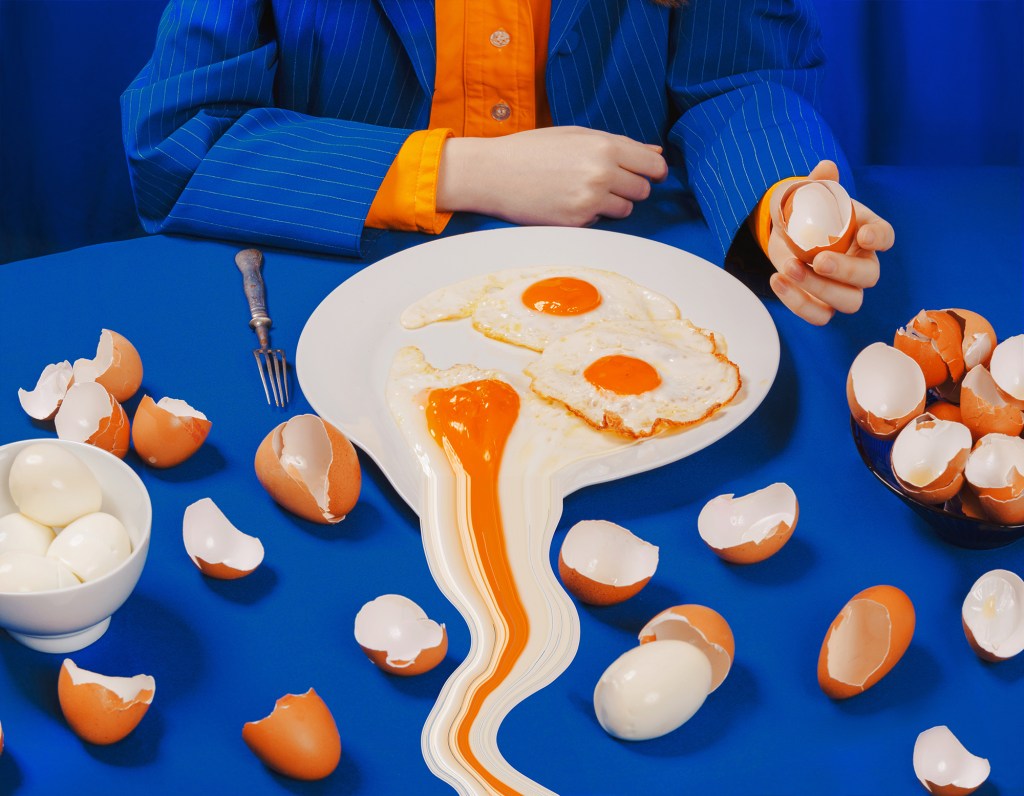
Artwork by Tijana Moraca (2023)
A set of double marks, signed with hands raised and fingers twitching; “Wuthering Heights”, spoken with derision. This is how I’ve been introducing Emerald Fennell’s latest film to friends.
My use of air quotes is not only a poor attempt at physical comedy but a direct riff on Fennell’s own approach to filmmaking, encapsulated by her view that “any adaptation of a novel, especially a novel like this, should have quotation marks around it.” Millennial in gesture and millennial in production, “Wuthering Heights” provokes the question – protective grammar or not – at what point does an adaptation stop being worthy of its source material? When must it be judged as something else entirely? What stupefying heights must we, the audience, endure and how far must we be allowed to fall before we begin to ask where the hell it is that we are?
With the film opening on a botched public hanging, we are dropped into a cruel world where spectacle prevails. Amongst a leering crowd, we join a young Catherine Earnshaw (Charlotte Mellington) and Nelly Dean (Vy Nguyen) who marvel as a condemned man enters a state of asphyxiation-induced priapism. The rigor erectus (death erection) sets the stage for what is to follow: a suffocating, pornographic collage of era- and plot-defying fanfiction that runs roughshod over the 19th-Century novel and its characters.
In Fennell’s “Wuthering Heights”, generations of Earnshaws are conflated in a single, alcoholic father flattening character complexity and confusing Heathcliff’s (Jacob Elordi) motivations; the two POC characters – an older Nelly Dean (Hong Chau) and Edgar Linton (Shazad Latif) – act as antagonists to the central romance, while a whitewashed Heathcliff lusts for the audience’s adoration; Isabella Linton (Alison Oliver) is made a masochist, shoddily subverting the abuse that makes the novel so harrowing; and we are denied the child that binds the plot to its inevitable, repetitive horror. In short, everything that could be done to undermine the original text – to cheapen and plunder it – is done. What remains? A sloppy montage of pretty though vapid scenes that would more appropriately be found in the draft folder of a TikToker’s CapCut than any serious cutting room.
Going in, I trusted in Fennell’s vision of a Saltburn-style excess; I was willing to stand in defence of her baroque horniness. So what if the film wasn’t faithful to the period? Who cares if a few bathtubs were drained, or a grave or two fucked? Surely, I thought, these concerns would fade away in the gorgeous richness of Fennell’s excess and, under the swathes of organza and latex, we would find beating the bloody heart of Brontë’s novel.
At moments, I could feel it weakly pulsing through: Catherine Earnshaw (Margot Robbie) billowing across the moors towards her doomed marriage; the naïve dreams of domesticity materialising in Isabella’s dollhouse; Heathcliff’s tailored, and admittedly sexy, apparition appearing through the mist. Ultimately, though, diaphanous desire quickly gave way to ichorous lust: dough slopped and massaged, carcasses trimmed, eggs fingered, entrails spilled. Hems of dresses became mired in blood and pyramids of glass were erected as crude monuments to vice. Teetering on the edge of camp, the imagery constantly stumbled into the gaudy and absurd. Fennell’s golden touch in Saltburn turned putrefying, as if all creative direction had curdled in the dank, moor air.
Yet, in the 10 days following its opening the film has made over $150 million worldwide. Across TikTok and Instagram, clips of people weeping at the film’s close have spread like wildfire – or plague. Opinion seems divided: The Independent gave the film a miserly 1-star, while The Telegraph awarded it a somewhat shocking 5-stars. What, then, is happening? The film’s popularity is also the thing that undoes it: the oblique appeal to spectacle may allow for multiple climaxes, emotional or otherwise, but leaves the viewer bereft of connection. It is all penetration and no foreplay.
If Fennell’s “Wuthering Heights” is the “greatest love story of all time” – one that the producers told via supplication to TikTok marketers and the terminally online – then I find myself summoning an equally online prayer: may this love never find me.
By Troy Fielder
 The Camera