
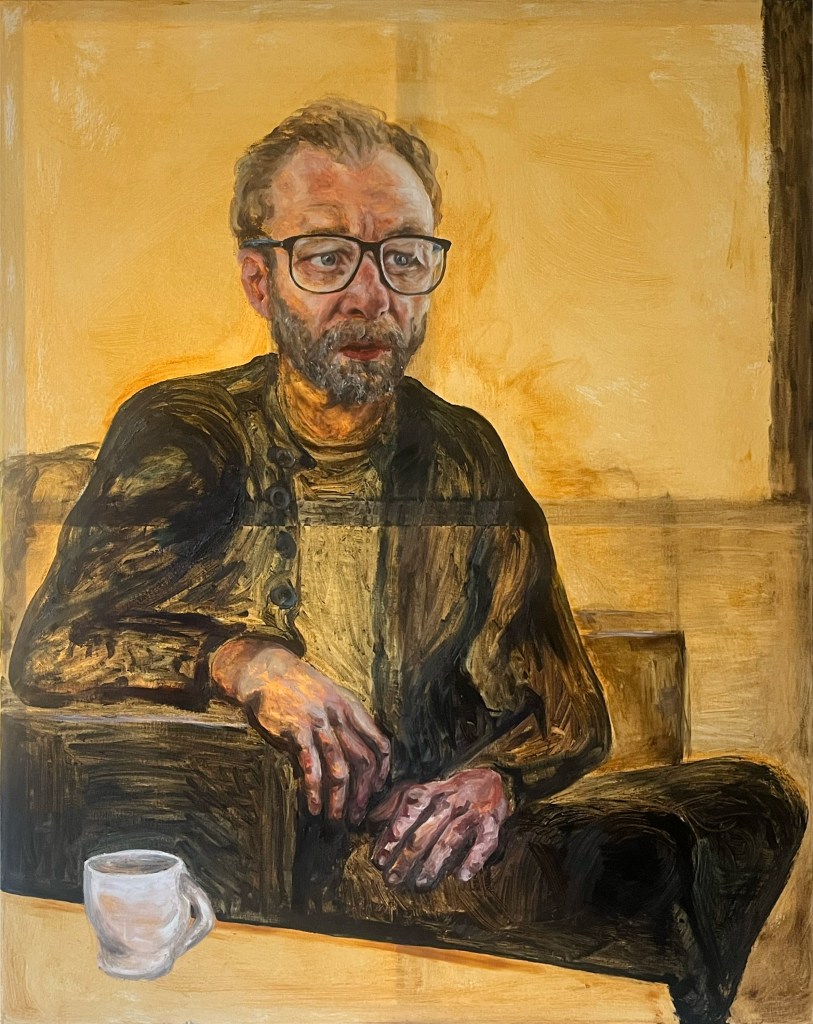
Artwork by Natasha Kawalek (2026)
Matt Berninger is an American writer and singer. He is the frontman of The National, a rock band founded in New York in the early 2000s. Since then, the band has released ten studio albums and has collaborated with the likes of Taylor Swift and Sufjan Stevens. As well as this, Berninger has released two solo albums and has written for film and theatre in collaboration with his wife, Carin Besser, and others. On 8 December 2025, he performed his most recent solo album, Get Sunk (2025), at Cambridge Junction along with his collaborators, Sean O’Brien and Ronboy. This is where the following interview took place.
I bought Matt Berninger a copy of John Donne’s major works because ‘The Flea’ (1633) has always reminded me of a National song. Not because it is about ‘desire’ or ‘romance’, or because of the behaviour of either of the characters, but because of the ambiguity of the relationship depicted. Following two stanzas of the speaker’s attempt to persuade a love interest to sleep with him by noting how their bloods commingle in a flea—
‘Mark but this flea, and mark in this,
How little that which thou deniest me is;
It sucked me first, and now sucks thee,
And in this flea our two bloods mingled be;’
—the young girl casually crushes the insect, purpling her nail with a blot of blood.‘Triumphant’ with herself, the speaker observes, the girl then accepts his logic only to reveal that it is unpersuasive. Nonetheless, he resumes his argument, and it is unclear whether the poem’s continuation figures as an attempt to reclaim his ‘authority’ or to simply continue with a flirtatious game.
Who is directing this exchange? How seriously does either party accept the terms being set? Is the speaker’s persuasion manipulative or self-aware in its excess? Is the girl’s flea-crushing rejection, boredom, or even a knowing reply in kind? The poem, I think, recalls a National (or Berninger) song precisely because it refuses to resolve any of this ambiguity in the same way that songs like ‘Tropic Morning News’ or ‘Bonnet of Pins’ don’t, for example, both of which stage complicated exchanges.
The speakers of Berninger’s songs are less bent on persuasion than they are self-grappling, absorbed in gloom or ‘over-thought’. The dialogues they recall, however, reveal a similarly strange relational sparring. In ‘Bonnet of Pins’, the first single from Berninger’s latest solo album Get Sunk (2025), the ‘she’ figure interrupts the speaker’s expectation of her abiding absence and playfully names her knowledge of the same. The song figures as a sort of literary ‘scene’ (a style of writing not unfamiliar to The National but which was nimbly pursued in the recent solo album), with all the odd specificity for which Berninger is known: ‘a Styrofoam coffee’, a ‘father’s feather jacket’, ‘photographs of tractor bones on the walls of model luxury homes’.
Strangely fitting that Berninger’s first response to a question about the writing process was to describe it in terms of the arrangement of a garden: the grasses, the flowers, the trees, and the bugs. (While a flea might belong more to a cat or dog within it than the garden itself, I had not expected any sort of insect to figure in our discussion). We were sitting in a dressing room at Cambridge Junction: a whirring-bulbed and yellow-lit space with dark walls and old couches. Sean O’Brien and Ronboy were sound-checking. Berninger sipped from a mug of black tea.
I had asked, given the ten or so years of working a graphic design job in New York, moving through the city, its worlds and romances, before The National really ‘took off’, whether experience or imagination were more important for Berninger when writing a song. Whether writing from or projecting into a particular situation was preferred. He responded that both were important but that, if anything, the process leans more toward ‘fantasy’. As a writer, and possibly more importantly, as a person, both the past and the future exist as part of this fantasy: they are stories that we tell ourselves about our lives. Berninger summarised the writing process using a metaphor that is pointedly mixed. While a song might begin in a moment that really happened, the ‘fantasising’ that the process entails at once distills character, scene and description, reimagines the same, and produces an ‘impressionistic, blurry feeling’ through the careful arrangement of a sequence of words.
MB: The song ends up being meticulously structured. But, at the beginning, it’s just a field of flowers and bugs. It’s about grabbing glimpses of moments and little things. And to stay with the metaphor of a garden, I could have a wildflower, a wasp, a worm, or some dirt… You provide just a few details. A room, or what someone is wearing, and this gives just enough of a sense of an environment.
… But I don’t go into the process necessarily thinking about any of this. I will write lyrics and then I’ll rewrite the whole song and maybe keep only one little pip, one tiny piece. Then, I’ll just circle around that. So much of the time, once you get that little bit, that thing that gives you the sense of the song, you spend the rest of the time trying to write melodies and other words that don’t fuck it up, that don’t take you out of that blurry zone. Later, when I’m listening to the song, what I am looking for, or, what I always ask is ‘Does this thing float?’. It is a case of carving away and starting over until you feel like the song starts to lift off the ground. And you don’t know why. It’s weird.
CK: How would this differ, say, for a song like ‘Bonnet of Pins’ versus ‘Nowhere Special’? They are quite different. ‘Bonnet of Pins’ is a scene whereas ‘Nowhere Special’ is fragmentary, like a stream of consciousness.
MB: Totally different. ‘Bonnet of Pins’ started from those three words: bonnet of pins. I had seen a sculpture that looked like a bonnet of pins and I just texted myself that. It was probably a year or two years later… I was working with the band and the sequence ‘bonnet of pins’ just stuck, and I thought to myself, why do I like that? I started writing more about this person wearing a bonnet of pins and then the bonnet of pins became this whole other thing because the words floated. ‘Bonnet of pins’, that floats. Why?
… ‘Bonnet of Pins’ was one where I was trying to set a scene or a place, move through it, and leave. It’s like a little action adventure. A romantic night, a scene from a movie. But then ‘Nowhere Special’ is a maximalist sort of… maybe, some iteration of when your brain works faster than the speed you can talk. Even in this conversation. We’re talking but there’s all these other things… all these other images of what’s going on in your life, what you have to do today in your mind. A song like ‘Nowhere Special’ is sort of like, ‘Here’s a thought that keeps slipping in amongst all the other stuff”. A lot of it came from improvisation. It was more a case of letting the song be a pile of flowers and bugs than arranging them per se. A pile of flat, dead flowers and bugs in the garden, on the shop floor.
But regarding what ‘Nowhere Special’ really says, Berninger continued, looking back with hindsight, it is hard to tell. He described recently reflecting on his body of work and realising that he perceives no real lines of separation between the individual songs he has written or even between entire records. Between the way he was writing two decades ago, in his early thirties, and the way that he continues to write today, amidst the strangeness of the 2020s.
MB: I read older songs and think to myself, ‘I’m writing the same shit’. My brain is in the same place. My soul is in the same place! A lot of times. But it’s kind of comforting. Often, you have an idea of who you are and you try to manifest this concept but that idea ends up not being you at all. When I listen back to all the songs I’ve written, I don’t know precisely what I was trying to present other than, I suppose, say ‘I was here’, thinking, living, through the same sort of stuff.
For Berninger, it is the ‘presencing’ in and through a song, an artwork, a work of prose, a film that underpins his love for ‘Art’ more broadly. It is here that you find a reflection of yourself, and as part of that reflection is the reality that you, along with everybody else, form part of a ‘connected tissue’. It is within this ‘tissue’ that any real truth resides, rooted in the simple fact of the self-echo’s appearing at all. That some other distant individual in the guise of ‘artist’ or ‘writer’, etcetera, has captured this is a powerful thing.
Berninger explained that the self-echo might be found in the very specific. It might not make discernible sense. It might be useless, in a practical sense, and retold only with vague imprecision. Still, its presentation in spite, and because of all these things is enough to elicit what Berninger refers to as a kind of faith. The terms of this are tangled in the web of bold (but often performative) spiritual vs. secular rhetoric as well as the (often but not always rightful) resistance to practicing religion that forms a common part of popular culture today. It is worth thinking through, in spite of this.
While we started by talking about the writing process and the garden, we moved on to talk about God.
MB: I do think that being an ‘artist’ is being religious in a way that you have faith in this abstract thing that is useless, that doesn’t seem to help the world in any tangible way—like God doesn’t—but you still just believe in it. You believe that it is good. You believe that it will make you and other people feel better. But why is this? It doesn’t solve any concrete problems. It usually makes no money for anyone. It usually brings the artist mystery. And in this way, it is the same thing as faith in God, and, in fact, for me, it is faith in God…
… See, if anyone ever asks me, ‘Do you believe in God?’, I always say yes. But I am talking about art. That’s really what the God thing is, I think. I also half believe in a ‘real’ God. Maybe. I want to so badly. But for me, regardless, there’s very little difference between the word ‘Art’ and the word ‘God’ and what these two things mean . They mean the need for understanding, the need for safety, the need to be loved and/or recognised by another person. And I think that’s what artists are doing. They’re communicating with that. With God.
CK: Something that I’ve noticed while attending National gigs is that—the people in the audience—I think it’s clear that many of them are wrapping their own experiences and relationships around your words and your ideas. Yet, at the same time, you’ve before cautioned against overly investing in particular narratives and identities as though they are immalleable. Do you think about the ideas you put out to the world when you write? Or are you more so expressing that Art-God thing you’ve discussed?
… Let me give you an example. When you sing ‘Mr. November’, so many people seem to latch onto that one line. ‘I used to be carried in the arms of cheerleaders’. It is quite ferocious, a vivid moment, yet to whom does ‘I used to be carried in the arms of cheerleaders’ literally apply to? Not to me. Then, there’s the emotional tilt of the line, which feels somehow disappointed in the context of the song’s other lyrics, or even exasperated.
MB: See, it’s that everybody wants that. It’s the idea of yourself. It’s the ‘I used to believe I was going to be something’. ‘I used to believe in myself’.
Berninger clarified that, when writing, unlike the overarching mood or blurry feeling, it isn’t that any particular narrative or identity is pursued per se. In fact, he explained that much of the process is craft, not concept, that careful garden arrangement he previously discussed. Perhaps most simply, writing comprises the delicate endeavour of expressing a part of himself, his thoughts, or experiences in some discovered form.
MB: It’s like, ‘I’m just going to tell you, “here’s everything”. “Here’s everything that’s been going on”’.
The words which resonate (or not) with an audience cannot be anticipated. Berninger will write ten or more songs before he writes just one line like the ‘cheerleader’ one: ‘I’ll explain everything to the geeks’ (‘Vanderlyle Crybaby Geeks’), ‘We’re half awake, in a fake empire’ (‘Fake Empire’), ‘I was carried to Ohio in a swarm of bees’ (‘Bloodbuzz Ohio’). Certain phrases spontaneously become ‘little t-shirt slogans of feeling’, but this is only ever really found out after a song is released or performed. It is almost like ‘catching smoke in a net’. It takes a lot of craft, some ‘Art’, and a case of seeing if the smoke is caught. And if it is caught, seeing what that smoke is. Which line, or moment (self-) echoes and is shared.
MB: I haven’t gone to mass in twenty-five years but I do feel like I go to church every night that I am on tour. Every time that I open up my laptop or go into the studio with someone excited to write something, it feels very much like a retreat, some sort of retreat for the soul.
… The reason why I’m still touring and making records is to be around other people in a room just trying to make something. To make something that didn’t exist before and see whether or not it moves us. We all know that songs can do that. Show us that magic is real, that true love is real. That is God is real. We all know it, really. It is real even if it seems only to appear for a brief moment. True love, or whatever; it is real. And the moment of it being real stays with you. The first time that you felt something for a person or a thing, for music or for Art, the first time that you got lit up by whatever it was; that sensation never goes away. Well. It sort of does, but you can reconnect to it. Those moments stay with you. You have them forever.
We were running out of time, by then, to talk, and time is where the conversation finished. A great number of National and Berninger songs seem, in some way or another, to pivot on this point: the idea that most of our experiences are fleeting, especially those which involve another individual, but that they nonetheless echo loudly in the present.
‘I keep what I can of you / Split-second glimpses and snapshots and sounds’, ‘You in a Kentucky aquarium / Talkin’ to a shark in a corner’ (‘New Order T-Shirt’). ‘Everyone was lighting up in the shadows alone / You could’ve been right there next to me, and I’d have never known’ (Light Years). ‘If the guy comes to do the garden / I’ll leave an envelope by the faucet / I’m not expecting anything from you, though’ (‘Silver Jeep’). ‘Memorise the bathwater, memorise the air / There’ll come a time I’ll wanna know I was here’ (‘Weird Goodbyes’).
It is here that a different sort of ambiguity persists. This is not one which is immediately between two people in the midst of conversation—the playful rejection of the girl in ‘The Flea’, the quietly teasing ‘poor you’ of the mysterious ‘she’ in ‘Bonnet of Pins’—but which lives with the reflecting, solitary self. It concerns navigating the tension between someone’s material absence and their felt presence, which is definitively real and true in its own way.
MB: Even in your despair, when you feel like all that stuff that was good and which made you so happy is no longer there anymore, it is still. You just have to tune in again. In the middle of heartbreak, true love is still there. You’re just missing it. You’re just missing what that feeling was, but it’s still there. You can conjure it. You can touch it. Whether or not that person who you feel triggered it is physically there or present anymore. They are there. They are present. Whether they’re dead, whether you haven’t spoken in years, whether you hate them now. You did love them at one point, and that’s there.
CK: It’s sort of embarrassing—or it feels silly—to say it, but a lot of your songs make me think that. That things like love are ‘eternal’ or something. That even if you at the same time hate the person or they’re absent or dead, the ‘love’ part is still an eternity whether it’s withered or materially disappeared because of the fact that it did once happen. It’s hard to explain.
MB: I often think it. It’s like with the death of a person. Often, I think that their presence resonates even more, even more loudly after that happens. I’m just picking someone that everybody loses, but when my grandmother was alive, I don’t know if I thought about her that much. I mean, I saw her, of course, and it was great when I did, but somehow, having lost her, her presence rings in me now more than it ever did when she was alive. It’s the frequencies. I can tune into the frequency of my grandmother in a way today that is better than when I was physically experiencing her, or the thing called her. The package that was Clara Berninger.
… I think the person who you lose becomes a tuning in your soul and in your mind that you can access and be present with. I mean, my grandmother is here with me now, if that makes sense? I still have a real sense of her. And I think it’s because I am her, because she echoes in me. I repeat the thing she says. And so did my dad. So, maybe I got those words from her or maybe I got them from him. It doesn’t matter. What matters is that the echoing is as much a real presence as is a physical presence, and sometimes more.
This ‘echoing presence’ is not the ‘they are with you still’ of our contemporary idiom, the cursive font on a Hallmark card, which is well-intended but not really real. It is more than that. It is to say that through all of the ambiguity we live, that which we think about, and reflect on and feel, which we fantasise over as future or past, is as much of a reality as is the empirical. You might lose and never see somebody again, but their ‘lighting up in the shadows’ beside you is a genuine potential, whether you ‘just’ think or ‘factually’ perceive it.The echoing is as much a real presence as is a physical presence, and sometimes more.
By Caitlin Kawalek
 The Camera