
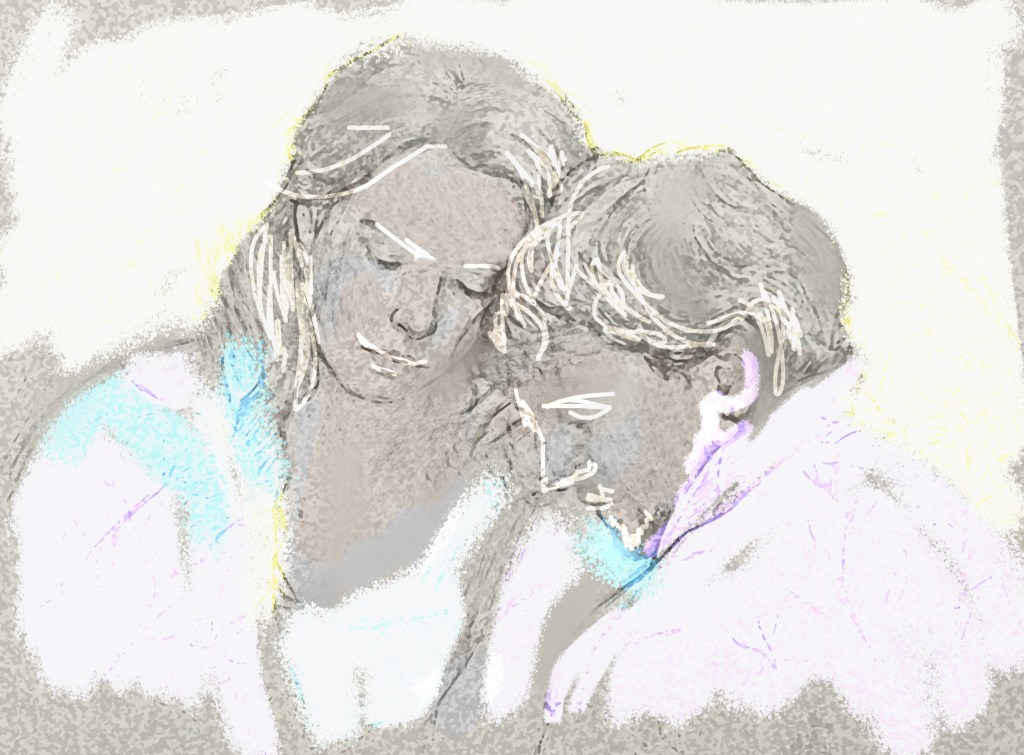
Artwork by Guido Maza (2026)
Despite robust fan-fare and pre-emptive award ceremony capture, Chloe Zhao’s Hamnet seems now to be attracting a puzzling yet steady stream of online ire. The range of circumspectly approving discourse and acumen has given way to something more uneasy and polemical. To be sure, this movie has at made its own undeniably steady progress via the collective, critical digestive system. Clearing, with ease, the body critic’s gaping mouth (the festival circuit), it happily found it’s way down the oesophageal tract (staffed critics) and happily into the stomach (general press), without any hiccups (so to speak). But now parts of Hamnet are lodged in the upper (and lower) inte(rnet)stine. It’s at this juncture of attention, which we are now in, that the first glimpses of voyeuristic derision are presenting themselves. Why?
A few hypotheses: the adapted work – Maggie O’Farrel’s 2020 superb novel of the same name – as an international bestseller was sure to become the eventual fodder of online contrarians; there are also the inevitable, febrile eyeballs which trace Paul Mescal’s every sponsorship, not to mention those of Spielberg and Mendes, two of the film’s predominant backers. And yes, one might even yarn some wooly theory about the impending disaster that is Emerald Fenner’s adaptation of Wuthering Heights cross-pollinating Zhao’s innocent, adjacent film with a not insubstantial amount of critical bloodlust for contemporary adapted period dramas. But this is too diplomatic. Disappointment with the film cannot be be explained sincerely, let alone exhaustively, in light of these exogenous, uncontrollable factors. How the film injures itself is what’s key. More specifically, the kicker for Zhao seems to be a feeling, increasingly corroborated by audiences as days go by, of having been quite clumsily force-fed an anticlimactic howl of grief for the sake of it.
The film should be congratulated for going beyond the thematic bounds of previous Shakespeare bio features, indeed for wrenching this subgenre away from remote 20th century sensibilities (‘Shakespeare in Love’ of course, and to a lesser extent Kenneth Branagh’s ‘All is True’.) Jessie Buckley performance as Agnes Shakespeare beautifully honours a character who is the enigmatic anchor of O’Farrell’s novel. By her leave we witness the wonderful, understated first sequences wherein Agnes is simultaneously perturbed and magnetised by a charismatic William (Mescal). The audience is subtly, vicariously borne in to those ‘landscapes’ and ‘spaces’ which she perceives within him via her haptic clairvoyance. But, more widely, this notion of convalescence between physical and internal expanses, spaces and visions (with all the attendant registers of grief, bereavement and wonder that this bestows) is what the film struggles to visualise. That being said, the set design by Alice Felton (whose previous work included 2018’s The Favourite) is nothing short of masterful.
The film’s confident strides in the first 30 minutes are lost by the third (no, not fifth) act. This is not entirely Zhao’s fault but a structural issue with the original novel-text which, in its first part, dovetails majestically between two, separate time-narratives. One can at the same time understand and feel let down by the choice of standard linear framing; it forces negligence of certain characters which O’Farrell develops beautifully in the novel. Mescal looks too permanent over the years. He is never a convincing 18-year-old William. There is no arc to him. It may not be so much his fault as being overshadowed by Buckley’s cleaving performance, but something feels anodyne and stunted, anticlimactic like the film itself. What can perhaps best sum up this feeling by the time the credits roll is the unforgivable late inclusion of the track ‘On the Nature of Daylight’. This was a truly bathetic, Freudian error. Dispelling all the efforts of Buckley, it fully unravels the film’s close as a crass prescription: ‘Cry! Cry! Cry!’.
For all its merits, and there are many, Hamnet is intent to substantiate itself on the enlisted and placated sycophancy of the audience rather than its own potential.
By Toby Carmichael
 The Camera