
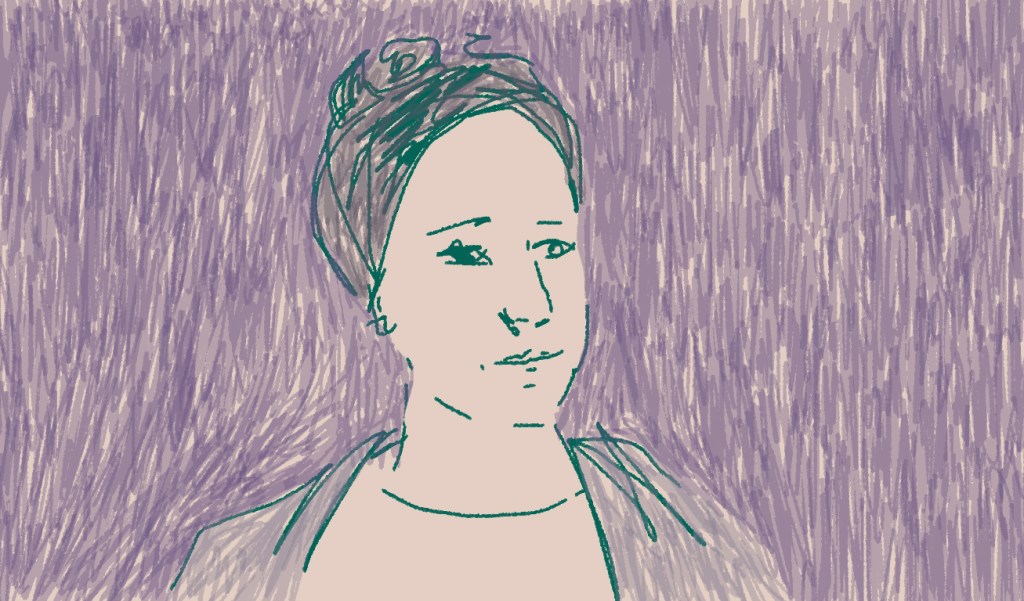
Artwork by Josse Mansilla (2026)
Cambridge weekly essays are miserable. Every Tuesday — my dedicated ‘writing day’ — I wake to the frightful sight of six days’ worth of reading, knowing that within the next few hours all this careful work will be bent and slung into the shape of fifteen-hundred words. It’s a process of intense condensation. For me, an English student, it means selecting one or two quotations to summarise a five-hundred-page novel. It means axing a relevant text because it is ‘outside the time-frame for that paper’. Essays on postmodernism should not touch Laurence Sterne; essays on Chaucer should never encounter Zadie Smith’s adaptation of Chaucer’s Wife of Bath: The Wife of Willesden. It can be frustrating, distancing real-world issues and practicalities from academic work — work that is bound-up in these issues, yet denied the opportunity to explicitly engage with them.
In his essay ‘The Function of Criticism at the Present Time’ (1865), Matthew Arnold reveals the historic moment when academics were more engaged in politics. Arnold complains that ‘our organs of criticism are organs of men and parties having practical ends to serve’. Each academic journal served a different political party: The Quarterly Review, the Tories; The Edinburgh Review, the old Whigs. Such political leanings stifled the true purpose of criticism, which for him was the creation of ‘a current of true and fresh ideas’, ‘disinterested’ in practical concerns. Since then, the academy – and the academic essay – has gone Arnold’s way. Academic success no longer means pandering to a political cause; it means academic specialisation, citations, reputation, publications. What was once the role of criticism and academia — engaging in public debate — has been replaced by popular journalism, television, and social media. The introduction of tuition fees in Britain under the New Labour government before the turn of the millennium — and their rise under subsequent Conservative governments — has further transformed the education system into a business where profit is the motive and students are the product. What was previously an institution of an elite minority, whose role was bound up in the function of society — academics as public servants and commentators — became a marketized, individualistic system. Today, the academy is under attack by right-wing governments, leading to funding cuts and a global crisis in the humanities. Compared with Arnold’s time, the essay carries significantly less weight as a space for public debate.
Zadie Smith’s newest collection of essays, Dead and Alive (October 2025) situates itself in the Arnoldian tradition of debate, moving between popular and academic registers. Smith’s use of the essay form harks back to Montaigne’s notion of the essay as a ‘trial’ for thought, as she juxtaposes the analytical with the anecdotal and the universal with the personal, drawing academic thought into every-day life. Following the success of her previous collections, Changing My Mind (2009) and Feel Free (2018), as well as the Covid-19 collection Intimations (2020), the subjects in Dead and Alive — gen Z, climate change, screen-addiction, ageing — are similarly wide-ranging. Despite the book’s heft and broad subject matter, Smith takes great pains to make the writing as accessible as possible. In the preface she writes: ‘[w]ithin the covers of this book, you have freedom of movement, and this freedom is absolute.’ Her Foreword, ‘On Hospitality’, references her ‘favourite’ philosopher, Jacques Derrida, as she welcomes the reader into the essay collection, quoting Derrida’s theory of openness towards the ‘unknown, anonymous other’.
Art’s accessibility is a theme of the opening essay, ‘European Family’, where a past interview question — why the recent focus on visual arts? — becomes the entry point to the question of practical literary theory: ‘one that considers the realities of women’s lives’. Why visual art? Because of the baby, Smith says, writing of her lunch-break whirls through the Musée du Luxembourg with a child screaming at her chest. It is the only artistic consumption possible for her at the time. This preoccupation with how everyday life coexists with thinking situates the collection in a kind of middle-ground between academia and the media institutions that have come to replace it (one thinks of Benjamin’s famous essays on culture). Smith’s approach is akin to Arnold’s social current of ideas, as she carefully re-introduces a rigorous kind of academic thinking back into mainstream culture, without being partisan, without the doctrine.
In another essay, Smith characterises the artist Celia Paul’s autobiographical work ‘Self-Portrait’ as a ‘gentle intervention’ for young girls seeking validation over self-realisation. Perhaps the same can be said of Smith’s essays, which, in both content and style, gently acquaint the reader with ideas that interrupt previously held assumptions. In one instance she compares the importance of Stormzy’s appearance on the Glastonbury main-stage for the black-British community to that of a sixteenth-century monarch for his countrymen. Describing the stage as a palace and the crowd as supporters, Smith communicates how Stormzy’s place in British culture is far greater than that of just a grime artist. Her way of writing involves a novelistic sleight of hand – the essay’s metaphorical approach is crucial for her argument.
The collection is not without its blind spots, however. Duties to be ‘intellectually rigorous’ can mean that Smith’s more political essays feel slightly out of touch. An essay on Palestine devolves into a critique of university encampments, a baffling concern considering the collection’s thoroughgoing opposition to neo-colonial attitudes. Such evidence perhaps reveals the limits of Smith’s conversational middle-ground, and of the essay form as a vehicle for contemporary socio-political intervention. How useful is the Arnoldian notion of ‘disinterestedness’ for cultural commentators today? In the face of the increasing threat of the far right, is taking a political stance more important now than ever? The political force of the essay, so railed against by Arnold, is not to be surrendered . To be engaged in the currents of the world means knowing when intervention must step beyond its gentle limits. In this way, Smith’s collection functions as a necessary provocation for Cambridge students to step beyond the limits of academic convention and contribute to a broader, more meaningful conversation, employing the essay as a crucial tool for imaginative and finely-judged political and cultural critique.
By Roscoe Marshall
 The Camera