
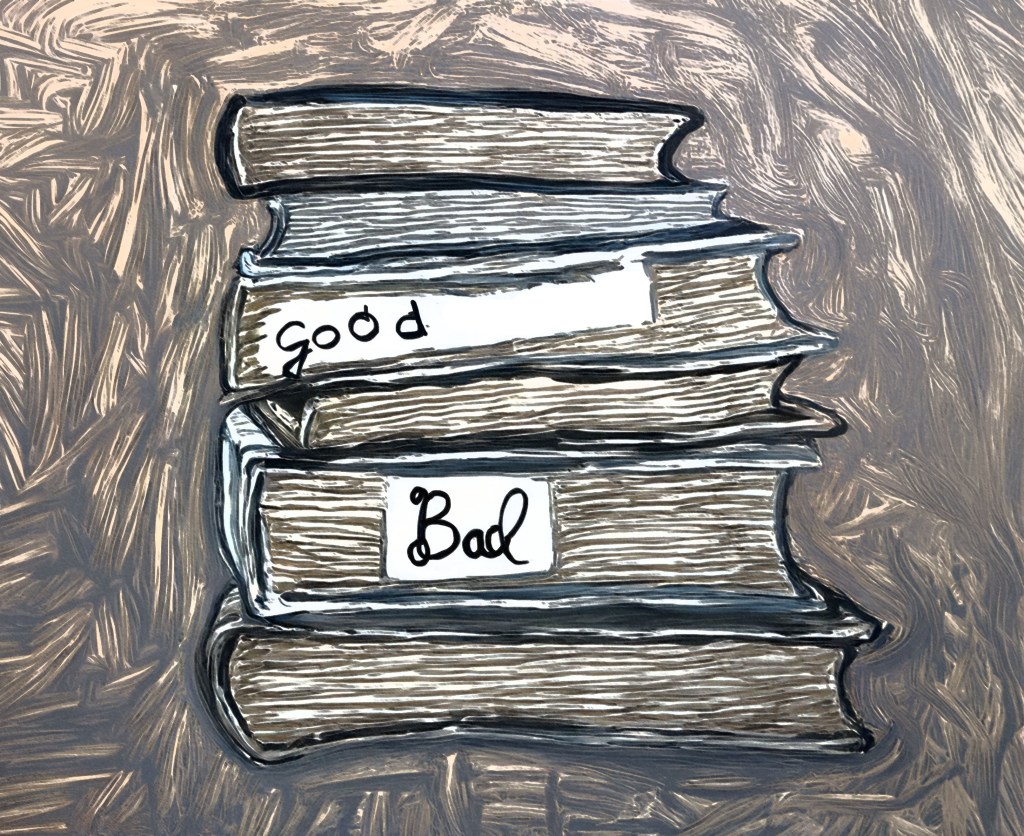
Artwork by Bradley Richards (2026)
Tom Crewe (b.1989) is novelist and contributing editor for the LRB. I first came across Crewe’s work via his short story ‘The Room Service-Waiter’, featured in Granta’s ‘Best of Young British Novelists 2023’, which stood out among that talented cohort for its deftness of style and quiet poignancy. Crewe’s debut novel The New Life, also released in 2023 with Simon and Schuster, won him multiple awards including the Orwell Prize for Political Fiction and the Betty Trask Prize. Crewe zeros in on a particular historical moment in the late nineteenth century where a new, queer way of living – in Crewe’s words, ‘a better and truer way of being’ – is an emergent possibility desired by a network of interwoven characters.
The 2025 Literary Festival brought Tom Crewe to Cambridge to discuss the centenary of Virginia Woolf’s Mrs Dalloway, alongside novelist, poet and screenwriter Megan Hunter and journalist and broadcaster Alex Clark. I met with Tom Crewe at the bar of my local cinema in Cambridge, and, once our half-pints were acquired, we proceeded to have an appropriately meandering discussion about Woolf’s modernist megalith, Crewe’s debut novel, and much, much more.
Jasmine: What’s your relationship to Virginia Woolf and to Mrs Dalloway?
Tom: Well, I think Woolf was and is a liberating force in the Novel. I think she still feels very fresh, and as such it’s possible just to respond to that sense of experiment […] and the possibilities she makes you aware of. I read Jacob’s Room for the first time quite recently and it still breathes […], it comes off the page – this is a writer trying to do something new.
When you see the confidence with which she moves from Jacob’s Room – which is a brilliantly written and interesting but ultimately quite a limited novel – to Mrs Dalloway, how she takes all of those new techniques and expands on them, finding a way of marrying that experimentation with character, with scene, with emotional development, with a sense of history and depth behind the characters, […] I think that’s very inspirational, especially for someone writing a second novel. That sense of ‘this is what you can do next’ I like a lot.
Until agreeing to do this event, I hadn’t actually read any of her novels for years. But I’m always reading her essays. Orlando is really an essay more than it’s a novel. It’s a historical essay. I love her feeling for history and for historical character – or characters in history – but also her feeling for literary history. I love the way she seems so in touch with the literary past. And no matter how much she was trying to do something new in her own moment, she’s never condescending to the writers of the past. She’s fully appreciative of them and fully in tune with them. And that’s something I would endeavour to do myself. I like how at home she feels in the literary past. I think that’s probably what gives her novels their richness that stops them feeling purely like experiments.
J: When I was rereading your novel today, I realised it shares with Mrs. Dalloway that same sense of propulsion, of a character being carried by history and history working through them. That energy is so potent in your book and, as you say, in Mrs Dalloway.
T: Well, I hope that my novel has some fleetness of foot in the same way that Woolf’s does. Partly her example is of when to cut away, of how to find that rhythm, to find that throughline. I hope I’ve taken from her and from other modernist writers that sense of getting rid of the baggage when it feels unnecessary and creating something sparer and more elliptical. I like the modernist sentence, its strange convolutions, its willingness to intensify rather than clarify. To risk a style, I suppose. Reading Mrs Dalloway, her use of semicolons is so strange. She’s always prepared to risk an unusual image or an unexpected word. Her word order is unusual. Her sentences almost seem to work backwards.
So I definitely felt, on the sentence level, I was more influenced by modernist writers. I also think dialogue is really important. Woolf isn’t actually necessarily your prime example here, but someone like Henry Green whose novels are almost entirely dialogue, or Ivy Compton Burnett. That sense of trying to construct scenes mainly through dialogue rather than anything else. Which is almost the antithesis of Woolf, really.
J: There’s a scene in Mrs Dalloway where Clarissa and Peter Walsh fall short of understanding each other without speaking at all. So there’s that absolute economy of language in terms of dialogue, interspersed with entire paragraphs of everything that isn’t being said. All of that description is incredibly emotive, but the dialogue itself is so sparse.
‘She looked at Peter Walsh; her look, passing through all that time and that emotion, reached him doubtfully; settled on him tearfully; and rose and fluttered away, as a bird touches a branch and rises and flutters away. Quite simply she wiped her eyes’.
T: I think she maybe understood this thing, which it took me a long time to become comfortable with, and I feel now I am getting better at it than I was when I wrote this first book, of just leaving it up to the reader. Learning to trust the reader or to trust that the reader will develop the image in their own head even if you don’t show it.
J: The TLS paraphrased Edmund Voss in their review of your book, describing it as ‘a study of two temperaments and two consciences, each a product of late Victorian age’. This struck me in relation to our discussion, given that both your novel and Mrs Dalloway have a similar kind of movement, alternating between the perspectives of two protagonists. Formally, the divisions between your characters are of course much heavier than Woolf’s, and yet…
T: Yes, I hadn’t thought about that. She is so good at that movement. And it’s something I feel like the structure of my first novel didn’t really allow for. […] What I so admire in her and hope to be doing more of [in my own work] is that ability for the prose to naturally leap between characters, between perspectives.
J: And even a sort of intersubjectivity, as with Peter Walsh and Clarissa?
T: Yes, exactly. I wanted my two main characters to be in this sort of dialectic or to be always reflecting on each other and when they’re writing to each other in the novel. The letters are just one mode of seeing this interaction between them and maybe the least revealing. So yeah we’re both doing that. I suppose I’m sure she does it much better.
J: The next question comes from a friend of mine, who wonders if Woolf might be the unfortunate ancestor of what she describes as the ‘vapid bourgeoise stylishness’ of some contemporary literary fiction? So my question is, generally, how do modernist stylistics influence contemporary literary fiction? And is that for good or for bad?
T: Well, I think I agree that it probably is that influence working its way through this sense of dispensing with all the accoutrement of the traditional Victorian novel and framing in what seems to be very Whiggish terms. That the modernist novel is progress, […] and anything that happened previously is reactionary and conservative, makes no sense to me as a way of thinking about literature. I just wouldn’t think that you would say one form was better than another […] or that some hybrid wasn’t actually a preferable way of doing it, or that the whole thing should be about freedom.
I’m thinking of Rachel Cusk, for example, saying she was just suddenly sick of character, or Knausgaard suddenly saying he’s sick of character, or sick of the apparatus, which is similar to Woolf saying she wants to strip everything right down, with a book like The Waves, to voice, to ‘pure poetry’. And why try? Why should the novel […] attempt to ape life’s mundanities. When it’s not that. It’s poetry. It’s a different form and it should aspire to this kind of intensity. And so I’m sure that’s at the root of much of that stripping everything back to voice or this very internalised, very ruminative, essayistic novel where people are really pondering life.
So maybe, unfortunately, she’s birthed that, but I don’t think that’s a fair assessment of her own writing. Because, as I said earlier, I think that she never lost touch with that sense of what the past could give her. In her best books she maintained that sense of human richness and connection and of being alive to the world’s beauties. Part of the reason Mrs Dalloway is so joyful to read is because it’s so alive to the interest of the streets and the city. The minutiae of daily life, elevated. But also, I think, rereading it, the relationships are very well drawn and as I said earlier these characters have their pasts stretching behind them or in fact encompassing them. They are enmeshed in relationships going forward and sideways and back in time.
So I don’t think that [vapid bourgeoise stylishness] is what Woolf was like at all. And in general I would say that I am much in favour of character and plot and relationships and of the kind of psychological density in the novel. I am not personally very satisfied by novels which try to do without those things.
J: What do you think about historical fiction? People say that this [taps Tom Crewe’s book] is a historical novel. Maybe someone might even say, ‘I like Sarah Waters, she did a Victorian PhD and she wrote a bunch of lesbian novels. Maybe Tom Crewe is the same’. What would you say to that?
T: Well, I like Sarah Waters a lot. And I would be very happy with that comparison because I think she has, first of all, paved the way, but also offered a model of a novel that has transcended genre categories, which I don’t think are worth anything anyway. She brought in the gay experience and made it seem a natural subject of a best-selling, prize-winning novel, and it’s easy to forget how unlikely that seemed even twenty years ago.
I don’t like the phrase historical fiction because I don’t see myself as writing something called that. I see myself as writing a novel that is trying to be the best novel it can be. I ultimately believe in good books and bad books. And I think obviously some books are more tied to genre structures or objectives or traditions than others. But I would imagine that the closer you follow those kinds of things, the more limited your book will be. And therefore you can write a book whose subject is historical or crime or whatever. But if it is a truly original, successful, sophisticated book, then it will be literature.
I just don’t recognise it as something I’m doing, it’s just too enormous. I mean, all human history? Any novels set at any historical period all linked together and put on the same shelf and told they have something in common? And meanwhile, literary fiction, I mean, what a meaningless concept!
J: Okay, so, in sum: form is good. The constraints of genre, on the other hand, feel a confining imposition. Can I ask you a couple more questions?
T: Yeah.
J: Thoughts on snobbery? Woolf wrote an essay on snobbery, or being a snob in 1936, I think. So then there’s just a broader question about how Woolf’s perceived elitism or indeed socialism or indeed anti-semitism sit with our notionally more egalitarian world? Because your book… well… you’re obviously a socialist.
T: Yes.
J: Me too.
T: [raises fist in air in solidarity]
T: In response to your question, I just don’t… I just don’t care. I just don’t see why you would care. Like, read the books. Critique the books.
That’s what she was and it adds to our understanding of the books, but it doesn’t subtract. It only adds. It can add and add and add, and it should never subtract. If the work is good enough to stand up in our time, and therefore that she stands up in our time, that’s what keeps her in our consciousness. And I don’t see anyone wanting to remove her work.
J: Okay, right, really big question. Do we think about time differently today?
T: I don’t think people have a strong sense of the past in the way that they used to. Literary society or middle-class, university-educated society does not have the depth of historical knowledge or the same sense of familiarity with subjects and characters of the past that Woolf’s generation did for all sorts of reasons. It strikes me a lot that very well educated people don’t really know anything about history at all. And I just think that that would have been incomprehensible to people in a similar situation fifty years ago.
Something has switched, some sense of what we choose to pass down has changed: what we prioritise, what we think is interesting and useful. I do wonder whether many writers in my own generation read especially deeply about the literature of the past. And the familiarity that Woolf, for example, had with the writers of the seventeenth, eighteenth and nineteenth centuries, […] I doubt many people have that anymore. And it’s something I hope I have, or at least I’m trying to have. Though I feel I can only really achieve that by not reading anything created in my own moment. […] But I do think probably as a rule, writers read too much of people of their own generation.
J: Okay, last one. When did you last spend half a day just wandering through London and where did you go?
T: Well, I mean every day I spend about an hour walking through Regent’s Park which is very invigorating. I find it very good for writing; I eventually had to re-class it as writing time, otherwise I felt like I would put off doing it but actually when I go for a walk I normally fix all the problems. I used to think, ‘no, I have to stay in my chair to work out what’s wrong and solve it and get the paragraph finished’. And then I realised that that didn’t produce the paragraph, whereas if I went off for a walk then I would. But I also just love that sense of being out in the park and seeing what’s going on. I like walking between some of my favourite bookshops.
J: What are your favourite bookshops?
T: A lot of the bookshops are just particularly good Oxfams and that kind of thing. There’s a good Oxfam in Bloomsbury near the LRB office on New Oxford Street, […] and there’s Skoob Books. But I think maybe the best bookshop is Walden Books in Kentish Town. So an ideal day would be walking between bookshops.
J: That’s nice. Cool. Thanks so much for speaking to me. Oh, just one more. Would you rather be Clarissa Dalloway or Leopold Bloom?
T: Well, this is my dark secret. Because I’ve never read Ulysses.
J: No, me neither. An old professor of mine told me to ask you that. I don’t think he’s read it either.
T: I am going to read it really soon. I can’t go on any longer. But you know when the more you leave it […] the greater the significance. It’s that unhelpful thing when part of you resists. It’s somehow easier not to have read it or not to have to engage with it.
J: Why don’t you read all of Proust instead?
T: I have read all of Proust.
J: Well, then you’ve got to read Ulysses.
T: I know. It’s silly. Ask me that question for the year and I’ll give you an answer.
J: Yeah! I will!
By Jasmine Webster
 The Camera