
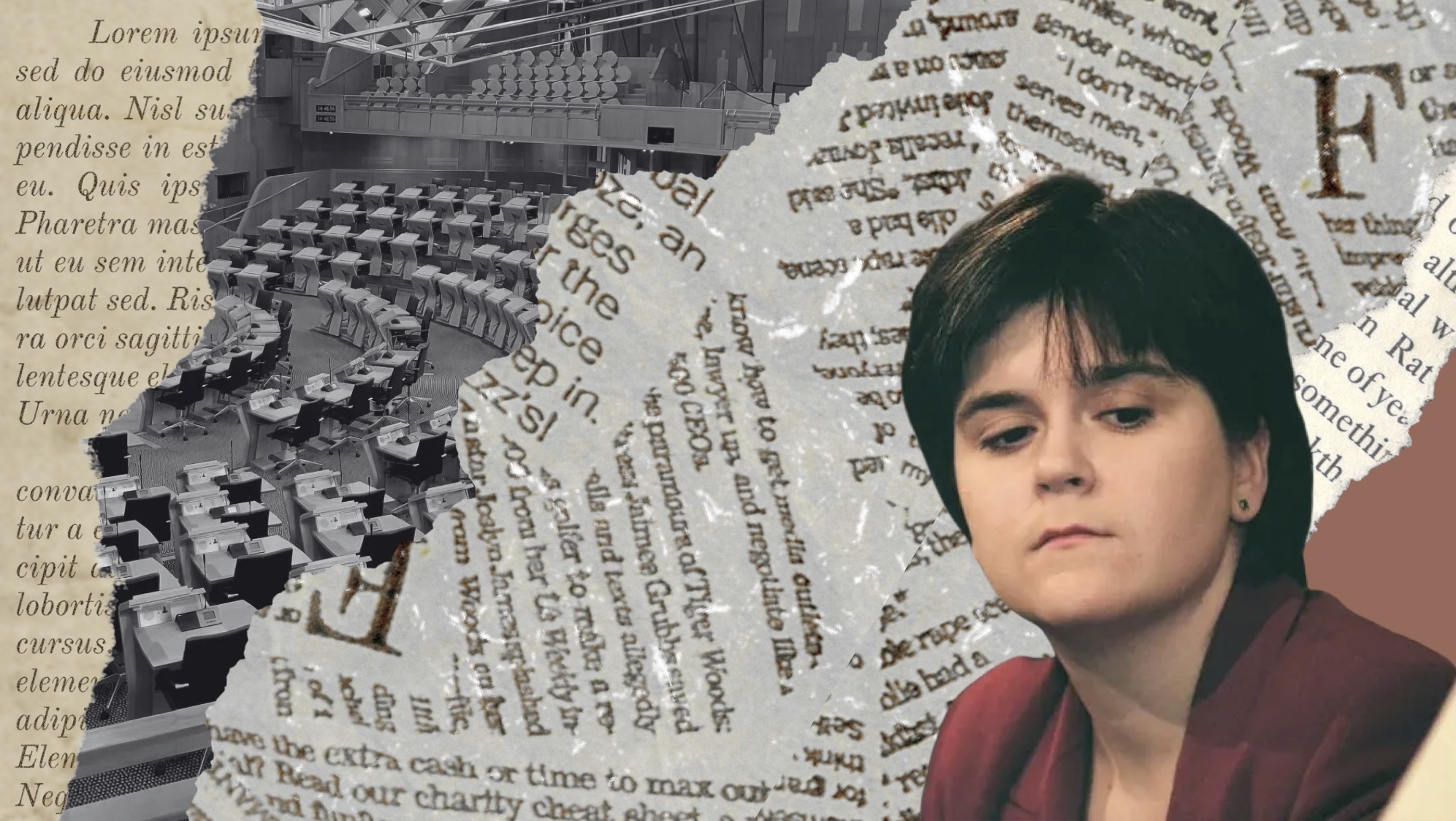
Artwork by Pia Blondel (2025)
In September 2014, Nicola Sturgeon stood at the centre of one of the most consequential political moments in modern Scottish history. The independence referendum, held after years of mobilisation and debate, ended in defeat, with a slim majority (55%) voting to remain in the United Kingdom. For many politicians, such a loss might have marked the beginning of a retreat. For Sturgeon, it became the prelude to leadership.
Cut to November 2025. I am waiting to interview the former First Minister of Scotland at the Cambridge Union, where she has come to speak about her newly published memoir, Frankly. Around me, attendees queue under the Union’s lights, programmes folded under their arms. The atmosphere is measured, almost studious. When her publicist approaches to apologise for the delay and asks whether a brief discussion with Sturgeon is okay, there is no question of saying no.
Elected to the Scottish Parliament in its inaugural term in 1999, Sturgeon went on to serve as First Minister from 2014 until 2023, becoming the longest-serving holder of the office and one of the most recognisable political figures in contemporary Britain. Across nearly three decades in frontline politics, she presided over the aftermath of the independence referendum, successive elections, the Brexit years and the COVID-19 pandemic, shaping a leadership style often defined by discipline, clarity and a meticulous attention to detail.
Yet it is not policy or constitutional strategy that Sturgeon wants to foreground in her memoir. Frankly offers a strikingly personal account of her life, her political decisions and her abrupt resignation in 2023 from both her position as First Minister of Scotland and leader of the Scottish National Party. It is with this in mind that I ask what made this the right moment to write it.
“It is a transition point in my career and in my life,” Sturgeon explains. “I’m about to step down from Parliament after 27 years, I’ve departed government office and I’m moving into a different phase. So it seemed like the right moment to put my story into my words.” Having lived and led through what she describes as “some really momentous events in modern Scottish history,” she wanted to mark a bridge between what has been and what might come next.
The book is unusually candid for a political memoir, a genre for which Sturgeon is not particularly fond. “I’m not a big fan of political memoirs because I find they tend to be quite self-serving and quite dry,” she shares, “I don’t find them particularly illuminating so I wanted to write something different. I set out with the intention of being quite open and personal.”
Did she surprise herself with how much she revealed? She smiles slightly, “Once I got into the swing of it, I probably ended up going further in that direction than I might have thought.”
Literature, she explains, has always been central to her life, not just as an escape but as a formative force. When asked which books shaped her most, she hesitates, admitting it is a question she answers differently every time. Still, one novel stands out.
“Sunset Song is probably my favourite book of all time,” she notes, referencing Lewis Grassic Gibbon’s novel set in north-east Scotland during the First World War. “I’d always loved stories but that book gave me a real appreciation of just how language can educate, entertain and really move you.”
Her reading, she adds, has always crossed genres and periods: from Walter Scott to Robert Louis Stevenson, the Brontës, Jane Austen and contemporary writers such as Ali Smith, whom she describes as “one of the greatest living writers,” as the author comes into the room to greet us.
This lifelong relationship with fiction, Nicola believes, has political consequences. When I ask whether leaders might make different decisions if they read more literature, her answer is immediate.
“I do actually,” she shares. “If I could change one rule for the whole world, it would be that reading literature, reading fiction, would be a qualification for holding high political office.”
Fiction, she argues, deepens empathy and the ability to relate to people from lives radically different from one’s own. “The world would be a better place if more leaders were readers.”
Now, having closed one of the most prominent chapters in modern Scottish politics, Nicola finds herself contemplating what comes next. “I’m a little bit like a kid in a toy shop,” she admits, conscious of the need not to grasp at every shiny opportunity that presents itself. Writing remains central to her future plans, including, she hopes, writing a novel, alongside continued engagement with causes she cares deeply about, from gender equality to climate change and opportunities for young people.
Yet when asked what she ultimately hopes readers take from her memoir, her answer is strikingly simple.
“I’m a fairly shy, introverted, working-class girl who ended up leading my country. If I persuade even one young woman to believe that she can follow her dreams and fulfil whatever she wants to do in life, then that will make me happy.”
By Pia Blondel
 The Camera