
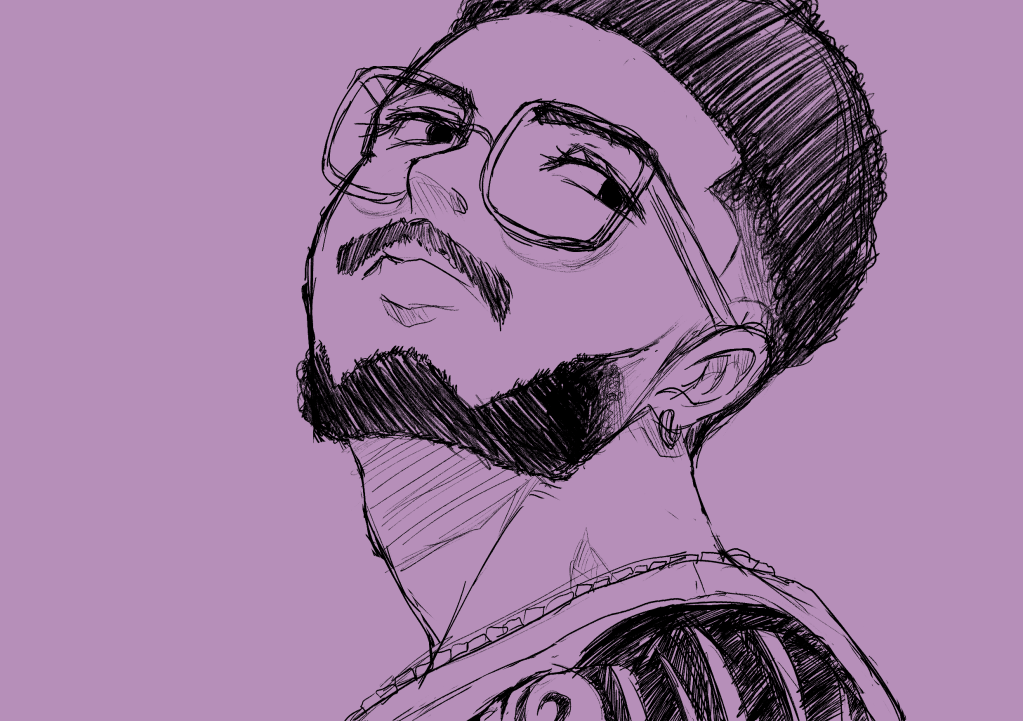
Artwork by Xavier Oladuti (2026)
Bryson Tiller, a.k.a Pen Griffey (or Slum Tiller) is an American ‘singer who raps’ hailing from Louisville, Kentucky. He is principally known for his 2015 debut album, Trapsoul, which is his most commercially successful and acclaimed album (the initial sour reviews notwithstanding). Trapsoul is regarded today as a landmark album for the modern fusion of trap and R&B, though the blend traces its roots back to the Toronto sound – an atmospheric, sonically dark R&B popularised by the likes of Drake, The Weeknd, and PARTYNEXTDOOR. In the years since its release, Tiller has struggled with his mental health — a result, he claims, of the internal and external pressure of being perceived as a one-hit-wonder. Regardless, he has persevered, averaging an album every other year for a decade despite generally mixed reviews. And so, with the recent release of his fifth studio album in 2025, it begs the question: where does Tiller find himself mentally and musically today?
Solace & The Vices is a staggered double-album release, with the rap-heavy The Vices on August 8th, followed by the deliciously R&B-infused Solace on October 2nd. The Vices is a decent enough trap showing, with some featured artists from the South contributing guest verses of varied quality. Other than praising the melodic highlights in tracks like ‘More than Money’ and ‘Last Call’, or the atmosphere and flows on ‘Mini Kelly (feat. Rick Ross)’ and ‘On My Way’, there really isn’t much else to say about The Vices. It is mostly comprised of surface-level flex bars and well-produced, standard rap and trap music. It’s worth noting that there is an undercurrent of internal discontent running beneath the braggadocio, though this is suggested more by the disc’s title than by the music itself. However, this theme manages to cut through the music at times, with lyrics like “Hangin’ on threads, baby, just let me drop, don’t cut me down” from ‘On My Way’, clearly demonstrating Tiller’s awareness of how unsustainable his prior lifestyle was. It’s a condemnation of the all-too-common rapper lifestyle of his past, but Tiller clearly had a lot of fun making it.
It was only with the release of Solace that we were finally blessed with some classic Tiller.Trapsoul, Anniversary, and Solace are the (two-and-a-half) albums that define Bryson Tiller’s personal progression. They were all released on October 2nd, with 5 years between each of them. They even don similar album art, with the signature T R A P S O U L styling. Though the art for Anniversary is almost literally a reflection of Trapsoul’s, Solace clearly breaks away from that trend, bar the continuation of the font.Indeed, unlike Trapsoul and Anniversary respectively, Tiller isn’t looking forwards or backwards, but rather living in the moment.
Trapsoul is about needing it, Anniversary is about keeping it, and Solace is about accepting it, whatever form it takes. I suppose the ‘it’ is, simply, stardom: the accolades, the fame, the respect (and lack thereof). Despite Tiller ‘doing him’ in recent years, such as releasing his Christmas EP in 2021, titled A Different Christmas, Solace really distils what shall characterise this third era of Bryson Tiller: treating music as therapy. He describes this connection to music in his Zane Lowe interview, released on September 30th. Since recording Solace & The Vices, Bryson Tiller has been sober, and he’s loving the clarity that comes with this. In fact, he states in the interview that, after seven years, he’s finally recommenced working on his fans’ long-awaited album: Serenity.
Solace sounds great. It has lovely production, great vocal performances, and generally tight songwriting. There are so many memorable moments to choose from, be it the vocal runs on ‘Autumn Drive’, the entirety of ‘Workaholic’ and ‘Star Signs’, the sweet falsetto intro from ‘I Need Her’, the choral harmonies in ‘Genuine’ and ‘Uncertainty’, or the tenderness of ‘Sick Interlude’ and ‘Harley’s Outro’. It’s sweet to hear how Tiller’s daughter, Harley, being his biggest fan pushes him forwards to this day. Solace sounds vulnerable, honest, and like the work of an artist who is finally ready to stop dwelling on the past. It has a strangely feel-good quality, perhaps aided by the much larger proportion of tracks in a major key and a theme of reflection without overtly negative framing, in comparison to Anniversary, for instance. Autumn vibes aplenty.
Between Trapsoul and Solace, there are some direct comparisons to be drawn. For instance, the difference in perspectives between multi-platinum hit ‘Don’t’ from Trapsoul and ‘Damn’ from Solace. They are both songs about Tiller feeling like an inadequate partner, but with different framing. ‘Don’t’ is written from the perspective of an admirer waiting for his chance, warning Tiller with pointed lyrics such as “Don’t play with her, don’t be dishonest.” However, ‘Damn’ is written from Tiller’s perspective with lyrics like “How do he take my bitch? Probably ‘cause a nigga ain’t shit.” There is a clear contrast between how much Tiller exposes himself between 2015 and 2025, choosing now to speak for himself and truly accept his shortcomings as a partner, perceived or otherwise. Furthermore, there is contrast in both written and sonic tone. ‘Damn’ is written in a matter-of-fact way, as opposed to the ubiquitous melancholy in ‘Don’t’. And, ‘Damn’ is performed with a fairly flat vocal tone, versus the much more emotive performance on ‘Don’t’, portraying acceptance and growth.
Anniversary and Solace are easier to compare thematically. Anniversary feels like Tiller is asking for permission to be a star again, whereas Solace feels like he’s venting his grievances with success from a therapist’s chaise lounge. For instance, in the track ‘Inhale’ off Anniversary, Tiller croons “Yes, I spent all these fuckin’ years dwellin’, yes, I feel irrelevant.” Conversely, on ‘Sick Interlude’, he confesses, “I’m sick of not being invited.” The sharper, more candid lyrics, demonstrate Tiller’s mental clarity, growth, and acknowledgment of the industry underappreciation that led to his feelings of irrelevancy over the years.
The singer’s heightened vulnerability is also a sign of the times. Over the last decade, alternative R&B for men has become the new normal, with female singers dominating the genre across the board, as male singers operate solely within the alternative space (with partial exceptions such as Giveon and Lucky Daye). The lines between hip hop and R&B, particularly for men, are blurred into obscurity in the present day. Further, emotional honesty is at a 21st century high. Tiller’s fifth LP slots firmly into the state of the art as a nice addition, though not a redefinition. It’s gratifying to see that the art form, to which he has given so much, is finally returning the favour – carving out space for Tiller’s candid musical dialogue with himself.
He’s back, and he’s better. Tiller speaks openly about how well he’s doing. With his own video game, Brutal Industry, set to portray the difficulties of the entertainment biz on the way, after returning to high school to earn a diploma in 2020, it’s a pleasure to witness him flourish while we eagerly await Serenity.
It appears Tiller has finally achieved the goal which he stated outright at the end of the disc one opener: “No more strife…”
By Antonio Oladuti
 The Camera