
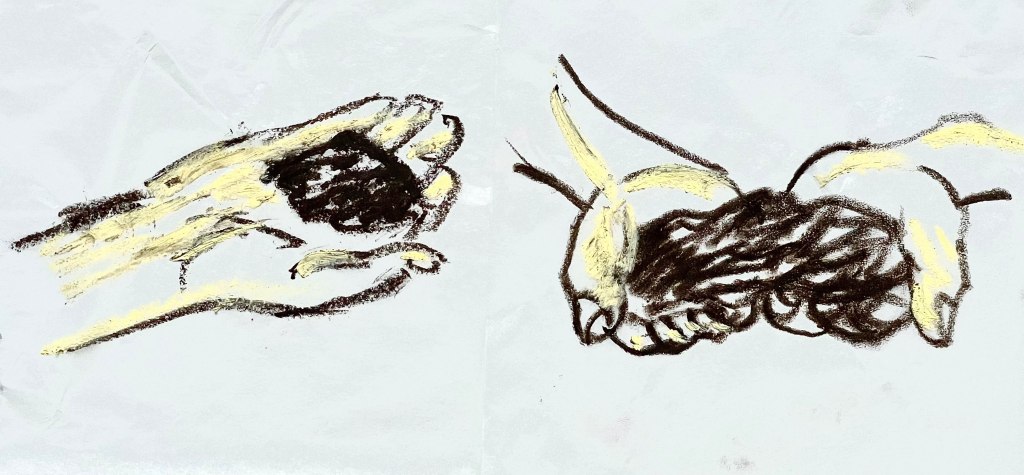
Artwork by Kevin Lim
It began, for Ania Ready, with a small sheet of paper. ‘There was a discovery made fairly recently’, she explains to me over Zoom, recalling how a historian, Dr. Myfanwy Lloyd, came upon a ‘folded up paper note in the archive of soldier, Arthur Tyler’. Tyler had been part of the Oxfordshire Yeomanry that liberated Bergen-Belsen in April 1945. Written on this note was a collage of scribblings, including several addresses that had been shared by liberated prisoners who sought to tell family members that they had survived. One of these addresses belonged to a man in Houston, Texas. This was the uncle of Naomi Warren (née Kaplan), a Polish Jewish woman who had survived Bergen-Belsen along with two other concentration camps.
Contextualising her recent exhibition, Life Lines (2025), first shown at the Soldiers of Oxfordshire Museum in Woodstock, Ready elaborates how Tyler kept his promise to Warren and wrote to this uncle in America. After this, Warren’s uncle sent care packages to Bergen-Belsen, which remained a camp for displaced individuals for some time after its initial liberation. Eventually, with the help of this uncle, Warren made her way from Germany to the United States as one of the first Holocaust survivors to receive a US visa. Pulling into one of the maritime ports in New York, Ready notes how Warren recalled seeing the Statue of Liberty and thinking that she could finally start anew. ‘This story was very moving to me’, Ready explains, noting resonances between Warren’s story and her own childhood in Poland decades later during a period of national post-war renewal that had a profound bearing on individual lives: through the stories of parents and grandparents, for example, who had endured the atrocities of war first-hand.
It is the movement within Warren’s post-war story—that which began with the passing of a folded address from one hand to another—that initially prompted the development of Life Lines. At the beginning, Ready’s interest centered on what Warren herself repeatedly emphasised: that both survival and flourishing in life depend on the development of networks, in conducive conditions of growth and opportunity and in those of injustice and brutality alike. Referring to the concentration camps, Warren ‘often mentioned the importance of the “network”’, Ready notes. ‘The importance of having people around, of having friends, making friendships even in the hardest possible places like concentration camps. In the camps, the network was literally a means of survival’.
This emphasis on connection is reflected in the months Ready spent researching Warren’s story with a small group of artists assembled by the Soldiers of Oxfordshire Museum as well in the subsequent development of the exhibition. ‘There was a musician, there was an actor,’ she says, ‘we specialise in different types of media […] and also have different heritages’. Over three sessions, what developed between these individuals was both a working group and a shared attentiveness to Warren’s story of survival, to each other, and to the question that presented itself powerfully in Ready’s mind as she began to ideate what would later become Life Lines: ‘how can you map a life?’
Ready’s map initially emerged through a web of requests—emails, phone-calls, and favours—extending through her own network and beyond, as she asked for soil samples from the places that had shaped Warren’s story. Some of these arrived easily, and others appeared by way of circuitous, nearly impossible routes. The sample from Wołkowysk, Warren’s birthplace—once part of Poland but now within Belarus—proved the most difficult to obtain. ‘Poland and Belarus are quite sealed from each other’, Ready says. ‘Also, there are huge political tensions […] relating to war in Ukraine and the migration crisis. My email was blocked when I tried to reach out to a local factory to obtain soil from near where Naomi grew up’.
Despite this, the soil found its way to Ready, passed from hand-to-hand much like Tyler’s note had been. A colleague attending a conference in Houston stopped to gather a handful from outside Warren’s former home. Friends of friends collected soil from the railway station in Poland where Warren had met her first husband who died during the war (‘there was all sorts of residue, including a cigarette butt’). Bergen-Belsen’s soil arrived unexpectedly rich and healthy: the camp was eventually burned down following a typhoid outbreak, after which a now-verdant forest grew in its place. ‘Each soil imprint became almost a symbol of Warren’s story and of the history of what materially goes into, or happens upon, soil and stays in it forever’.
Remaining with the concept of the network, the installation and first part of the Life Lines exhibition that grew from these samples, ‘Naomi – A Life Line’, invited viewers not only to observe but to touch the soil. Small containers of each sample sat in front of folded paper notes—echoing Tyler’s—each inscribed with relevant fragments of Warren’s biography and the means by which the soil had travelled into Ready’s hands. ‘I wanted to bring something really tactile to the viewers’, she says, ‘something that would help create a physical connection with Naomi’s story’.
For Ready, this tactility was not just a stylistic flourish. She tells me that she has qualms with straightforward, documentary exhibition of experiences of the Holocaust in artistic contexts. While studying the Bergen-Belsen archives, it became clear to her that there was an element of managed curation, artificiality, or even the aestheticisation of suffering within them. ‘The camera’, for example, ‘became an intruder at times’ as it captured the survivors of Bergen-Belsen. Touch, by contrast, allowed for a different kind of artistic encounter: one that was slower and less extractive, as engaging with the exhibited object became a stimulus for reflection, not passive observation. ‘I wanted to approach the exhibition in a humane way, an exploratory way so that viewers could discover and learn things for themselves’. ‘Traces’, the next part of the exhibition, extended this reflective process by presenting the viewer with chromatographs of each soil sample on light-sensitive paper. Each differing in colour, quality, and shape—much like the soil samples themselves—Ready describes the display as a metaphor for nature as a silent witness to history, holding onto the traces of human presence long after events have passed.
This tactile and non-documentary approach resonates with Ready’s broader artistic practice, which brings together photography, archival material and cameraless techniques to explore underrepresented histories. As part of this, her body of work demonstrates a particular attention to women’s experiences—female mental health, for example, and experiences of structural inequity—as well as the ways in which personal and collective memory take material form. Collaborating with museums and historical collections, Ready typically responds to archival materials to stage contemporary encounters with the past that interrogate issues of agency, displacement and belonging.
Important to Ready and her development of Life Lines in particular was the acknowledgement that, despite the scale of the trauma she endured, Warren’s life was ultimately one of renewal. ‘One thing that I wanted to emphasise, aside from all this hardship and suffering, is the fact that Naomi’s story is also one of renewal and rejuvenation’. After arriving in Houston, Warren remarried, raised three children, ran an import business in a male-dominated industry, and later became a key figure in establishing the Holocaust Museum Houston. ‘Emotionally and psychologically, Naomi moved on’, Ready says. ‘She was and wanted to be much more than a survivor’.
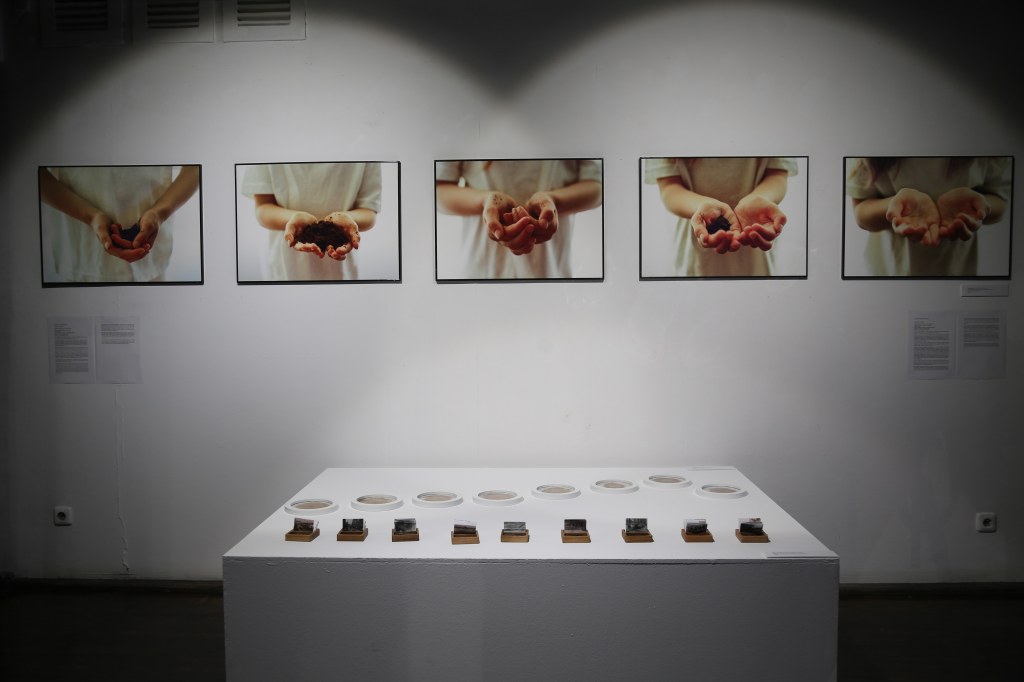
Installation view of exhibition by Ania Ready. Courtesy of Wozownia Art Gallery, Poland.
It is here that Ready’s own life and experiences begin to inform the exhibition more directly. When I ask her about ‘From Her Mother’s Country’, a section of Life Lines that exhibits Ready’s five-year-old daughter, Mimi, holding the soil samples, she describes another kind of network: the complicated and evolving lines of heritage, language and culture that both bind and separate her from Warren’s story. Elaborating on this point, she refers to the fact that, before the war, Warren had been in Warsaw preparing to move to England to study—an ambition cut short by the German invasion of Poland in 1939. ‘This ambition… reminded me of my own story: I moved from the north of Poland, where I grew up, to Warsaw after university. Later, I moved to the UK. I sort of made the passage that Naomi couldn’t’. This was an opportunity afforded by Ready’s different circumstances: the redevelopment of Europe in the decades post-war, Poland’s late twentieth-century independence from the USSR, a global culture of movement and exchange that seemed to bloom earlier this century.
Born during lockdown, Mimi grew up without the multi-cultural and linguistic texture that Ready’s older daughters knew. At that time, ‘we slipped almost entirely into speaking English because it felt more efficient’, she says. ‘Mimi didn’t really encounter Polish at all… now she finds it difficult when she hears me speak Polish to anyone’. Like for the viewers of Life Lines, Ready wanted to create, through touch, a bridge between her daughter and the land that she herself had left. ‘I was curious what it would mean for Mimi to hold that soil’, Ready notes: how she would respond to a material trace of a history she has inherited as opposed to lived. In several of the images, Mimi’s hands are shown cradling the soil, but in the last, they are cupped and empty. ‘For me, that emptiness echoes what happened during lockdown—the way our connection to Poland became so fragile, almost slipping away—and it also gestures to the ruptures and missed passages that shaped Naomi’s life’.
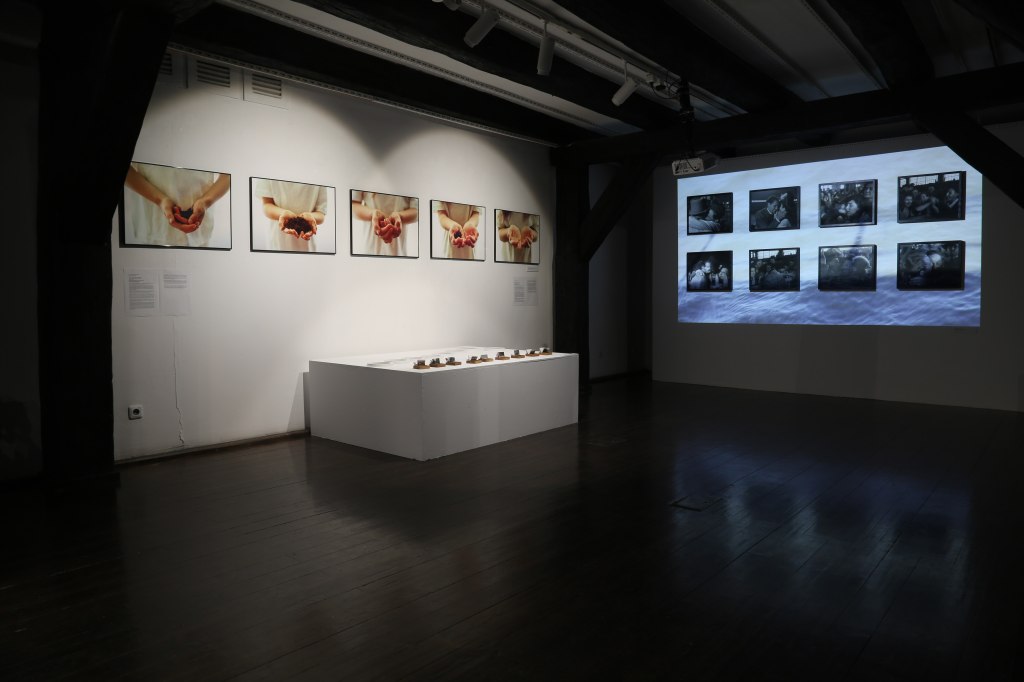
Installation view of exhibition by Ania Ready. Courtesy of Wozownia Art Gallery, Poland.

Installation view of exhibition by Ania Ready. Courtesy of Wozownia Art Gallery, Poland.
The two final sections of Life Lines widen Ready’s lens from the personal to the collective. ‘Reunions’ draws on archival film footage from 1946: silent scenes of families from Europe meeting on American docks—similar to Warren’s experience—their gestures, first tentative, then overflowing with joy after years of fear and separation. Ready pairs these frames with her own projections of water and shadow-bodies in motion, encouraging the viewer to apprehend the tide of history as it encroaches on every moment as it happens. ‘Imprints on Water’ develops this further. Photographs of refugees are suspended on the surface of gently moving water, presented alongside a poem by the Jewish writer Irit Amiel. The photographs drift and waver on the water, which echoes the preciousness of memory and connection. Following the photographs of Mimi’s hands with the soil, these closing pieces indicate that renewal is neither straightforward nor infallible. Rather, it is an ongoing process of crossing, reuniting, and being carried forward despite everything that threatens to sever the life line.
Amiel’s poem is very simple, Ready notes: ‘It’s literally a list of family members who were born thanks to the fact that Irit’s father pushed her out of the window of, I think, the Jewish ghetto when she was a child and she survived… It’s a beautiful poem and it fits nicely with Naomi’s story. There’s a very moving photograph I remember seeing of her sitting alongside her daughters, and then her granddaughters, and then her great-granddaughters. In this image, it becomes clear suddenly that thanks to the simple fact that Naomi survived the Holocaust, this entire family continued, grew, and continues’. The poem, like this image, and like Ready’s exhibition, rests on the simple yet powerful point that our lives are held together by networks of relation that both intersect with and are informed by the stories, displacements and inherited memories through which history takes shape in the present.
By Caitlin Kawalek
 The Camera