
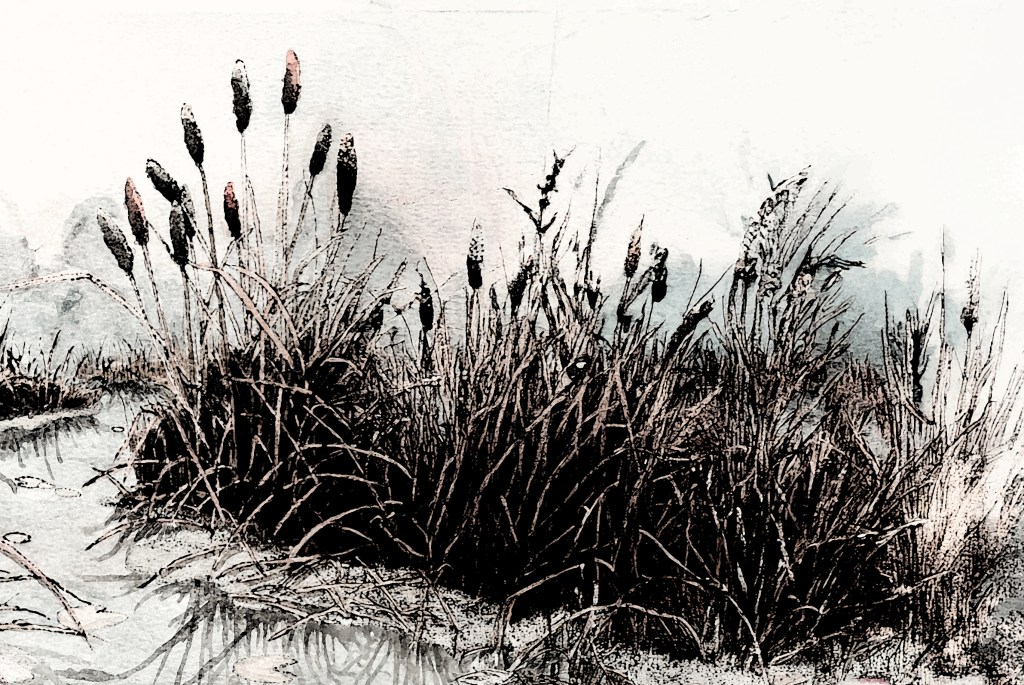
Artwork by Steven Mardones (2025)
Bonnie Lander Johnson’s Vanishing Landscapes: The Story of Plants and How We Lost Them (Hodder Press, 2025) explores the histories of seven plants in Britain – apples, saffron, woad, reeds, oak, grapes and wheat. The book documents Bonnie’s conversations with people who keep traditional, local techniques of working with plants alive alongside an account of Britain’s political and economic history from the medieval to the early modern period. It shows how our relationship with the natural world has changed over time, what cultural practices we have lost and why, and how we might use this local knowledge and ethics of care to rethink our relationship with plants and living things at a time of ecological crisis.
George: Each chapter of Vanishing Landscapes is structured around a meeting with someone who has kept alive local knowledge concerning traditional forms of agricultural labour. This knowledge, once known to all, has been lost in the globalising process of modernity. How does the book seek to share a small part of this knowledge with its readers?
Bonnie: I suppose my instinct for putting this particular story together was as a historian. I think it’s important to know the steps that we went through culturally, collectively and individually to produce the world that we’re in, which means not just the story of top-down changes but also the story of how we push for change as a collective, however unwittingly or implicitly.
At the same time, I wanted to give readers a feeling of journeying around the country and meeting people who have chosen specifically to leave the urban setting to try and live a life closer to plants within more traditional ways of working. I often find that the general public and students assume that because medieval and early modern commoners were illiterate they were diminished in some way compared to us. I wanted to show that these people lived full lives – they were super smart and even a bit sniffy about the arrogance of the literate who imposed certain theological, philosophical, legalistic and governmental expectations onto commoners. They were a deeply poetic people.
I wanted to capture that old sense of walking inside a landscape in which we are part of its fabric. I think the posthumanism debate has slightly misunderstood medieval and early modern theologies of nature. In this period, human beings worked the land but their aim wasn’t always to dominate nature. At best there was a symbiosis between humans, animals and plants that worked well in the agricultural system, so well that it lasted a long time. Medieval people were suspicious of technology and innovation because they knew that change would mean more for the people above and less for them.
G: The book also contains accounts of various oral histories and stories – such as your aunt’s sighting of the ghost of a peasant in a tree. There’s one point when you walk into a clearing in the woods in Sussex and you offer two different ways of reading the scene. It is ‘The kind of place a fairy might be waiting, if we were in a story. The kind of place a house might be, if we were in real history.’ How does the book navigate between the ‘story’ of learning the craft and the wider political and economic history embedded in each chapter?
B: To a certain extent this book is a fiction because I’m trying to recreate a way of living that the historical record suggests to me was real but which was not recorded. These skills were not written down, they were passed from parent to child as the basic form of living. We instinctively showed the young how to survive and what the rules of the commons were: a set of responsibilities and traditions that was handed down orally for the preservation of the community and the household. So I’m trying to document a way of life that was oral. I think one of my frustrations as an academic was that I couldn’t achieve that within the academic mode of writing. In Botanical Culture and Popular Belief in Shakespeare’s England I did what I could with the academic evidence, but I wanted to be able to depart from the weighing of recorded fact to give readers an idea of what it would have felt like to live as a medieval commoner in the agricultural world.
I suppose in a way you could say the narrative is a bit of a fairy story although it’s not folkloric in the way that those stories operate. The historical evidence came from the archives and that, I suppose, is a standard academic story but summarised to the extent that one wouldn’t consider it an original contribution to the historical record, although I think the argument could be sustained in academic language.
G: The book’s historical and economic history is developed in relation to the conversations with these people. How does talking with them about their ancient ways of working with plants connect to the book’s recovery of a local, oral culture?
B: In a way, you could say there’s a certain irony or even a tragedy to the fact of those two narratives being together. One of the problems I had to grapple with the book concerned nostalgia. As a culture we are really suspicious of nostalgia as a delusion, or a sickness, or an unhelpful lie that we tell ourselves about the past. But nostalgia is also really good for us in the sense that it encourages us to think about the changes involved in how we got here and to decide if we want to undo some of those changes. Nostalgia is part of being a human being, at any time. The medieval people I’m seeking to describe would have experienced nostalgia as well. I suppose I wanted to allow us to dwell in that for a while and not think that it’s a weakness.
G: In the chapter on saffron you mention the medicinal knowledge of rural women who were held in suspicion by the literate, scientific establishment. What was the importance of representing these forms of female knowledge?
B: Because I so often encountered this assumption that the further back in history you go the worse it was for women. I don’t actually think that’s true. The household was the engine of all economic activity for all mediaeval and most early modern people. All industry was rural because that’s where their resources were. Modernity was the moment when urban centres became industrialised. So the household was the place where everyone was multi-skilled – working as brewers, bakers, midwives, doctors and saffron pickers.
We have allowed ourselves to clinicalise and professionalise not just the essential things in modern medicine – like surgery – but all cultures of care. We’ve lost our confidence to birth at home and to look after the dying at home, and that was part of the vast body of knowledge that women – not just women, but women especially – were once respected for. There was dignity, respect and skill in the sheer range of domestic labour. It’s sad that we let a lot of this go. We allowed those cultures of care to be outsourced to the medical industry.
G: How does the book represent care towards the natural world?
B: I found records of villagers who could tell you which beam of their house was taken from which tree, creating a relationship between the architectural space of the house and the topographical space of the wood. Their houses were built in the very woods from which the trees were taken. That sort of close relationship with trees and woodland spaces required a degree of care from everybody within the parish boundaries. That care of the local, of the collective domain, is also something that we’ve given up. We have local neighbourhood councils but it’s not quite the same.
G: Care is linked to the question of wastefulness too, right? Near the end of the book you quote the Irish farmer Eamonn, who says that ‘Those old Irish farmers knew what they were doing. They stayed low to the found and watched the plants, raised each one with care, wasted nothing’. In the chapter on woad, Rowena (who uses local plants to dye wool in the Scottish Highlands) describes how she doesn’t take more than she needs.
B: Yeah, Rowena is very careful now, she doesn’t waste anything. She used to grab armfuls of plants or order them by the kilo and throw out what she didn’t need. Now she lives by the plants and knows their life cycle so she’s very careful about how much she takes – she can see what the plant needs to get through the season.
I was surprised when Eamon said that. He said he got better product by working by hand because on the tractor he was too far from the ground and he couldn’t see what was happening. Walking in the field he can see the state of the soil, the spacing between the plants. He knows what each one needs. That was a revelation to him. He’ll never go back to using a tractor.
G: You mention how these skills – once shared by common people – have become a form of specialised practical knowledge, and that these craftspeople or artisans support themselves by catering to an urban elite. Could you say more about the contradictions of this situation?
B: There’s a certain poetry or irony there. The women in the Highlands who dye local wool rely on selling their product online, especially in America. I found that narrative quite surprising actually – a lot of the people who buy fabrics made in the Highlands are émigrés from the Highland Clearances. That history is more recent and it’s heartbreaking. People living in America today who are disconnected from the history that brought them there still feel an affinity with the Highlands. So these women are able to make a living doing dyeing clothes by hand. Maybe that’s something of a solution. If you’ve been to the Highlands recently, it’s a relatively empty landscape. It would once have been full of people wandering around on the hills with their sheep.
G That makes me think about what Raymond Williams says about an empty landscape – the landscape is not ‘naturally’ empty; it has been emptied deliberately through processes of industrial capitalism. For Williams, ‘the idea of nature contains an extraordinary amount of human history’. What did you learn from recovering the human history of plant use?
B: Medieval people had a word for unharvested woodland – ‘wildwood’ – but it was already imagined. We don’t actually know what the landscape would look like without humans in it. There’s plenty of theories – the whole rewilding conversation is an attempt to try and work out what that might mean, but we have inherited a landscape that is worked. I have issues with environmental arguments that would seek to remove humans. The land needs us. For a long time we had a system that wasn’t perfect but was sustainable. A lot of the rules of the common that I read about were clearly there for sustainability and for sharing – to ensure there was enough for everybody.
G: In the chapter on wheat you write that ‘We try to find words for [soil] but nothing’s quite right’. How did you approach writing about the natural world? What difficulties did you encounter? And how does the writing of the book and its artwork speak to this interest in craftsmanship?
B: It took me a while to find the meditative voice that enabled people to walk inside the feeling of the place. A life lived in the land is tricky to describe. Standing in that field with Pat the farmer, his knowledge of the soil was amazing – he now thinks of the soil as his fifth child. It’s hard to put that knowledge into words – but then I suppose as writers that’s precisely our challenge to evoke or describe something that you wouldn’t otherwise be able to encounter linguistically.
G: Your use of the phrase the ‘old ways’ recalled Robert Macfarlane’s book of the same name. Whereas he’s walking the ancient waterways and pathways through Britain you’re considering ancient ways of making and working with plants. Was that a book you had in mind? Or do any other books lie behind this one? How did Cambridge – the people, the place and its geography – act as a starting-point for the project?
B: In Oxford and Cambridge we are surrounded by the medieval world to a greater extent than in other cities, and we actually have quite a bit of commons left. We still live in medieval cycles – agricultural and liturgical – through the termly structure of the academic year. In the middle ages the long summer was spent working at the harvest. Then we would come up and study for eight weeks, and then there would be work to be done at Christmas time. Christmas is when the butchering happens because it’s cold and hygienic. It’s still a pattern that structures our lives. We still have these moments of rest that would have been marked by agricultural labour.
In Cambridge, I really got into the history of the fens. I think you have to make an effort if you’re not from the fens to appreciate the flatness and learn about the history. That’s how I fell in love with the landscape here. I think there is a lively conversation around ecopoetics in Cambridge. I guess if I’m frank I think there’s a masculinism to Rob’s work – I wanted to offer a female perspective. A lot of nature writing has the sense of a muscular protection of nature, so I wanted something that spoke a little bit more to our sensibilities.
G: The chapter on grapes ends with a consideration of ‘growing and making as a kind of devotion’, and the book closes with a reflection on the human relationship with plants and living things as a form of ‘communion’. I wanted to ask what is gained by trying to hold onto the divinity of plants? How does this change the way we see them and engage with them?
B: I suppose that comes out of my concern with an environmental advocacy model that sees humans negatively. I believe that all human beings and nature have been made, whichever spiritual or a religious model we think through. There is an animate life in all of matter – life binds us to matter in a way that has a certain divinity. Protestant intellectual innovations introduced empirical approaches to matter that have given us so much, especially in terms of scientific and medical developments. At the same time, these frameworks reinterpreted matter as dangerous, or empty of life or soul. Early medieval theology believed that there was spirit in all matter. This was part of accepting the doctrine of the incarnation. In modern secular society we would interpret this differently, but I think we would all instinctively acknowledge that plants grow and have a life that requires our respect. I think we’ve lost the spiritual dimension of our relationship with the plant world by not working for survival. I think a lot of people would welcome this perspective if they don’t already instinctively see it that way. I suppose my challenge was to try and work out whether these people felt it too.
By George Adams
 The Camera