
Artwork by Elizabeth Murphy (2025)
Wendy Cope in conversation with Alex Clark at the Cambridge Literary Festival, November 2025
Light is falling outside the Cambridge Union. Two large golden chandeliers hang from the ceiling. Rows of leather benches are packed with people, latecomers perch on windowsills. Photographers roam around the crowd’s edges. The clock has stopped at nine thirty-six though it is only four o’clock. We are waiting for Wendy Cope – poet, octogenarian and British national treasure – to arrive. Author of five collections – Making Cocoa for Kingsley Amis (1986), Serious Concerns (1992), If I Don’t Know (2001), Family Values (2011) and Anecdotal Evidence (2018) – Wendy was once tipped by popular vote to become Britain’s first female poet laureate but had no interest in the role (‘I have some sympathy with Kipling’s view that a poet has no business becoming an employee of the state. And, anyway, I prefer a quiet life’).
The event began with Cope reading a selection of her work, including ‘Another Unfortunate Choice’, ‘By the Round Pond’, several of ‘Strugnell’s Sonnets’, ‘Mozart in the Shopping Centre’, ‘Greydawn’, ‘Orb’ and ‘Men Talking’. This last poem demonstrates how Cope’s rhyme often works by dint of being more banal than expected, with the effect of irony, parody and/or satire. Each quatrain of this poem rhymes ABAA, where the first and last line are very nearly identical, returning the stanza to its beginning to mine the irony within the opening line:
If you were to die
Of boredom, there and then,
They’d notice, by and by,
If you were to die.
But it could take a while
They’re having so much fun
You neither speak nor smile
It could take a while.
The phrase ‘It could take a while’ (of course) signifies the time taken for the men to realise if the female speaker ‘were to die’, but then accumulates specific irony in its final repetition as the poem makes explicit that this is exactly the present question the poem is asking – ‘You’, who ‘neither speak nor smile’, might as well, or could actually, very much be dead. This combination of simplicity and irony has been Cope’s signature ability since Making Cocoa for Kingsley Amis (1986), and owes something to Wordsworth (as well as A. E. Houseman), who Cope parodies in ‘A Nursery Rhyme’ in that same volume. The next, identically-titled poem is a parody of Eliot, who is another (if unexpected) precursor to Cope, considering the original title for The Waste Land – He Do the Police in Different Voices – and his ability to mimic popular speech.

Photo by Johannes Gundy (2025)
The striking humour of Cope’s work meant that at some points her reading felt like (an extremely polite) stand-up routine. Take the poem that she began with, ‘Another Unfortunate Choice’:
I think I am in love with A.E. Housman,
Which puts me in a worse-than-usual-fix.
No woman ever stood a chance with Housman,
And he’s been dead since 1936.
Sometimes the ghost endings within the poems, the point at which the poem could stop but instead gathers momentum and keeps going, received muted laughs as well. Indeed, Cope’s answers to Alex Clark’s thoughtful questions were structured like her poems: often short and to the point, building expectation and ending with a punchline. For example, at one point Cope remarked that she owes the sales of Family Values to the fact that ‘some may have bought it thinking [erroneously] that it was a book on family values’. Or, when asked about contemporary poetry she remarked ‘most of the poetry written now I’m scared of’. After naming the specific formal construction of a particular poem – haiku, clerihew, Chaucerian rondel, pantoum, villanelle – she would repeatedly admonish the audience (with absolute sincerity) ‘I don’t think you need to know that but you should’.
Reflecting on her childhood, Cope mentioned how her father could recite Edward Fitzgerald’s Rubaiyat of Omar Khayyam and Tennyson’s ‘Charge of the Light Brigade’, and then how, after being bored by poetry at school, she became utterly obsessed with poetry during her 20s. During this time, she would practice formal exercises while she lived alone. (‘Not having anyone to talk to is very good for a writer’). She spoke about how she was suicidal during her early life, and that poetry came from hurt, quoting Auden on the death of W. B. Yeats – ‘Mad Ireland hurt you into poetry’. Teaching in a primary school for fourteen years meant writing poetry with her pupils, an experience which shaped her facility with parodying a childlike voice and perspective, such as in the well-known poem ‘Reading Scheme’, where the speaker is a witness to an adulterous affair between ‘Mummy’ and ‘the milkman’. It was at this stage when evening classes with Blake Morrison at Goldsmith’s enabled her to see her work in relation to the work of her contemporaries Tony Harrison (especially the sonnets from the ‘School of Eloquence’) and James Fenton (for his use of form).
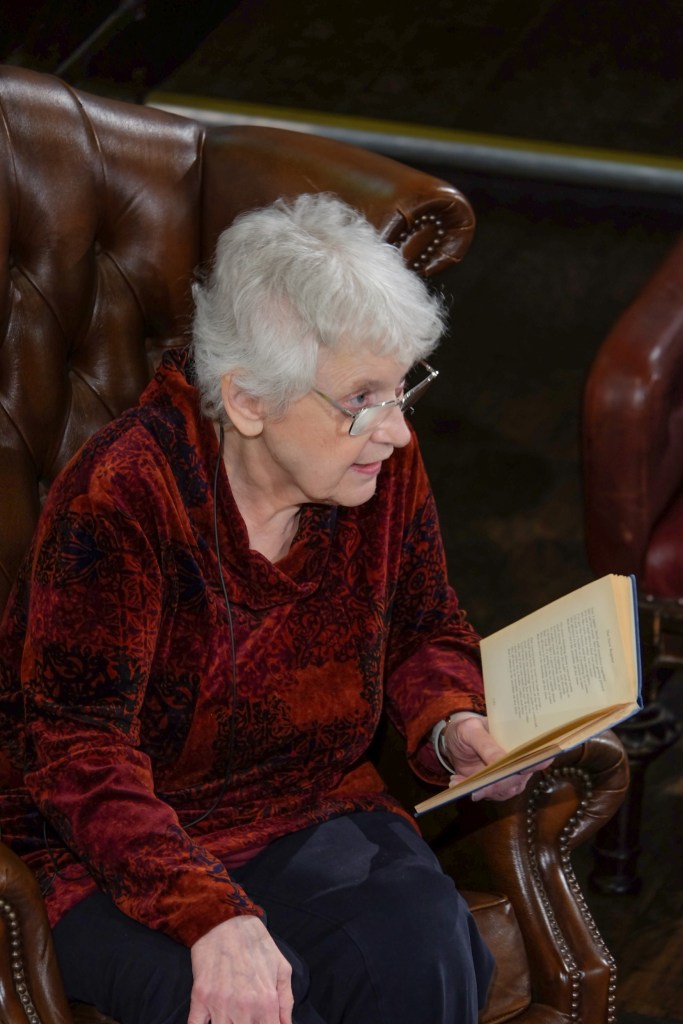
Photo by Johannes Gundy (2025)
Her wit and honesty were constant throughout the discussion. For instance, commenting on The Orange and other poems (2023), a selection of poems put together in response to the popularity of her poem ‘The Orange’ on social media, Cope remarked she was thrilled to have a younger generation of readers – the volume had sold so well (better than any of her other books) that she entered a new tax bracket. Following this success, her latest publication is a Collected Poems, an ambitious gathering of her decades-long body of work that recovers a number of previously uncollected poems with a sense of completeness rather than completion. As the ‘Introductory Note’ to the book reads, somewhat melodramatically, ‘[s]ome of the uncollected poems had appeared in newspapers or magazines. Some had never been published anywhere. This book is their last chance to avoid being consigned to oblivion’. For her writing life, she says, this is ‘job done’. She is not going to write another book. Though perhaps a small press pamphlet.
Wendy Cope’s Collected Poems, published last September, is now out in paperback.
By George Adams
 The Camera