
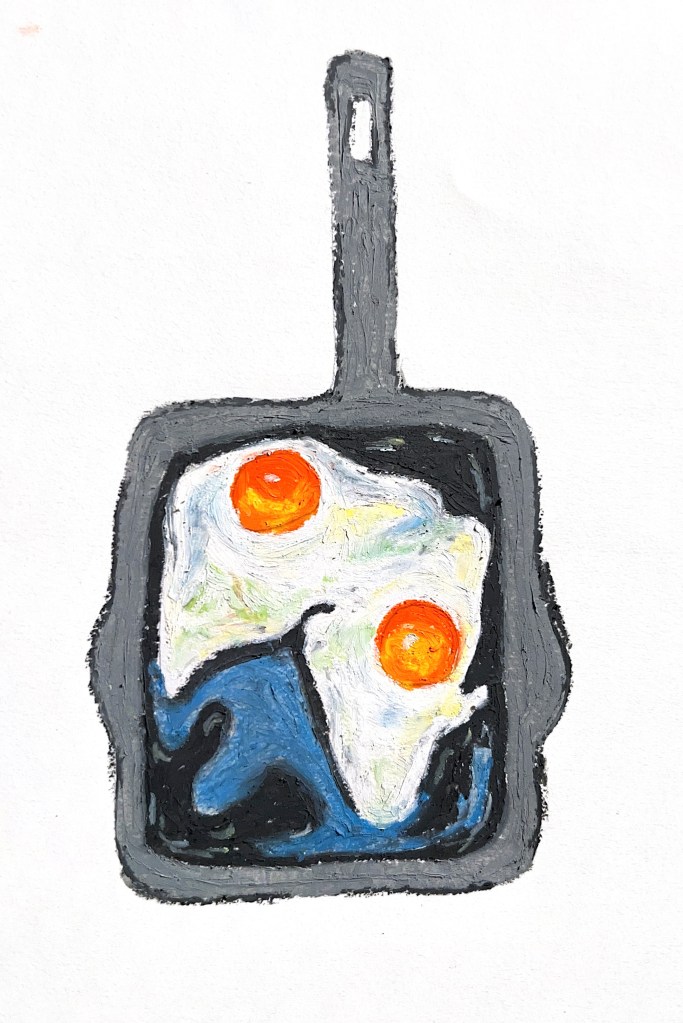
Artwork by Elizabeth Murphy (2025)
Minutes before being announced as winner of the Best First Collection at this year’s Forward Prizes for Poetry, Isabelle Baafi read one of the last poems included in her recently published collection Chaotic Good (2025). ‘Dear Eve (a letter to his second wife)’ begins in the Garden of Eden, a setting suggested by the title itself. The poem assumes the voice of Lilith, Adam’s first wife in Jewish mythology who was banished before Eve for disobeying him. It opens in this vein, remembering innocence and origin: that the world was once young and so was Lilith, that the garden was new, expansive, endless, and that the only mere whisper of downfall was a serpent shedding its obedience, alone. But ‘Who am I to judge’, Lilith digresses, ‘I drop things because they aren’t safe in my hands’:
mornings cracked
like eggs that spit and then harden in resignation.
Only one stanza in, Baafi turns from Eden and proceeds in a version of the domestic present. The cracked-egg mornings orient this movement. The mythic dawn gives way to a kitchen setting, and inside, the grandeur of origins shrinks to the intimate scale of a romantic relationship that is straining under infidelity. ‘Dear Eve’ tells the story of a modern Lilith, less disobedient than wronged by her husband. This man is one who ‘climbed trees as a boy’ and whose ‘heart still flinches at the snap of a branch’. Watched by Lilith, he learned to text in his pocket and sucked his thumb when he first mentioned Eve in a gesture that Baafi, on the stage, mimicked. Exasperated by his romantic conflict, he began to murmur ‘fuck’ into his pillow, and later, ‘bitch’ into Lilith’s hair. Eventually, he ‘cursed everything’ that wasn’t Eve—a fact stated plainly by Lilith who twists the curse to weigh on her successor. The women share in their knowledge of Adam: he has told both about his euphemistic ‘rapture’, a physical spot that Lilith charges Eve to find on the days that she knows will come and ‘bite’ when the new relationship begins to unravel.
Chaotic Good is framed by the story of an escape from a toxic marriage—one that was entered into young and quickly—but its emotional field is much wider. Divided into five sections, the collection threads through experiences that shaped the speaker long before the marriage began: the intricacies of girlhood, young desire, the legacies of family, faith, and chance that remain with a life and encroach on its edges. Each part returns to moments that refuse closure, showing how old experiences colour new ones and how moments of deep difficulty entail confrontation with the past and self-reinvention. It is in this temporal movement that the deep ‘ambivalence’ which Baafi has multiply identified as a central pulse of her writing becomes clearest—not straightforwardly as confusion or a lack of conviction, but as the admission that truth can sometimes feel discordant. That hurt can be deepened by love, for example, and that clarity and goodness require disorder so as to properly, and beneficially, exist. By the end of the collection, the speaker stands in the aftermath of her dissolute marriage with a self that is, at least partly, renewed. In Baafi’s penultimate poem, ‘Parthenogenesis’, the speaker re-births herself as ‘a crowning truth’ that emerges between mud and clear water. Her renewal is untidy, possibly provisional, but empowered in its partial bloom.
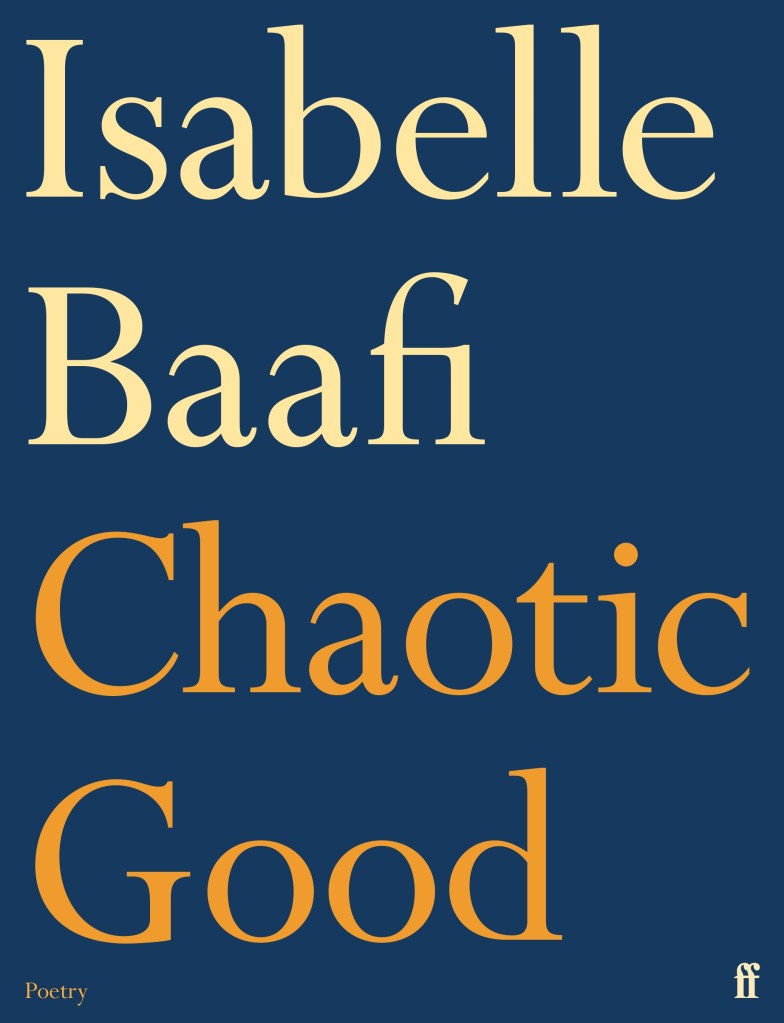
Isabelle Baafi, Chaotic Good (2025)
It was this ambivalent, yet acutely observed, thread that surfaced most vividly as I listened in the audience at the prize event. The likeness between the shedding snake and the cracked, spitting, frying-pan egg; Baafi sucking her thumb like Adam as he names the woman who has won him over; the same man’s cruel typing in his pocket; the same man’s childish fear, his heart flinching at only a branch-snap. The poem proceeds in an oscillation between the postlapsarian frame it conjures and the recognisable present into which it shifts. In its most fragmentary, climactic stanza, Baafi gestures at once to Eve’s biblical fall, to the agrarian hardship she would have to endure, tending to maize and unruly animals, and to more ‘modern’, or perhaps ‘timeless’, concerns about children, identity, biological formation, marital doubt and flirtatious men. The poem’s form mirrors this knot, its shifting angles of address and iterative lines building a rhythm of in-the-moment sense-making, the working through of thought as it happens. This culminates in a passage near the end of the poem in which Lilith returns to the opening snake. This moment, tellingly italicised in the printed text, enacts a kind of live self-correction as Lilith contradicts and exposes herself as morally implicated in her relationship’s end for the first time:
The hiss called me, but I ran from it
No, I ran from the hiss but it called me back
No, I ran toward the hiss, not from it
Some thoughts get uglier the truer they become.
A number of the poems read at the Forward Prize were strong, finessed, or even striking, but it was Baafi’s that was surprising. This surprise came not from any single moment, nor from an unfamiliar or provocative subject matter. Rather, it came from the way her emotionally ambivalent poem takes a story that is, in many ways, ordinary—a tumultuous, failed relationship—and tells it in terms that are keenly perceptive and relatable, yet also unsettling in their mythic inflections. Chaotic Good is a collection that combines exacting gestures with much larger reckonings with personal fracture, contextualised within the arc of a broken marriage and the reinvention that the same entailed: an arc which Baafi experienced herself. “Poetry saved my life”, she admitted, accepting the award with a modest speech. A more cynical version of myself might have puzzled over this, but I know, deep down, that what she said is honest.
By Caitlin Kawalek
 The Camera