

Harold Offeh, Covers. After Betty Davis. They Say I’m Different, 1974 (2013), C-print. Courtesy of the artist.
Entering the sliding doors on a dreary, rain-soaked November morning, hanging up my sodden jacket, and descending the steps into the foyer space that lies between the two main rooms of the Kettle’s Yard gallery, I was struck by a strange murmuring sound, full of energy, repeating through the space. This ‘multi-channel sonic instillation’ introduces visitors to the ‘mmm’ of the title of Harold Offeh’s new exhibition, Mmm, Gotta Try a Little Harder, It Could Be Sweet, a lyric taken from the British band Portishead’s song ‘It Could be Sweet’ on their debut, Mercury-prizewinning album, Dummy (1994). This lyric, integral for Offeh’s identity as an artist since his student days, is repeated across the walls of his first institutional solo exhibition in the UK, a survey of his work in performance, video and sound from 1999 to 2025.
The first room gives examples of his early work, including Alien Communications (1999), part of Offeh’s graduate exhibition from the University of Brighton, and the idea’s development in the series Alien at Large (2001-2004). In these films, playing on a group of boxy TVs underneath a multicoloured tent-like space in the centre of the room, circular magnifying glasses are placed around Offeh’s mouth to enlarge his lips and teeth, playing on stereotypically racist depictions of Black people, and documenting the reactions of passers-by. In Smile (2001), the artist keeps smiling for the camera for over half an hour. In her essay featured in the extensive catalogue to the exhibition, curator Anna Khimasia reads Smile as exploring the relation of the Black smile or cheerfulness within Black ‘affective labour’ that underpins the service economy of neoliberalist capitalism, including the art world – a theme developed in Services Rendered (2009), where Offeh performed the roles of a toilet attendant at Tate Modern and a doorman at the David Roberts Art Foundation.
At the same time, the room features the more outwardly joyful work of ‘Snap like a Diva’ (2009), a film where Offeh performs a number of different roles in drag and snaps his fingers as a point of contact between these personas, exploring the queer, black body through performance. Haroldinho (2003) (‘little Harold’) is the persona created in Offeh’s two-month residency in Rio de Janeiro, a name given to him by Brazilian locals, where he danced the samba in tourist destinations dressed in a blue workers’ jacket, bedazzled with sequined stars, cherries, grapes and papayas. As the curator Sepake Angiama notes, Offeh’s decision to dance in the worker’s uniform speaks to his interest in making ordinary forms of labour visible, in this case, through samba – a social, working-class, embodied expression of Afro-Brazilian culture developed by enslaved African peoples that was criminalised in Brazil until the early twentieth century.
In 2011, Offeh was commissioned by Art on the Underground to create a piece of work responding to the roundel tube symbol. His response, Tube Lips (2011), is a photo of a blue plastic tube held between his teeth and encircled by his glossy lips, fringed with stubble. After being installed, the poster was graffitied, leading Offeh to create a version of the work entitled ‘Gay Lips’, incorporating the vandalization into the work itself as part of a conversation between artist and public. More recently, in Emergent (Crystal Mouths) (2022), Offeh returns to the lips as a site for his work, placing different crystals in his mouth (quartz, pyrite, amethyst). From representing the environs of the city of London (in Tube Lips) in ways that expose homophobic or racist stereotypes, in Emergent the mouth is transformed into a geological feature, a strange uncanny opening that references the labour and politics of mineral extraction in Africa in the present day. The images’ power derives from the points of contact between the tender lip and the hard, unforgiving material of rock, with its capacity to puncture and tear skin.
One of the most powerful works on display in this room is Body Landscape Memory, Symphonic Variations on an African Air, Op 63 (2019), filmed during Offeh’s residency at Wysing Arts Centre, near Cambridge. Lush woodland provides a setting and a frame for the performances of Offeh and the artists Ebun Sodipo and Samra Mayanj, positioned against piles of logs and tree stumps, or lying silhouetted against the sky and scudding clouds. The music – Samuel Coleridge Taylor’s Symphonic Variations on African Air, Op 63, written as an imagining of the continent of his father’s birth – provides a rich soundscape to Offeh’s intervention in the British landscape tradition of the eighteenth and nineteenth centuries which so often occluded black people entirely, if they were not depicted as labouring or in relations of servitude.
The second room considers Offeh’s collaborative and archival projects in relation to themes of space and ‘the alien’, the body in performance, queer histories and archives, racial politics and experiences of emigration. The project Transporter (2013), a collaboration with schoolchildren to design new artwork for tube escalators on the London underground, uses video to document the children in the space participating in discussions, brainstorming, questions and drawing ideas. Speaking at the exhibition, Offeh described this process of making and collaboration as the artwork itself. The final outcome, a slice of outer space with a flowing score of musical notes, is populated by a variety of strange creatures, including a St Paul’s spacecraft and an alien in a natty polka-dot flying saucer holding a sign saying ‘I come in peace’. The Mothership Collective (2006), a funk-science fiction film designed as a communication to send to aliens and created via a series of public workshops, features Offeh’s intergalactic alter ego, while Hail the New Prophets (2021), an ‘interactive sculpture’ with two flaming eyes that connect to a red slide at the centre, is based on the jazz musician Sun Ra’s (1914-93) mothership, exploring childlike play in terms of the visionary imagination and Afrofuturism.
Returning to earth, Offeh explores politics of social justice in Statues Redressed (2021), an audio instillation where Stephen Nze recounts his experience witnessing the toppling of the statue of the pro-slavery member of Parliament William Huskisson in Liverpool in 1982. Offeh’s work draws connections between this story of anti-slavery anger and popular protest and the contemporary context of the toppling of Edward Colston in Bristol in 2020 following the Black Lives Matter movement. The importance of testimony is also apparent in We Came Here (2022), where Offeh stages a fictional conversation between Van Gogh (1853-90) and Olive Morris (1952-79), a Jamaican-born campaigner for social justice, feminist, Black and squatters’ rights. In their discussion, they share their experiences of emigration to Brixton a hundred years apart, discussing issues of integration, belonging and economic hardship in the city.
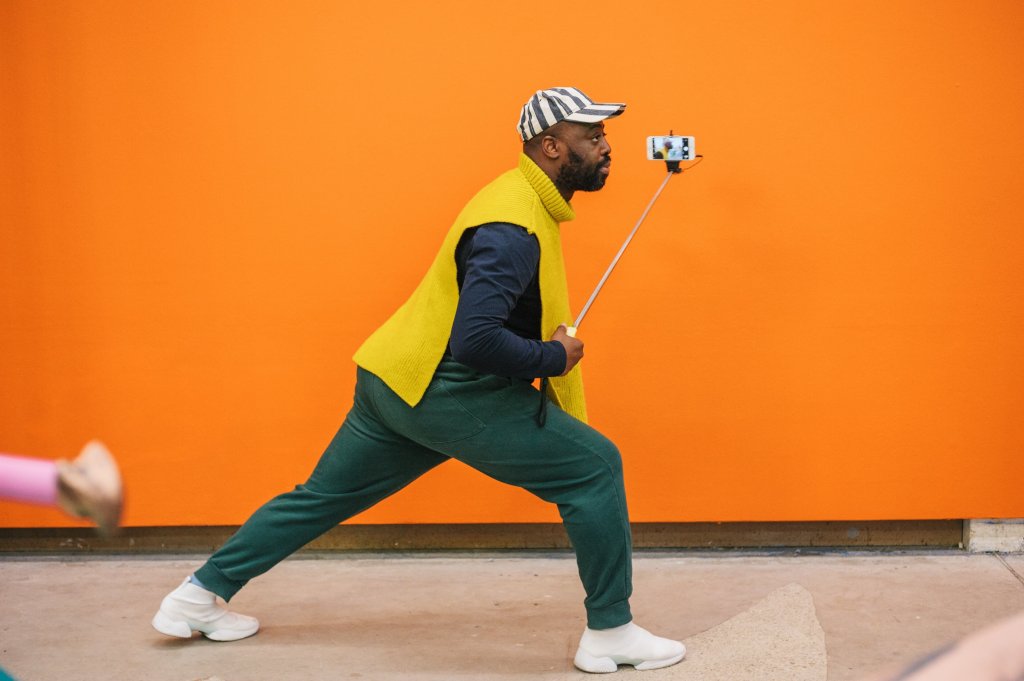
Harold Offeh, Selfie Choreography (2017-2020). Workshop presented for East Side Projects, Birmingham, UK 2020. Photo by Ashley Carr.
This interest in the archive encompasses queer histories. In Stranger in the Village (2019), created during a residency in Mito, Japan, Offeh interviewed members of the LGBTQ2S community in front of a bright bee-yellow background to hear their feelings of social estrangement and integration. In Down at the Twilight Zone (2018), three telephones voice the experiences of members of the LGBTQ2S community in Toronto between the wars. Most recently, Queer Sex Workshop (2022) features a group of queer-identifying members of the public responding, visually and through storytelling, to Duncan Grant’s archive of homoerotic drawings from the 1940s and 50s, considering how these drawings connect with queer intimacy in their public and private lives. Upstairs, visitors to the exhibition have the chance to explore Offeh’s personal digital and physical archive of work and images from his studio.
As a whole, then, the exhibition is characterised by its emphasis on politics and playfulness, exploring experiences of estrangement and Black queer culture in ways that open them up for collaboration and participation. This spirit of play is inscribed into the exhibition space: the word is emblazoned in purple and hung from the ceiling, and there is an area with materials to create your own artwork, including a selection of space-rocket stamps. In Offeh’s words, the exhibition is a catalogue of ‘the different roles you might play as an artist’, capturing the utopian possibilities in the Portishead lyric, Mmm, Gotta Try a Little Harder, It Could Be Sweet, that belong not to an ideal future, but are constantly realised as part of his iterative, searching practice in the present.
By George Adams
 The Camera