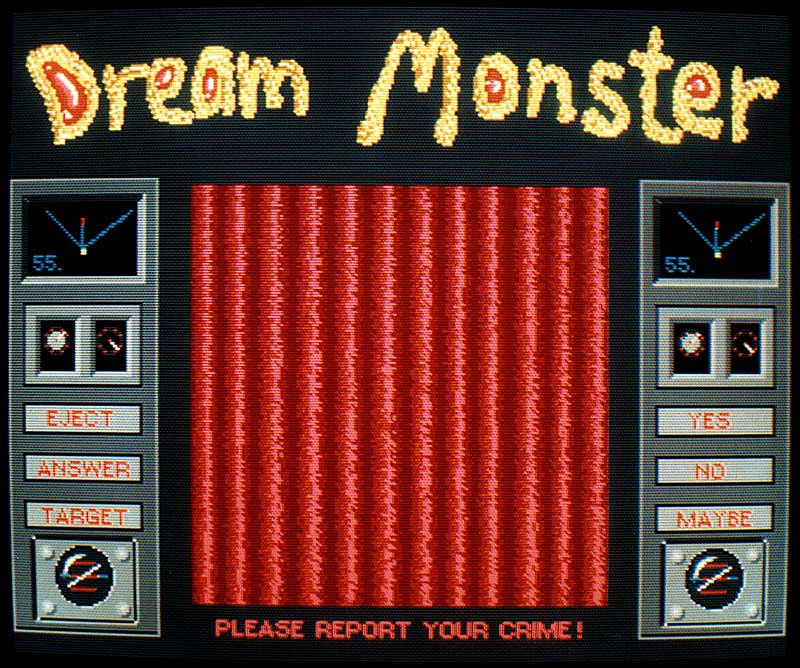
Fictional videogame stills/Dream Monster (1991-1992), Suzanne Treister. 16×20 inches, Digital Print. Courtesy: Suzanne Treister, Annely Juda Fine Art, London and P.P.O.W. Gallery, New York.
The Tate Modern’s springtime exhibition, palatably titled Electric Dreams: Art and Technology Before the Internet, attracted flocks of visitors and, in their midst, aesthetes and unknowing accomplices in modern AI’s titular crime of effacing human autonomy (myself not exempt in hindsight, having discovered the display on social media). Across 15 rooms, cinematic projections, kinetic constructions, and abstract patterns of scientific blueprints coalesced in a vibrant, animated pageant. Though framed as celebrating technology’s unshackling of the masses from man-made strictures of class hierarchy and artistic sentience, a more ominous interpretation suggests that the machinery merely displaces these with its own variant of disempowerment – rendering the mirage of freedom mere electric dreams.
Bedazzling onlookers with both visual and narrative captivation, Electric Dreams guides visitors chronologically through electronic art’s early innovation, starting in the 1950s. Emerging movements transcended geographical and disciplinary barriers, coaxing technology and machinery out of their post-war military contexts into an unlikely marriage with visual art. This crusade is creative as well as political, a democratisation that releases expensive electronics and lab equipment from their locus of strict functionality into broadened access to novel artforms. Movements such as ZERO wielded art as a vehicle to dismantle societal structures and conventions in aspiration of a utopian future with new beginnings and unrestricted possibilities. By reconfiguring the public spectator’s role from voyeur into participant, Groupe de Recherche d’Art Visuel (GRAV) retired the traditional portrait of the artist as a solitary savant in favour of collective activity.
An example that pervades Electric Dreams is cybernetics, the science of systems. Originally developed during World War II by Norbert Weiner – whilst inventing a predictor apparatus to improve anti-aircraft guns’ accuracy – cybernetics became incorporated into the 1960s’ post-structuralism philosophy and anti-establishment countercultural phenomena such as the hippie subculture. These movements deconstructed pre-established structures and absolute regimes of truth in favour of a non-hierarchical decentralisation and subjectivism.
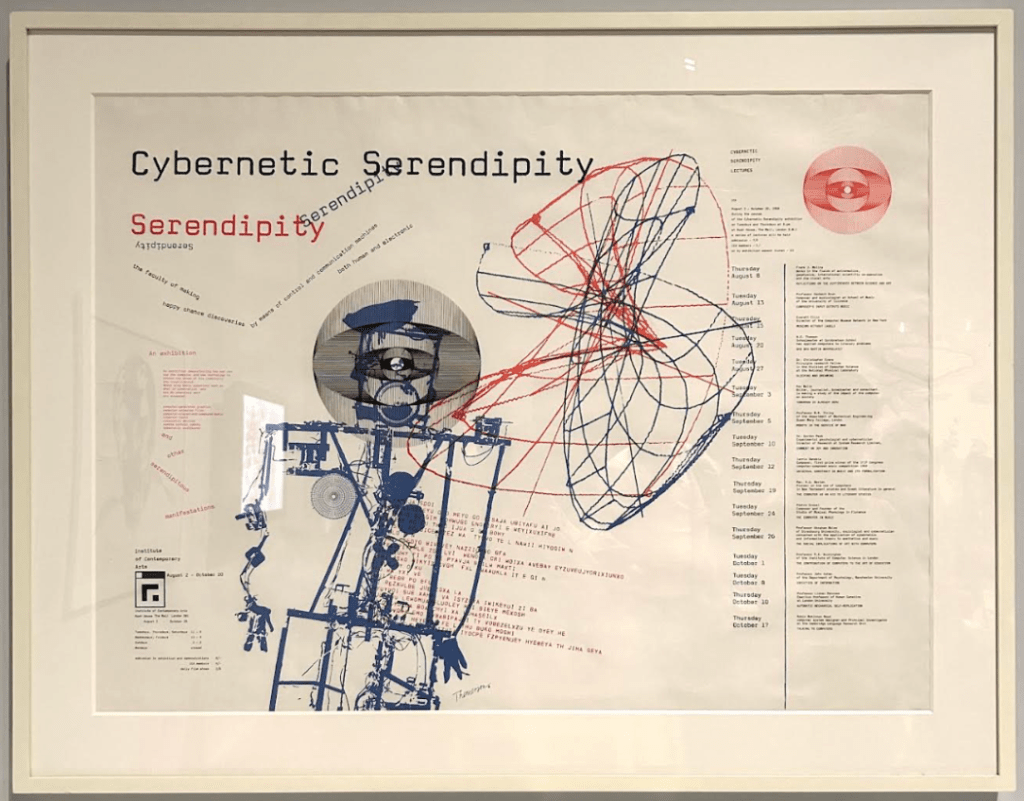
Cybernetic Serendipity (1969), Franciszca Themerson
Image: Holly Chen
To facilitate democratisation and accessibility, Wen-Ying Tsai’s Square Tops (1969) and Umbrella (1971) engage the public in interactive performances where viewers activate audio feedback control systems by clapping and stomping to increase strobe flashes’ frequencies. This defies art’s traditional two-dimensional entrapment behind glass, untouchable and indifferent to onlooker activity. However, the marriage of art and machine is perhaps less seamless than these artists fancy. Aiming to give the public control over art, the pieces simultaneously achieve an antithetical effect as onlookers’ motions become controlled by these directions. The human observer is both empowered to affect the machines’ kinetic activity and reduced to components that process instructions like lines of code, producing claps and clicks with predictable uniformity. Does this endeavour to humanise the machine inadvertently render the human a gear in the machine? This precarious balancing act ought to heed the warning issued by countless science fiction novels such as Do Androids Dream of Electric Sheep?
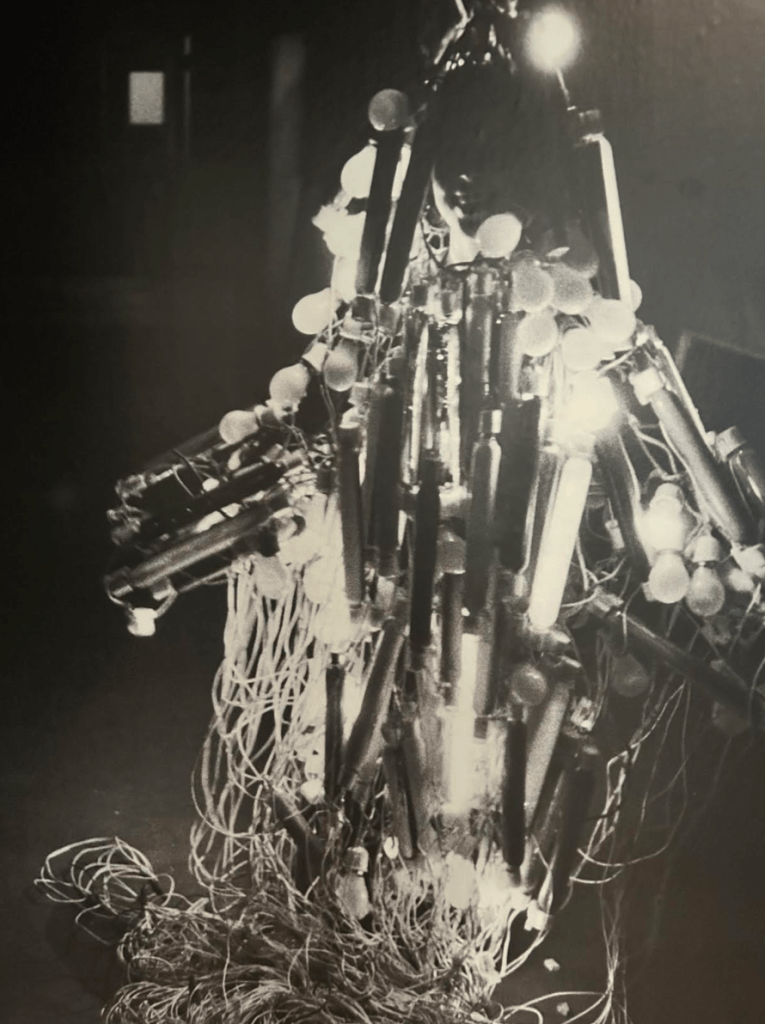
In the exhibition’s opening act, Atsuko Tanaka’s Electric Dress (1956), a traditional kimono is reworked as an enmeshment of two hundred light bulbs and electrical cords. Suspended in an illuminated scaffolding adorning its wearer, the costume outlines Japan’s post-war electrified cityscape. An inscription describes the piece’s portrayal of ‘electricity as an extension of the human body’ and references technology’s ‘visual language,’ personifying technology with human communicative capabilities. Technology purports to be an appendage and tool to expand the human body, territory, and power. Describing the most fascinating part of her creative process, Tanaka comments: ‘When I turn on the switch and the motor starts, the electric bulbs…take on an unreal beauty as if they were not made by human hands.’ To embrace technology’s portrayal as a faithful servant to humans is to stop at the first half of Tanaka’s annotation. Initially, the human wields the power – and some will argue (though this opens another can of worms) free will – to pull the lever in this postmodern variant of the trolley problem (sequined, no doubt, with illuminated tracks). Fittingly, the thought experiment – in which a bystander can intervene to divert a trolley from one track containing five people to another with just one victim – is often stylised to parallel ethical discourses on artificial intelligence. At first glance, the bystander possesses power to replace the default outcome with one which is mathematically preferable (one fatality instead of five), but those who reduce their analysis to a simplistic numerical comparison neglect the subtler sacrifices that take place such as the nature of intervention and dire consequences of algorithmic morality. Should the artist flick this switch that electrifies the dress, with the effect of showcasing the creator’s artistic power over technology, if the act inevitably entails renouncing this very humanness?
Ironically, upon pulling the lever to evidence (to what end: as reassurance?) control over technology, the human hand unknowingly relinquishes power. The composition acquires an ‘unreal beauty’ unnatural and unknowable to the human and, appearing ‘not made by human hands’, misappropriates the human’s creative power. A short circuit’s deadly threat further endangers the human, trapping the wearer within this stiff, danger-filled tangle of lights.
Electric Dress (1956), Atsuko Tanaka
Image: Holly Chen
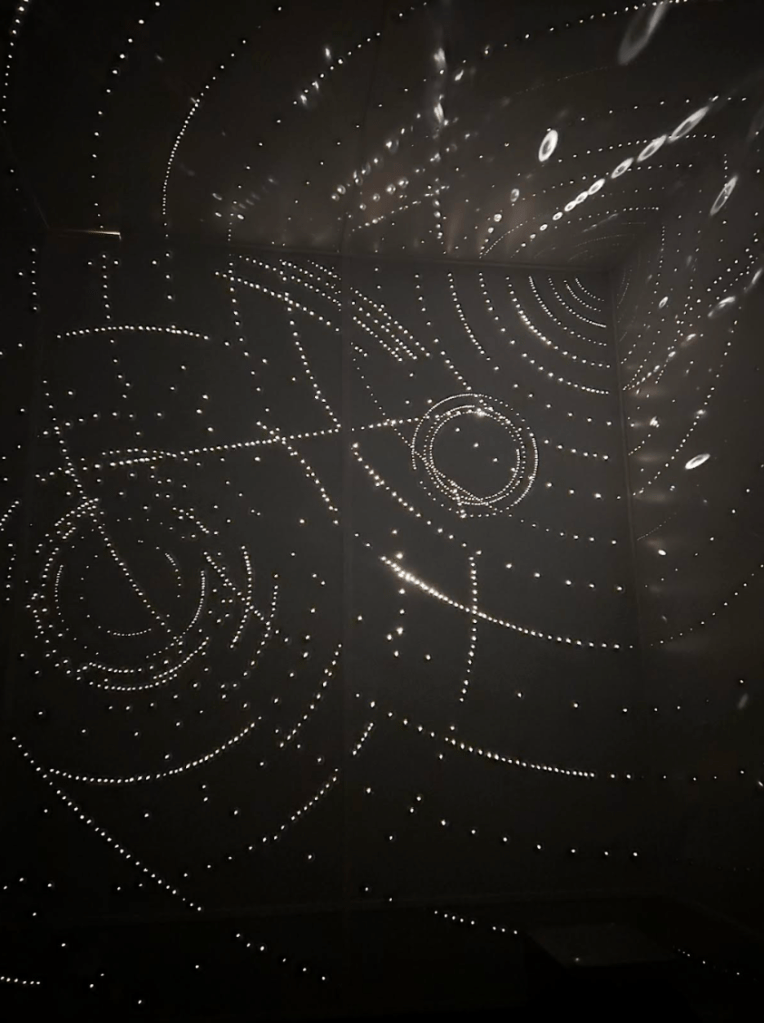
This imagery of enclosure is revisited several rooms later in Liliane Lijn’s The Bride (1988), a dramatic wraith-esque sculpture contained within a rectangular steel enclosure with walls of mesh punctuated by narrow metal bars. Manipulating light’s three-dimensional properties to convey themes of mythology and death, the imposing cage protects the Bride’s fragility, as Lijn summarises, instead of trapping her, defying mechanical materials’ conventional masculinity. The former interpretation, however, is difficult to justify. The Bride‘s dimensions extend uncomfortably close to the walls in both height and width, permitting little space for movement or growth. The all-covering mesh allows the Bride to be viewed only through the omnipresent steel lines and bars whose resistant material and visual presentation are reminiscent of prison bars. This optical contradiction seems easily remediable if the Bride’ was surrounded instead with glass or a free-flowing material. How ought one to discern protection from entrapment with sparse evidence in favour of the former? From what is the Bride protected – what caused her purported fragility – if not machinery itself?
Further ironies dot Electric Dreams of technology handicapping the human whilst professing to amplify it: in Room 4, Brion Gysin’s rotating Dreamachine (1959) projects flickering patterns onto closed eyelids, shutting off the primary sense of sight and subjecting spectators to the vulnerability of the curtailed human experience whilst purporting to engage a greater number of senses. Across the room, rearranged fragments of prose and poetry decompose the human into disorderly computer-generated permutations.
The eerie progression of the machine’s escalating power and the human’s re-displacement into passivity culminates in the exhibit’s finale, where Narcissus’ pool via video texture mapping software renders the human face a two-dimensional screen projection that distorts facial features beyond recognition. Those waiting and gaping in line are complicit in the same irony that haunts Electric Dreams and The Bride: viewers, persuaded by the illusion of control in activating this distortion, eagerly allow technology to disfigure their image. In this immersive exhibition, is the human immersed or drowned? Like Narcissus (and The Bride), we pine for an artistic ideal wholly emancipated from the man-made grip of traditional modes only to produce Frankenstein-esque installations that catalyse the opposite.
These conflicting co-existences of power and powerlessness coalesce into the human’s willing complicity in relinquishing autonomy which parallels our modern-day affiliations with Artificial Intelligence (AI) art. In 2016, Hayao Miyazaki issued a scalding response to an AI-generated Studio Ghibli-style animation: ‘this is an insult to life itself…Whoever creates this stuff has no idea what pain is.’ Commenting on Miyazaki’s reaction, MSN described art as having ‘always been about emotion – about feeling something when you look at a piece, knowing that behind it was a human…’ This popular criticism echoes Miyazaki’s sentiment that art’s value crucially entails the observer’s perception of raw human emotion and struggle which AI dilutes. This metric may disqualify the title of good and genuine art from those Electric Dreams exhibits whose aim of demonstrating technological flair and versatility is sufficiently prominent as to reduce their emotiveness to a mere by-product.
Dream Machine (1959), Brion Gysin
Image: Holly Chen
Though compelling and largely accurate, this emotion-based classification is too arbitrary to be a distinguishing factor. Even the most emotive critic has gazed upon a man-made artwork without perceiving the promised emotion from lack of understanding or psychological proximity. Furthermore, there exists man-made art created without emotion or pain which may admittedly be less provocative (or, to the advocates for artistic suffering, less intrinsically valuable) but is undeniably human art. Perceived emotion is a qualification correlated to but not necessarily dependent on the creative process.
Another attempt to distinguish man-made from AI art poses the argument that AI art, generated via mimicry, lacks true originality. Positing authenticity as the discerning factor presents its own issues: mimicry is (for better or worse) far from exclusive to AI art, as exemplified by the four-chord plague of the pop music industry. The host of man-made music that sounds no more original than AI-generated music is nevertheless deemed (again, for better or worse) human art. AI may, as MSN’s piece acknowledges, one day create original art – though originality existing on a spectrum renders this metric also arbitrary – which should not permit its graduation into the human art category.
Human art’s innate value therefore transcends both aesthetics and, in contradiction to Roland Barthes’s rejection of the creative process’ relevance post-completion, its audience’s interpretation. The qualifying factor must not be emotiveness or authenticity but rather its intrinsic definition as a design produced by a living person. Ted Chiang in Why A.I. Isn’t Going to Make Art identifies ‘choice’ as the differentiator: ‘Real paintings bear the mark of an enormous number of decisions’ whereas a text-to-image prompt engineer makes limited and more simplistic decisions. Brion Gysin’s incorporation of ‘chance and magical thinking’ into language via computer-generated poetry demonstrates this filling-in act which replaces human rationale and decision-making with technology’s arbitrary permutations.
Displacing the power of choice from the artist induces the vulnerability that pervades Electric Dreams. Diverse displays of human vulnerability – Electric Dress‘s wearer at the mercy of a short circuit, the caged Bride, the Dreamachine‘s blindfolded spectator, and the disfigured human face in Narcissus’s pool – mirror our ‘sheer dependency’ on technology, which MSN highlights as a consequence of AI’s accelerating accessibility. The fine line between the exhibited subjects’ protection and entrapment – empowerment and vulnerability, enlightenment and blindness – demarcates to a similarly precarious degree humanity’s control over and reliance on modern AI.
Tatsuo Miyajima offers a refreshing perspective that perhaps approaches true autonomy. Room 12 of Electric Dreams comprises one wall covered in ever-changing red-lit numerical sequences (Lattice B, 1990) and a 3-metre ring lined with red digits in constant motion (Opposite Circle, 1991) and is otherwise completely dark. The fanciful artistry of prior exhibits, which shroud viewers in the blissful blindness of their futuristic dazzle, falls away in Room 12. Darkness funneling viewers’ gaze onto the sequences that eerily resemble an explosive gadget’s countdown, Room 12 confronts technology’s reality as a destructive force that threatens humanity and art.
Miyajima sees modern technology not as ‘an end in itself’, a vision that diverges from other artists’ treatment of technology as a destination. He describes his conception of the future as ‘not a pictorial image but a spiritual concept’, thereby steering clear of the Dorian Gray-esque curse of overreliance on visual art’s two-dimensional peripherality. That is, Lattice B and Opposite Circle‘s visual quality ends at being optically observable. Other exhibits are an end in and of themselves, stopping the audience before the art – with viewers’ purpose being to admire their visual splendour. Lattice B and Opposite Circle are a passageway to transcend optics to epiphanies that lie beyond. By using technology to reawaken rather than dull the human senses, Miyajima reclaims power over technology without permitting it to disempower the human.
The unwitting relinquishment of human autonomy to a transhuman cause is one cautioned throughout history, from The Picture of Dorian Gray (which long preceded technology’s initial traces) to Do Androids Dream of Electric Sheep? (which extrapolates technological development into a tangible apocalypse). Where do we stand amidst this artistic and political crusade? Individual insubordination is a mere paper raft against society’s rapid gravitation towards AI-propelled productivity – art has diffused creative essence back into technology’s unimpassioned functionality as AI art is championed for its efficiency and serviceability. Ultimately, this is an experiment in the relinquishment of human autonomy via that of choice and a test of human complicity in self-effacement.
Electric Dreams was on display at the Tate Modern from 28th November 2024 – 1st June 2025.
By Holly Chen

