
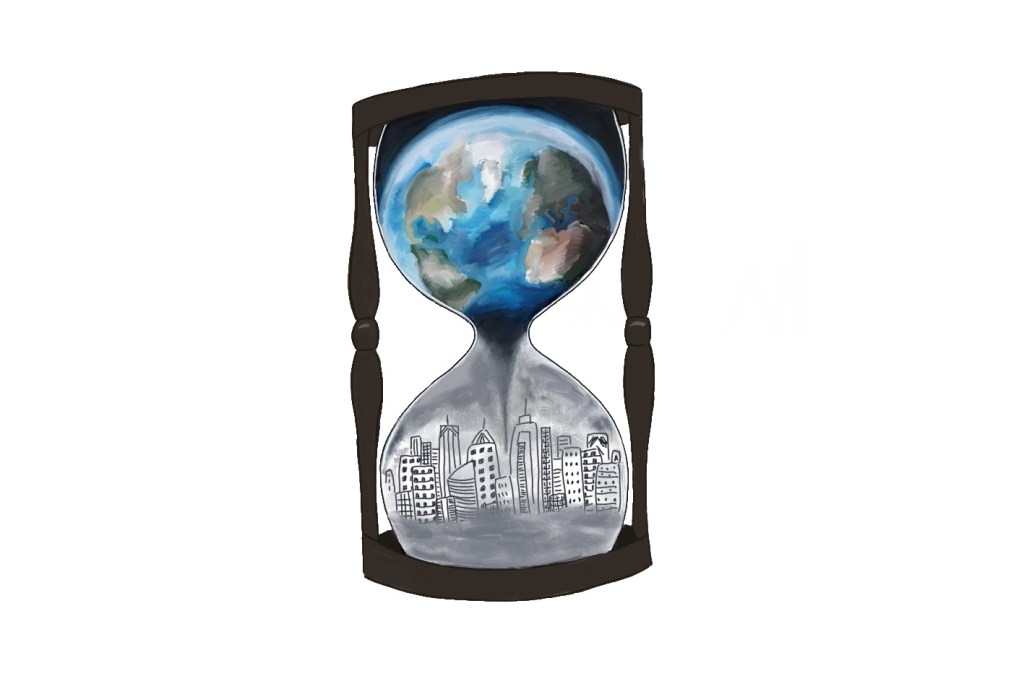
Art by Carmen Vintro
Peering into a canyon-sized copper mine deeper than the world’s tallest building, Ed Conway can barely see the bottom. The enormity of this man-made hole, and the sheer magnitude of raw material we mine from it, is shocking. Conway visits this Chilean mine in his new book, Material World: A Substantial Story of Our Past and Future, which argues that despite seeming to live in an increasingly digital age, our voracious consumption habits have made us more dependent on raw materials than ever.
The book unravels our highly complex, often obfuscating, global supply chains to uncover the six primary materials—sand, salt, iron, copper, oil, and lithium—on which we depend. Prior to his talk at the Cambridge Literary Festival, Conway and I discussed the dangerous fragility of the global economy, who pays the true cost of our material dependency, and how we can become more conscious consumers by learning to respect the objects we use everyday.
‘There’s this bug in economics,’ Conway tells me. ‘Price and dependence have become dislocated.’ The price of the sand we dig out of the ground and turn into glass, for example, does not reflect the fact that the entire global infrastructure depends on that sand for the fibre optic cables that form the electricity grid. ‘But when you look at statistics like gross domestic products,’ Conway explains, ‘commodities like sand add such a small value to them.’ And yet, without sand, there is no electricity, no data centres, no internet. The ensuing problem is that policymakers, politicians, and journalists don’t adequately focus on the potential risk of relying so heavily on just a few mines.
‘The world is much more fragile than we imagine,’ says Conway. ‘But humans are resilient.’ When a hurricane blew through North Carolina and flooded the Spruce Pine mine, the only place in the world where quartz essential for silicon chips is mined, human ingenuity got the mine running again within a few weeks. But Donald Trump is making the precarity of it all even more frightening, Conway tells me. ‘When you’re aware of the existence of all these dependent networks,’ he says, ‘a potential trade war makes you wonder when things might start breaking.’
Conway reports from the sites where these six materials are mined and processed: he peers down into the deepest mine in Europe and takes us into the nano world of silicon chip manufacturing. Describing the visceral experiences of seeing the scale of these mines and factories in person is important to the ethos of his project. He hopes it will help us realise that ‘we are protagonists in that enormous hold on the other side of the world. Because by pretending we’re not, we are enabled not to think about the compromises: the environmental compromises, human rights compromises, cultural compromises. This feeds an appetite for consumption that arises when you think this stuff is cost-free. It is easy to just order something from Amazon, from China, but there is always a cost to that journey.’
But who bears that cost? As I read Conway’s accounts of these heavily polluted regions of the world, this question was front of mind. A lithium mining executive in Chile who spoke with Conway perfectly captured the problematic answer that Western (more precisely, colonial) society gives to that question: ‘We need to show the local communities how important the sacrifice they’re making is for the planet,’ he told Conway. This warped view—that indigenous people should realise the heroism of giving up their land to mine minerals for the batteries that might power a greener energy future—ignores the reality that it’s really their way of life that’s being sacrificed for ours, that their livelihoods are being destroyed so that we can consume more.
When Conway writes that these mines are ‘hidden’, I can’t help but think that what he really means is that they’ve been exported. The ugliness of the developed world’s material dependency is invisible to its Western consumers, but it is very visible to the indigenous communities whose land and livelihoods our society has chosen to sacrifice. A term coined in Days of Destruction, Days of Revolt by journalist Chris Hedges seems highly relevant to Conway’s project: ‘sacrifice zones’, places deemed OK to sacrifice for the sake of progress elsewhere. These zones are most often in poorer, historically colonised countries: we stopped building copper mines in Cornwall, but we’re OK sacrificing land in Chile to meet the Western world’s demand.
Conway doesn’t mention ‘sacrifice zones’ in his book, but he acknowledges, ‘the legacy of colonialism is the unpleasant underbelly of the Material World’. A sense of the injustice overcomes Conway when he speaks with local villagers in Chile who tell him that the miners ‘are raping Mother Nature’ and ‘taking away our rights to water.’ And when he visits a gold mine in Nevada, he reflects, ‘I don’t believe in the water gods the Indigenous Western Shoshone tribes worship, but even so it was hard not to feel there was something, well, brutal and significant about peeling away the skin of the soil and peering beneath the surface.’
Although, as Conway explains, mining companies can sometimes ‘screw up’ like Rio Tinto did when they destroyed two ancient indigenous sites in 2020, vilifying them can make them ‘retreat from the conversation.’ Conway adds that these mining companies often make local communities ‘wealthier than they would otherwise have been.’ Wealthy, of course, in terms they might not find as valuable as the wellbeing of their spirited land.
The question of purpose—why are we doing what we’re doing and what gives us a sense of meaning—comes up throughout Conway’s book. Speaking to local people, miners, and executives gives Conway a complicated perspective. On the one hand, mining can destroy peoples’ homes and their sense of belonging. But on the other hand, there are people whose sense of purpose has been built on mining, and feel a sense of loss when they are forced to take another job like working in a distribution centre. There’s something about ‘taking stuff out of the ground and turning it into a tool that improves our standard of living’ which has been part of what it means to be human since we dug rock out of the ground and turned it into an ax in the neolithic era, Conway explains. This ‘extraordinary continuity that goes back to our very earliest days’ is profound. As our economy rapidly changes, so too do the labour practices that we’ve formed structures of meaning around.
In the face of threats to both environmental and indigenous livelihood, I asked Conway whether writing Material World made him reconsider some of his own consumption habits. ‘I’m more aware of objects’ hidden life, and what it took to get them to me,’ Conway says. ‘As a more conscious consumer, I have more respect for objects, and am less keen to just buy gadgets.’ But Conway is careful not to ‘cast everything through the lens of sacrifice, because then it’s very hard to get people to listen. For me, the answer is getting people to be more connected to what they’re consuming, and understanding how much energy or carbon it takes to make things.’ Hopefully then, he says, people will be ‘more likely to recycle, and less likely to buy stuff and dispose of it.’
Material World confronts the deep tensions faced by the environmental movement which can hide behind easy slogans like ‘Divest now!’ and ‘The Solution is Less Pollution’. How can we power the green energy transition without mining more and polluting more, at least in the short-term? Can capitalism drive the innovation needed to reverse environmental damage and create new ways of sustaining our standards of living? Whose way of life and sense of purpose is worth saving? Conway may not offer answers, but the questions his book raises are the ones our generation cannot afford to ignore.
By Carmen Vintro
**
You can purchase a copy of Ed Conway’s book here.
 The Camera