
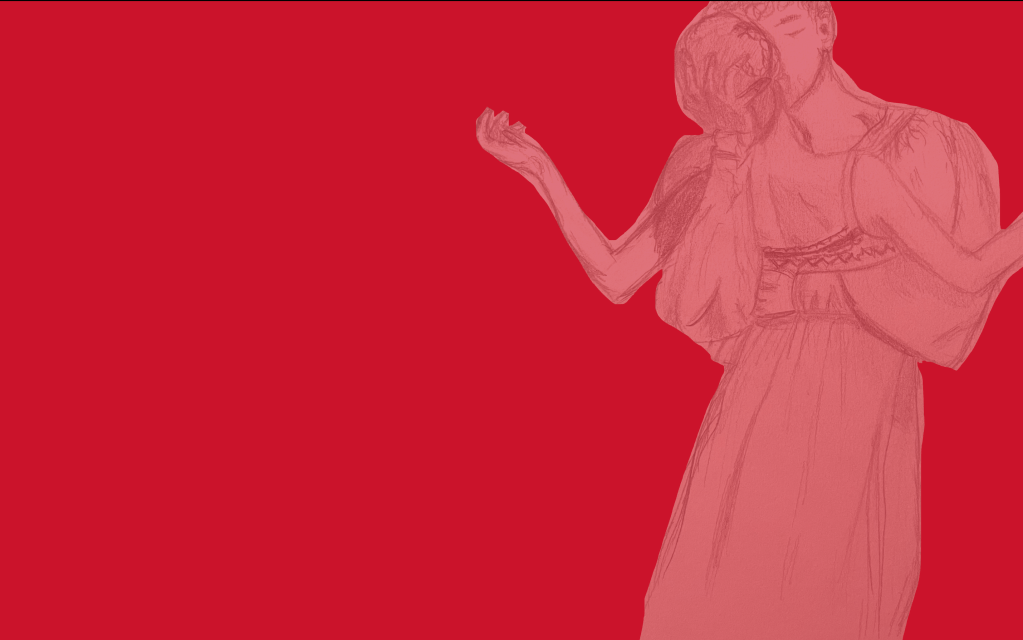
Art by Sophie Baptista, with Kiana Rezakhanlou.
Opening nights aren’t always a mark of success, in ballet as much as other theatre. The audience rioted at Stravinsky and Diaghilev’s Rite of Spring – now a classic – in 1913. When Kenneth MacMillan’s Manon – which celebrated its fiftieth birthday last year – opened, the Guardian’s Mary Clarke dismissed her as “a slut” and Des Grieux “a fool”, with no regard for the work’s complexity. MacMillan’s Romeo and Juliet, though, which premiered in 1965, was an instant success. Although opening night’s Margot Fonteyn and Rudolph Nureyev weren’t actually the pair on which the ballet was made (the real muses were Lynn Seymour and Christopher Gable), their curtain call lasted forty minutes, and the work has remained a stable part of the Royal Ballet’s repertoire ever since. Watching this run is an excellent reminder of why.
Perhaps it’s no surprise that the revival has been so successful. The Royal Ballet tends to shine in works by the two choreographers most integral to the company’s history: Frederick Ashton, responsible for the “British ballet style” distinguished by quick footwork and ample épaulement, andMacMillan himself, whose enormous range produced everything from quirky, abstract works like Danses Concertantes, to the serene Requiem, to, most famously, dark psychological dramas.
Romeo and Juliet, though, is special. A friend of mine (no great ballet lover, but then again, he hasn’t seen this version) recently suggested to me that its impact is just down to Shakespeare’s story and Prokofiev’s music. He has a point. Both are undeniably great, and the ballet couldn’t exist without them. MacMillan’s production is wonderful, I think, because he knew that. He lets the music, and the ballerina’s expressions, do all the talking as Juliet sits on her bed in Act 3, contemplating how to get out of marrying Paris. (Stillness at moments of great emotion are a MacMillan trademark – they appear several times in the lovers’ Act 1 encounters and in Manon.)
But the view that MacMillan doesn’t have all that much to do with this ballet’s success doesn’t explain why a DVD of Tamara Rojo and Carlos Acosta in the lead roles sent me back to ballet lessons at the age of ten, after several years off, whilst the Bolshoi’s version of the balcony scene leaves me cold. (The choreography is too plodding for the music – I see two very well-trained dancers rather than two teenagers falling in love.) MacMillan’s, on the other hand, is outstanding.
It defies almost everything that’s expected of a full-length narrative ballet. Away, tutus and rhinestones – Nicholas Georgiadis’ designs are distinguished by their rich autumnal palette, attention to historical detail, and range of textures. They have worn well – Romeo and Manon are as much his legacy as they are MacMillan’s. Pointe shoes aside, the “look” of the production evokes Renaissance Italy as strongly as Gozzoli’s frescoes do; the headgear and colours work especially well.
The actual dance is just as fresh. The highlight of a ballet is often its pas de deux. In Classical ballet, these follow a strict structure: the opening sees the couple dance together, then there is a male solo, a female one, and a flashy coda (the more fouettés, the merrier). There are usually bows and curtseys after each part. All this has its merits. But it is nothing like watching a MacMillan pas de deux, which can convey anything from initial meetings to tender post-coital moments to sexual violence. The only guarantee is intensity.
MacMillan knew that his pas de deux would be physical and emotional peaks, and he usually began work on any scene with them. His narrative choreography, though, is built to tell the audience a story more than to dazzle it. The above structure is irrelevant to the balcony scene, because Romeo has to dance for Juliet, still a little shy with him, before they come together. This is an emotional naturalism. That attitude extends to the physical: there is no dance in the wedding scene, just the ceremony. The mime of Romantic and Classical ballet, which so easily seems stilted and amusing in the wrong hands or to untrained eyes, has vanished.
MacMillan’s interest in character is also at work in a very different kind of duet – the swordfights. Both Act 2 face-offs are real highlights. Mercutio runs rings around Tybalt, his quicksilver jumps set against Tybalt’s heavy, drunken movements – until he turns his back to mock Romeo and is fatally wounded. The only thing that could then make you feel sorry for Tybalt is exactly what happens, when the enraged Romeo utterly thrashes him about the marketplace and runs him through. Reece Clarke and Gary Avis play this fight particularly well; I’ve seen it more times than I can count, and it still had me on the edge of my seat.
Suggesting that Shakespeare can be improved upon is generally considered sacrilege, but I would argue that, between Prokofiev’s score and MacMillan’s choreography, which cut some of the play’s bittier scenes, the ballet reaches an even greater dramatic intensity as it presses on to its conclusion. The ending is also bleaker – MacMillan’s final tableau is the corpses of the two lovers; no overcast reconciliation tempers the tragedy.
Such an established success puts pressure on current performers, but both casts that I saw (Yasmine Naghdi/Matthew Ball and Anna Rose O’Sullivan/Reece Clarke) more than held their own. While it was utterly absorbing to sit close enough to see everyone’s expressions, the bird’s-eye view that I had on my second visit permitted the ensemble scenes greater depth. It also lent a particular horror to Romeo’s dance with Juliet’s lifeless body – at that distance, signs of life in her are harder to discern and the contrast between tension and limpness is more pronounced, seeing both their figures in full.
Naghdi and Ball make getting lost in the world easy. They have, after all, become particularly well-known in these roles, and their ten-year partnership pays dividends in the risks they take – their balcony scene is thrilling to watch, and his secure partnering allows her to be fantastically floppy in the crypt scene.
Naghdi shines in “girlish” roles, which makes her Act 1 Juliet – playful, sometimes shy, certainly dreamy – an easy sell, but she also has the emotional depth to carry Act 3. This is the real dramatic challenge as the ballerina hardly leaves the stage. In those forty minutes, our heroine’s situation steadily deteriorates. If her pain isn’t synchronically persuasive, the tragedy is diminished, and if, diachronically, it lacks nuance, the audience gets left behind – it’s wearing to watch anything dialled up to notch 10 for too long. Balancing those demands is a huge ask of any performer, but Naghdi rises to the challenge, oscillating between the newly adult young woman, who bids a tender farewell to her husband, and a still-teenage girl who throws a tantrum when she is unable to articulate her feelings to her parents. Her silent scream at the end makes a wrenching finish.
O’Sullivan brings her usual sunny zest to the stage. Her Act 1 Juliet is a bit more confident than others; there is an especial quickness and precision in her initial response to Paris, which gives the encounter an endearing gentle flirtatiousness. She and Clarke truly shine together, though, in the famous “Believe me, love, it was the nightingale” scene. At this stage, Act 3’s opening pas de deux, the lovers should seem almost to dance as one; tricky, as the choreography often sweeps through several levels – Juliet leaps up and collapses onto the floor in tears, or Romeo lifts her up behind his shoulders before she tumbles forward and hangs almost limp at his knees. O’Sullivan and Clarke negotiate the challenge with enviable ease, though, and the result is dance that flows like water.
Between the physical demands – Act 1 alone is a full hour of solos, sword-fighting, and partnering – and the dramatic ones, it is easy to see why Romeo is repeatedly named as one of the hardest roles for men. Both Ball and Clarke acquit themselves admirably. From his laddish camaraderie in the marketplace to his initial awkwardness with his crushes, Ball manages to be a perfectly boyish Romeo without ever losing his beautiful lines. Clarke, meanwhile, strikes me as a more introverted hero, which in my books is just as successful. He gets Romeo’s dreamy slight sense of isolation from his friends, but that doesn’t stop him from being terrifying as his friend’s avenger, or increasingly despairing as his life takes one unfortunate turn after another.
It seems a real shame that the three Harlots (and the ensemble) are excluded from the streamlined curtain call. Both casts (Claire Calvert, Annette Buvoli, and Isabella Gasparini; Nadia Mullova-Barley, Leticia Dias, and Mica Bradbury) did full justice to these lively and colourful – literally – characters. They brightened up the marketplace scenes and their relationships with Romeo and Mercutio in Act 2 especially were given suitable depth. It helped that their excellent Mercutios (Joseph Sissens and Francisco Serrano) gave them much to work with.
One health warning: there are two scenes with which I’ve never quite clicked. Both fall in Act 2. The music and choreography for the happy Veronese couple’s wedding and ensuing mandolin dance are markedly less interesting than anything else. Additionally, the Act 2 finale, in which Lady Capulet expresses her grief for Tybalt, is a touch over-bearing. I can cope with the heavy music and her flailing at Romeo with a sword, but MacMillan even has her roll around on the floor, pounding her fists. The ensuing interval is a relief.
However, neither of these sections makes me a smidge less enthusiastic about everything else that this ballet has to offer. They also didn’t stop a different friend (a reliable witness, not a die-hard balletomane) who saw itfor the first time this year, from giving the work her whole-hearted approval. This is perhaps the most ringing endorsement. You don’t really have to know anything about the work’s history or study the differences between individual interpretations to be moved by its hot-headed characters and aesthetic beauty. Between the Royal’s performers and its crew, Romeo and Juliet has been in safe hands for 60 years, and it’s still drawing old fans and new alike.
***
Romeo and Juliet is on at the RBO until May 26. And if you can’t make it to the theatre, fear not. The Royal Ballet and Opera’s streaming service offers (for free, if you’re aged 16-25!) two filmed versions. There are also two excellent recordings of Manon, if the Parisian demi-monde is more your style, and one of Mayerling, if you’re feeling brave (just read the plot first), alongside a wealth of opera and dance performances.
***
By Sophie Baptista
 The Camera