
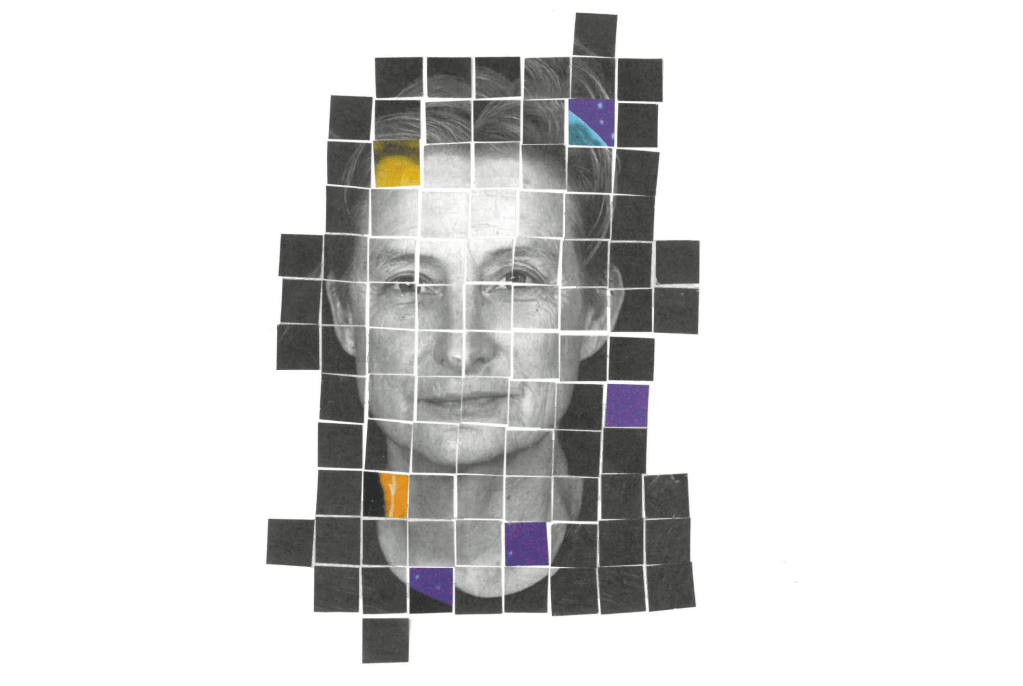
Art by Anja Segmueller
In early March, 2,700 people gathered to see Judith Butler give a talk. The renowned gender theorist and perhaps the only academic who could have commanded such an audience, was being interviewed by political commentator Ash Sakar in the Royal Festival Hall. The subject matter? Butler’s new book Who’s Afraid of Gender? and contemporary right-wing attacks on gender encapsulated in President Trump’s January Executive Order 14168, ‘Defending Women from Gender Ideology Extremism and Restoring Biological Truth to the Federal Government’.
Butler began by masterfully unpacking the language and philosophy behind the Executive Order. ‘Either you’re in favour of human complexity or you’re not, and they’re not,’ they explained, arguing that Trump’s Order formulates gender into a ‘phantasm’ that collects anxiety and fear until it comes to stand for generalised fear about the future and a loss of order. Leveraging the gender ‘phantasm’, Trump is aiming to put gender under conservative state control and reduce it to sex assigned at birth. Not only is this flattening of human complexity based on unscientific theories like gamete-size, but it has immediate, urgent consequences for trans people, who are now at risk of losing healthcare and being put in jails with a gendered group they don’t identify with, among other concerns.
It was at this moment that an angry shout burst from the crowd, which had hitherto been respectfully whooping, cheering, and clapping in support of Butler. Barely audible amid the commotion, a woman’s voice broke through, yelling, ‘What if you let a murderer of two women into a women’s prison?’ Sakar tried to shut down the heckle, but Butler wanted to respond. ‘You cannot essentialise on the basis of an exception,’ Butler explained, but before they could finish, the heckler shouted, ‘SHE didn’t answer my question!’, emphasising her explicit misgendering of Butler, who uses they/them pronouns. Booing erupted throughout the auditorium. Gracefully, Butler tried to take the high road by responding, saying, ‘Sometimes you have to respond to rudeness.’ Attempting to create a civil discourse, Butler noted that prison guards are the ones who commit the most violence against women in prison, not trans people. As such, we should care about prisons as a violent institution, they argued. But the heckler couldn’t be reasoned with and she started to yell again. ‘You’re done love,’ Butler said, shutting down the interaction with a slight condescension illustrating the difficulty of holding rational, respectful dialogue in the current political climate where opposing identitarian politics are at play.

Judith Butler, courtesy of Miquel Taverna (2018)
Moving on from the disturbance, Sakar probed Butler’s understanding of the woman gender: ‘Why do people gate-keep womanhood?’, ‘What is a woman?’, and ‘Are there limits to who can be accepted into womanhood?’ she asked. Butler answered by touching on points about the complexity and gray areas of biological sex expression, Jacqueline Rose’s insistence that the question of womanhood must be kept open so that there remains an orison of opportunity for future people to discover how it can be a livable category, and the problem with relegating authority on who can be what gender to external actors.
Throughout Butler’s talk, they kept homing the conversation back to fundamental principles: Do we want human beings to flourish? What makes a liveable life? How can we best live as a collective? Amidst Trump’s politics of forcibly flattening humanity to order and suppress people, Butler had one message: we must not get bogged down in identitarian taxonomies and lose sight of our shared, basic aims of freedom, justice, emancipation, and equality.
By Carmen Vintro
 The Camera