
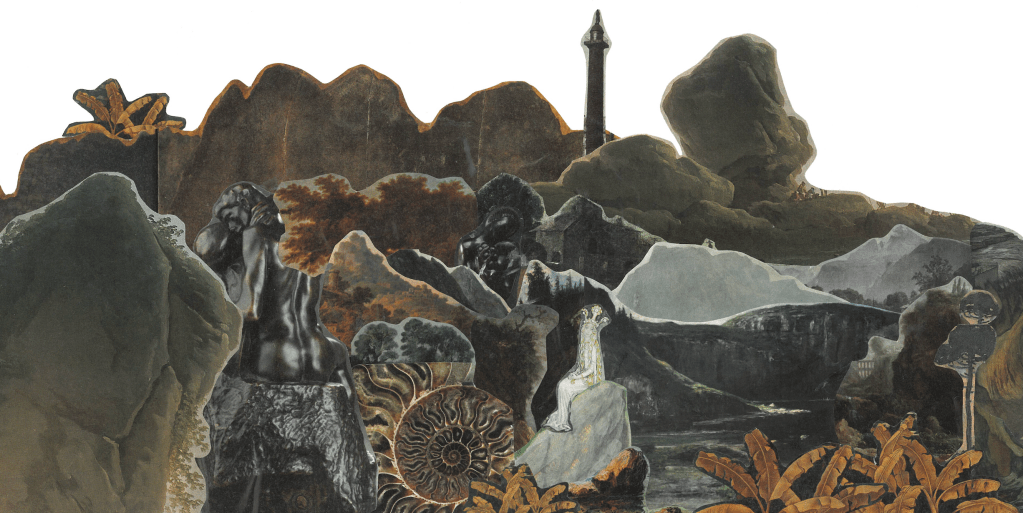
Art by Anja Segmueller
Michael Pedersen, Edinburgh’s Makar (Poet Laureate), is soon to make his novelistic debut.
Muckle Flugga (2025) will be published by Faber in May, less than two years after the release of The Cat Prince (2023), Pedersen’s third published collection of poetry, named after its eponymous poem which—in his own words—came from a ‘cognitive conga’ into his memories of boyhood.[1] Memories of boyish friendships, but also of that liminal time in which adulthood looms. This period, Pedersen notes, muffles tenderness, or wants to, hinting at a mettled kind of masculine existence.[2]
“As a boy I was whiskerless,
weighed down by the nest of knots
squat in my belly. As a cat,
I was so much more…” [3]
Before The Cat Prince, there was Boy Friends (2022), Pedersen’s first prose publication after more than ten years publishing poetry. Boy Friends is a memoir that recounts love, grief, and male friendship. It was written from a lime-green desk in the famously strange Curfew Tower in Cushendall, Northern Ireland, during a residency that Pedersen undertook shortly after the death of a beloved friend.[4] The book manifests in letter-form; it begins as a series of narrative epistles to this lost friend in the aftermath of his unexpected passing, but slowly metamorphoses into a tribute to several more formative friendships, contextualized by the phases of Pedersen’s life—at first, he is a ‘nipper’ in Leith, then a boy in Portobello, a university student, a London legal-trainee, a visitor to Cambodia, and at last, most recently, a writer based between Glasgow and Cambridge.[5]
Muckle Flugga tells the story of a rugged, shapeshifting isle that is home to only two permanent, human inhabitants: ‘The Father’ and his son, Ouse.[6] It follows the upheaval that ensues on this isle after the arrival of Firth, a chaotic writer from Edinburgh, who comes to lodge with ‘The Father’ and Ouse, challenging the limits of the world they have known. The isle of Muckle Flugga is inspired by the northernmost island in Scotland, atop of which stands a lonely lighthouse. This is where our conversation begins. Michael has been showing me the book’s front cover, and at its centre is an illustration of a lighthouse whose greyish bricks recall the Curfew Tower where he wrote Boy Friends. I mull over what I worry might be a trivial question, but then pose it anyway. I ask Michael whether Muckle Flugga is at all rooted in Boy Friends. Or am I overreading, I add? It is probably obvious that I interview rarely.
Michael nods.

MP: No, there’s a huge connection there. The books aren’t exactly companions, but they’re definitely in conversation with each other. In both, there’s a male friendship, a love story at the heart. A great watch tower that offers danger and salvation, and little pockets of people I know—as there is, I suppose, with any first novel. Boy Friends was true to my life, and had to follow the narrative of me, Scott, and the other friendships in the book. There were times when I wanted to go off on experimental tangents, but that would have made for an uncomfortable read within the non-fiction world, so I suppose that Muckle Flugga enabled me to have the wayward conversations that I couldn’t have before.
CK: What about the conversations in Boy Friends? I read somewhere that writing that book almost came to you by accident.
MP: Yes. I started Boy Friends as a sort of prose archive of diary entries. They were quite rudimentary at first because I was going through this emotionally turbulent time, and it seemed like a more achievable way of writing. I had been long booked to go to the Curfew Tower, and it was my original plan to work on my third poetry collection, but given what had happened, poetry seemed too complex and demanding. I thought then that I would first create an archive of friendship, of understanding, and then use that to later write poetry through the weeks… But the archive grew too big and untamable. All of a sudden, it wouldn’t be lined up and wrestled into poems. The object refused to become what I wanted it to, so I sort of had to submit to it by accident. It sounds a bit haphazard, but writing the book lit a fuse in me in terms of what writing can achieve, that which I felt I had been missing to a certain extent. But poetry will always punctuate it all…
CK: Yes, I was going to ask. You’ve moved from writing poetry to creative non-fiction, and then, prose fiction. That is obviously not to say that you’re leaving any form behind for the other, but some poets write only as poets for their whole careers.
MP: Poetry is like my compass. I don’t think I’ll ever write a book, whether it’s non-fiction or fiction, where reviewers don’t comment upon the fact that it was written by a poet. Even though I’m betraying the poetic genre—in a sense—I think that poetry is still very much alive in my writing. Even with Boy Friends, I was trying to Trojan horse poems into it. It was like a case of poetry by subterfuge, of squeezing them into more formatted prose… I have always loved the dissolution of genres. I love not being a sort of genre scientist but instead just immersing myself in language and the joy of it, letting that dictate the work.
CK: That’s cool, the point about immersion. I read something recently that was basically a critique of it. It was a convincing book, but boiling it down, the writer dislikes the fact that a lot of contemporary writing leads from a sort of unmediated first-person voice, one that is very intimate to the author. It’s almost as though they want to return to the super mediated, archetypal nineteenth century novel. After that book, I read another article on the same issue. But this writer thought that the immersive form was actually really important, probably a natural development in literature. That’s the view I share more, I think…
MP: The personal voice is interesting. And the thing is that a lot of working-class literature comes from this voice, allowing people to feel as though they can project life immediately from their eyes. This is the merit of immersive literature. It democratizes writing, in a way… Perhaps some critics dislike it because they argue that it’s easier to write when the writer becomes the singular character. Yet, reviews are also singular character, the reviewer narrates from their immediate perspective.
CK: It must be interesting to be on the receiving end.
MP: Yes. Of course, it is glorious when you get nice reviews. But what’s more important, and what I try to give more credence to, is the writing being important to people. Enabling them to connect with the stories, to take ownership of the stories, too.
CK: I agree, and that’s what I like about your use of language, especially. Oftentimes it seems as though you’re writing about that which is, in a literal sense, quite heavy and painful. And although the reality of that is there in the language, so too is there a light-handedness, and sometimes, or even often, a commingling with joy. This combination feels close, and important.
MP: I think I’ve been described as relentlessly optimistic, and I wholeheartedly agree with that… I love language, and I want my work to be as much a celebration of words and the joy of them as it is a celebration of a story. I didn’t necessarily grow up with language in this way because in certain class environments, showing that you love and use language accordingly can make you look vulnerable. I think my writing—my characters—sometimes portray this same contradiction. For example, sometimes my characters are quite brutish in their behavior, but then there’s this intricacy that comes through, say, in their love words… I try to imbue a love for language in at least one of my characters, moving between what is often quite a working class, a harder vernacular, to that which comes from contemporary Scots language—seen as a bit more tongue in cheek—and also words that are archaic and rare, little beasts buried somewhere in a dictionary.
CK: Yes, I think that comes across powerfully in your poetry, and I’m looking forward to seeing how it appears in Muckle Flugga… Staying with poetry for a moment, though, do you think that there’s something particularly important about the form? I read an opinion recently which held that it should show us what we thought we knew to be new again, for example.
MP: Interesting. I suppose there’s not really a universally agreed upon definition of poetry. Lots of people think of it as longer form literature with all the water wrung out—that sort of classification and condensation of language down to as few words as possible… For me, it is always a form of investigation, though. It is not necessarily about answering questions, but about learning how to ask the right questions. I think the highest justification for writing a poem is when somebody reads it and then says in a very simple mode that it feels like it’s been written about them. All of a sudden, it’s as though you’ve given them the green light, the emotional permission to inject their life into your life, and together, you’re unified in asking the same questions.
CK: I like what you say about the reader injecting their life into yours, or into the writing’s. To be honest, I often feel that way even when reading prose. You’re traipsing and traipsing through reams of words, but then, suddenly, there’s this one line or sentence that just gets you, deeply. And that makes the whole long process worth it.
MP: It can be so good that it feels personally invasive. Like it rings in you, rings like a bell.
CK: Definitely. And I suppose you must be conscious of this in the writing process.
MP: Despite the form—poetry or not—every sentence of mine has been edited to feel like it could exist as a self-contained creature, as though you could take it out of the book, and it be a portrait.
CK: So, this was the case with Muckle Flugga…
MP: Yes… although in a sort of strange process. I love writing dialogue, and I love writing poetic descriptions of the narrative scene, so that was where I began, and it was where I remained for as long as possible because I knew that this kind of writing would come the fastest and most easily for me. I developed quite a punchy document over a period of half a year. After that, I shut myself away for the whole month of January last year. I didn’t see anyone. I told my friends that I would be away for the month, and I wrote. I would write from early in the morning until the late afternoon, working line-by-line. Then, I would go on a walk around Glasgow in the evening and carry any dilemmas that I had with me in my head. I would eat dinner, and then go over the work until late. I was more ruthless than in the morning at this time—especially in the dark, January cold. The indulgence of my morning self was edited by this much more curmudgeonly self at night.
CK: That’s amazing—a discipline enviably far from reach. Did you edit this way?
MP: I wrote the bulk of it in that month. Then, I took a month away and came back to it. I went on a writers’ residency for a couple of weeks and did a full edit whilst I spent a few weeks there, working like I would on a poetry collection by looking at the sentences one by one. After that, I put it straight out to submission… I suppose I had been carrying the story for a long time. Boy Friends came out one year, The Cat Prince came out the other. I was in the run of putting words down on the page and I knew that I wanted to get an early first draft out.
CK: I think that’s so cool. To be at that stage in a writing career… I suppose that some readers of The Camera might like to write, or to do something that is creative and similar. Given all of those other things in life that can encroach on your time, or even just your mind, and disable you from executing the work, do you have any advice for those just starting out?
MP: Especially with prose, it becomes a bit of a stamina thing. It becomes a case of putting even just small pockets of your day aside to write a little bit of text or edit a little bit of text and then let that time become a sort of anchor in your life, amidst all of the other busy-ness. I tell a lot of my students that sometimes even ten minutes is enough, because, other days, you’ll have much longer. It isn’t as romantic as the whole inspiration-striking-and-then-writing-in-response thing. For me, it was a slow and steady evolving process—from publishing in journals and magazines, to small, indie publishers and then the bigger national ones. It is a slow process, but each step forward is another step, and should be celebrated for what it is.
CK: The timing has to be right?
MP: In a way. See, I would write the books differently now and would have written them differently had I written them earlier. Not necessarily better, but different, because you’re carrying around different concerns and loves and fears and vulnerabilities at different times and these will always extend into your work.
CK: You’re living with it.
MP: When I was writing Muckle Flugga, during that long month of January, when I was cooking dinner, I was constantly talking to myself as the characters – really testing out who they were beyond the plots and storylines. So much of them lived with me in the flat that hasn’t even made the page. I fleshed out their idiosyncrasies and how they’d react to both day-to-day banalities and gonzo sporadic happenings. It made them much more complete beings. In a sense, me too.
CK: Almost like friends…
MP: Friends, foes, lovers & floosies. Yes. And it was necessary, because writing the book was taking up nearly every second of my conscious life. I was also dreaming about the characters, resolving the issues that I had on the page in the world of nod… I was carrying the characters’ lives into my subconscious, so much so I felt like I was living not with but in the novel.
By Caitlin Kawalek
Muckle Flugga by Michael Pedersen will be published by Faber in May 2025. For more information, visit @michaelpedersenoyster, or Michael’s website, https://www.michaelpedersen.co.uk/.
[1] Michael Pedersen, ‘How I Did It: The Cat Prince’, Poetry School https://poetryschool.com/articles/micheal-penderson-how-i-did-it-the-cat-prince/.
[2] Pedersen, ‘How I Did It: The Cat Prince’.
[3] Michael Pedersen, ‘The Cat Prince’, in The Cat Prince & Other Poems (London: Little Brown, 2023).
[4] Michael Pedersen, Boy Friends (London: Faber, 2022).
[5] Pedersen, Boy Friends.
[6] ‘Muckle Flugga’, Michael Pedersen https://www.michaelpedersen.co.uk/muckleflugga.
 The Camera