

Claude Monet, Waterloo Bridge, Veiled Sun, 1899-1903. Oil on canvas.
Private collection. Photo © Christie’s Images / Bridgeman Images
Painted from a top-floor balcony of the most expensive hotel in the world’s largest city, Claude Monet’s London canvases are suitably ‘epic’. It’s not a word I like, but it seems apt when the exhibition’s curator, Dr Karen Serres uses it to describe the uniqueness of having 21 of Monet’s celebrated series together for the first time since 1904. Together, the paintings are some of the most influential depictions of the city ever made, and have travelled to the Courtauld from the four corners of the art world to find themselves just a stone’s throw from where they were first conceived.
Captured in shades of blue, green, purple and orange, Monet’s canvases were received with open-arms when they were first shown in Paris. French critics congratulated the by-now established Impressionist on producing ‘symphonies of colour’ and revealing London to be the ‘gloomy and smoky capital of another world’. While the subject matter of Monet’s work is instantly familiar (the series revolves around Charing Cross and Westminster Bridges and the Houses of Parliament), it’s hardly surprising that British reviewers were more sceptical of this other-wordly metropolis. Seen through the eyes of a local, Monet’s fantastical palette and block-buster lighting effects failed to convey ‘the almost morbid charm of the light in London,’ which was the smoky mise-en-scène for many a commuter. Elizabeth Robins Penell complained that ‘Monet slaps you in the face with a paintbrush, which London never does’ (oh for the scandi-cool era of 1910s London!). The Courtauld’s new exhibition invites the same questioning of Monet’s representation, seen for the first time practically in-situ.
London enthralled Monet. He made more paintings of the Thames than of waterlilies, and he began more than 100 canvases during his three visits between 1899 and 1901. Monet had first visited the city as a hungry and little-known painter, fleeing the Franco-Prussian war in 1870 with his wife and infant son in tow. Painted prior to the advent of Impressionism in 1874, his early views of London crawl with human details, from dockworkers to bankside pedestrians. You can see one in the National Gallery’s permanent collection, The Thames Below Westminster, where the familiar silhouette of Big Ben dissolves into a foggy haze.
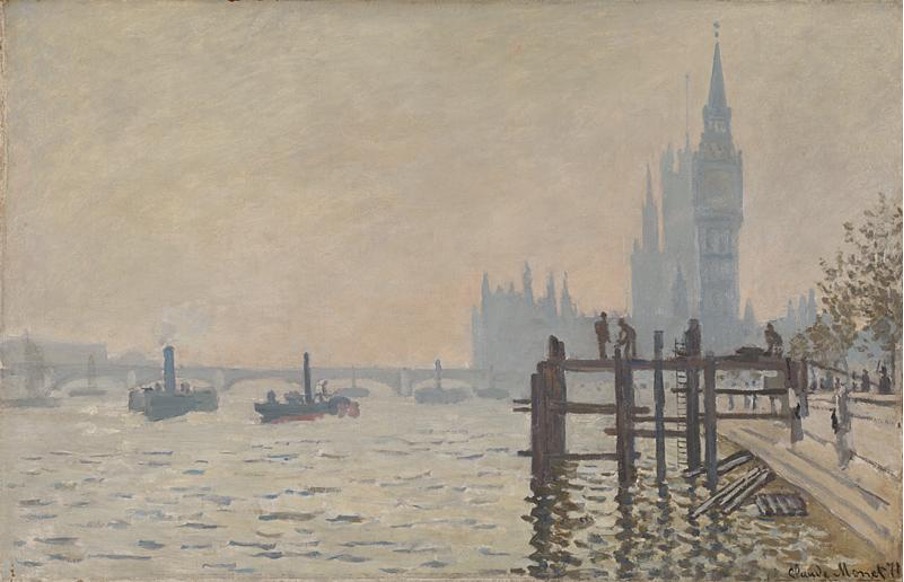
Claude Monet, The Thames Below Westminster, 1871. Oil on canvas. Image: The National Gallery
With a new wife, plenty of money, and an established reputation, Monet’s subsequent renderings of the city take a grander view. During his visits in 1899, 1900 and 1901, he no longer had to paint as a groundling, feet squelching on the banks of the river. Instead, he adopted an almost god’s-eye viewpoint from the top floor of the Savoy and from a private balcony of nearby St Thomas’s Hospital. His elevated position placed him above the fog-level, the perfect position from which to study the mercurial London air. Taking inspiration from Whistler’s Nocturnes and Turner’s Thames paintings, Monet cloaked the grimy reality of soot-clad London with a poetic miasma of colour.

James Abott McNeill Whistler, Nocturne in Blue and Silver, 1871-72. Oil on canvas. Image: Harvard Art Museum/ Fogg Museum.
Monet’s concern in this series had shifted away from London’s precise topology towards capturing what he called ‘the envelope’ – that space between the painter and his ostensible subject. It was something akin to Mallarmé’s poetic intention to suggest, rather than describe reality as we perceive it. In Monet’s pursuit with suggestion – or impression – individuals and details tend to disappear in the consuming haze of London’s famous fog, a fog which was incredibly changeable and meant he would often be working on multiple canvases simultaneously. His studio in the Savoy was littered with dozens of half-completed works that were finished intermittently over the next decade.
Though heightened, the colours of Monet’s works are indebted to the very real polluting effects of London’s industry. Sundays bored Monet because they were the one day that the Thames-side factories switched off, meaning less fog and less aesthetic effect. But even if it was only in 2020 that air pollution was officially recognised as a cause of death, the harmful effects of the emissions from factories, millions of domestic fires and ever more frequent steam engines, were well known. Monet was himself diagnosed with pleurisy during his visit to London in 1901, and lung diseases were common. In 1873 a particularly disastrous black fog had asphyxiated swathes of cattle at Smithfield’s Market, and in 1881 a ‘Smoke Abatement Exhibition’ was held at South Kensington, calling for a reduction in coal burning. By the time Monet was painting at the turn of the century, new regulations and electric lighting had reduced the number of annual fogs, but while the severity of London’s atmospheric pollution had decreased, factories continued to be built within the city itself, and its fogs turned from black to yellow.
A great example of London flaunting herself as the ‘capital of coloured fogs’ (as one French critic called it) is Charing Cross Bridge, a painting once owned by Winston Churchill and one of the first in the exhibition. The structures of the South Bank are scarcely visible behind the acid-tones of a pea-souper, and the bridge is centre stage, bi-secting the canvas energetically in a streak of grey turquoise topped with pillows of pale-blue steam. The river and the sky are one, an asthmatic concoction of apricot, lilac and dove grey brush-strokes that sets the tone of a sort of floating city that will recur in the later works.

Claude Monet, Pont de Londres (Charing Cross Bridge, London), 1902. Photograph: © The Courtauld
Other canvases make more of the unique proximity between civic and industrial structures which London offered. This wasn’t the case in Paris, where factories were pushed out to the suburbs away from the beating heart of the city. The solitary turret of Bankside Power Station is all we have left to remind us of the former abundance of factory chimneys, which litter the skyline in Waterloo Bridge, Grey Weather. In The Houses of Parliament, Sunset, the gothic splendour of Parliament shares the stage with the smudgy body of Vauxhaull’s industrial sites on the riverbank opposite, the phallic chimneys of one parodying the crenellated outline of the other, both illuminated by a pulsating coral toned-sun.

Claude Monet, Waterloo Bridge, Grey Weather, 1900. Oil on canvas. Image: Art Institute of Chicago/ Art Resource, New York/ Scala, Florence.
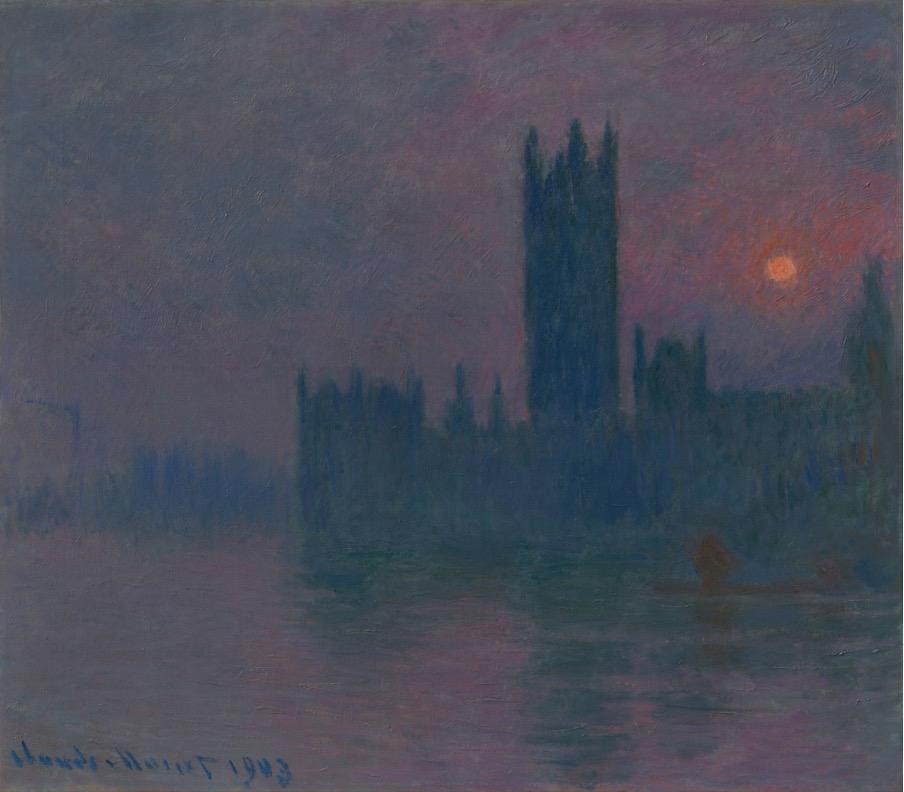
Claude Monet, The Houses of Parliament, Sunset, dated 1903. Oil on canvas. Image: Hasso Platner Collection.
Drifting past one vision of the Thames after the other, this exhibition becomes mesmeric rather than repetitive. Many canvases are so similar that it makes you back-track, comparing what minute variation Monet was trying to capture. The fact that the same few landmarks of London could fascinate Monet to this extent makes me want to see some benefit in my twice-daily shuffle through this huge city. London is ominous, industrial, outlandish and radiant by turns, but always an inspiration in each of its many guises. I tried to see some of the purples blues and greens that Monet saw when I commuted back from Victoria the next day but the sky was offensively grey. I will keep looking.
Monet and London. Views of the Thames is at the Courtauld Gallery until 19th January 2025.
By Iris Bowdler
 The Camera