

Art by Elizabeth Murphy.
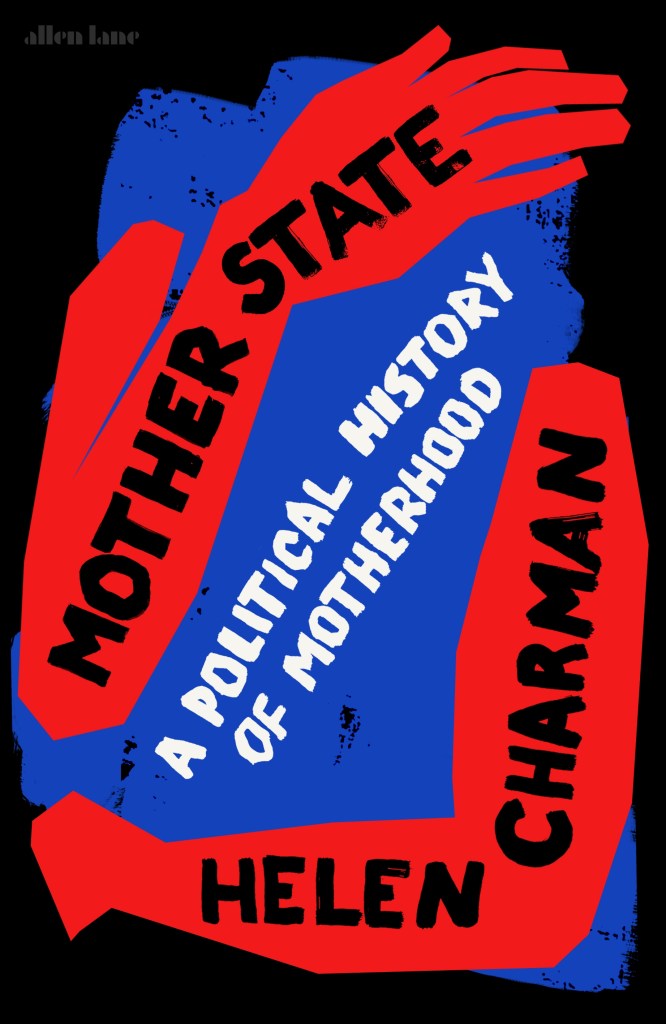
The first part of Helen Charman’s new book, Mother State: A Political History of Motherhood, begins with a momentous birth. It’s a cultural, rather than human, genesis: the premiere of the long-running, award-winning BBC drama, Call the Midwife. It might seem a surprising place to start for a book that explores motherhood in Britain and Northern Ireland across the last five decades. But, as Charman half-jokes when we speak, “Call the Midwife is an essential text” here.
Charman identifies a “cognitive disjuncture” between Call the Midwife’s booming popularity when it first aired in 2012 and the “total decimation of the values that it seems to be built on”. Its nostalgia-tinged tales of midwifery in London’s East End in the early years of the NHS coincided with the Conservative-led coalition government’s austerity policies, crippling the NHS and catalysing “this crisis in maternity services”. It was equally concurrent with the forcible eviction and displacement of East End working-class communities, “including mothers and their children”, to make space — quite literally — for the London Olympics: 450 low-cost tenancies disappeared in one fell swoop in 2007, when Clays Lane, a housing co-operative in Stratford, was demolished as part of preparations.
Call the Midwife, then, summarises some of Mother State’s central themes, all entwined in its title: “the state of actually being a mother, which includes, but is not limited to, pregnancy and birth”, “the interaction between mothers and states, which also includes its politicisation”, and the ways in which the British welfare state was itself “modelled as a maternal entity”. These three ideas are central to the book’s “basic premise”, as Charman charts her way from the 1970s women’s liberation movement to the austerity policies of the 2010s, through lesbian squats and striking miners’ wives: that “motherhood is political”. “In other words, we all know that being a certain kind of mother is frequently politicised — the single mum claiming benefits, let’s say — but motherhood is very rarely, if ever, understood as an inherently, automatically political thing.”
Charman is speaking to me over Zoom from her office in Cambridge, on a gusty day ahead of the book’s release and press tour. Mother State has been her project for the past five years, taking her through a full-time teaching contract at Durham University and Covid lockdowns where she was “just in my flat, by myself, going insane”, to her current role as Fellow in English at Clare College, Cambridge. It has its roots in the work she did for her PhD, about constructions of maternity in Victorian and early-twentieth-century novels. Throughout her doctoral research, she “couldn’t stop thinking about the present day. I couldn’t stop thinking about austerity, for example, and I couldn’t stop thinking about second-wave feminism”. Early drafts of Mother State were filled with references to George Eliot. “[M]y editor did have to very tactfully say, ‘Maybe that’s for a different book’. I think Daniel Deronda is relevant to everything, but not everyone agrees with me.”
Part of understanding motherhood as political means bringing “ambivalence” to the fore. For Charman, “maternal ambivalence” — “a doubled ambivalence”, “an ambivalence perhaps to the idea of having a child at all”, and “the ambivalence that a mother experiences in relation to their baby” — is essential. Motherhood, she explains, is not only frequently “privatised” but “shrunk”, in a way that fails to fully represent the complexity of the mothers’ testimonies that she found in the archives. “To expand the space that’s available for an understanding or consideration of motherhood is also to bring these interesting complicated mixed feelings out into the light.”
It also means bringing in the personal. “I am worried about my mother’s knees” is the surprising first line of the book’s preface. These knees are evidence of the labour her mother has performed both domestically as a mother and professionally in her decades working as an NHS physiotherapist. For Charman, it’s an important place to start: “I felt like I would be being dishonest if I didn’t situate myself within the work I was doing, and admit to the fact that it’s motivated by my own personal experience of daughterhood, as much as of inhabiting a cis woman’s body that increasingly, as I age, is being categorised as a reproductive one.” Her autobiographical anecdotes are “only as important as every single other person” mentioned in the book, part of a wider “collective tissue of experience and citation”.
The shifting political contexts of Charman’s adolescence are particularly pertinent to her analysis. She grew up as a cultural “trope”, in her words: the child of a single mother under New Labour. In sixth form, she received EMA (Educational Maintenance Allowance), giving her free travel to school; she was also part of the final year of university students in England and Wales to pay £3,000 a year in tuition fees. Both had changed by the time her brother, four years her junior, reached the same age, with austerity “massively accelerating the removal of any kind of social structural support”. EMA was cancelled in England in 2010, and the tuition fee cap was raised to £9,000 a year in 2012 (as of 2017, the cap is now £9,250). “You know”, Charman notes, “[in] the 2010 election, I couldn’t vote”. “I’ve been living with the consequences of the programme of austerity that was then enforced in 2011 onwards my whole adult life.”
Austerity isn’t Mother State’s only villain. Margaret Thatcher is introduced as “this book’s own bad mother”, and Charman admits to me that she’s “looking forward to no longer spending hours and hours of my life reading her autobiographies and her diaries”. In a chapter brilliantly entitled ‘Spilt Milk’, she lays bare the ruthless ironies of the self-cast “Iron Mother”, who took away national provisions of free school milk. She condemns Thatcher’s “nanny slash matron, ‘swallow your nasty medicine’” persona to me, noting how it enabled her supporters to “excuse cruelty as a form of care, as a form of nurture and betterment, and ignore the irony that her policies were immiserating mothers and children across the country”.
I shift the conversation stateside, out of my own curiosity, and ask Charman’s opinion on a couple of contemporary examples of motherhood and its politicisation in the US. “I’m slightly obsessed with tradwives”, she admits. She describes the viral trend of wealthy, white, conservative women who post romanticised videos of domestic and familial life as “fascinating and very scary”. She compares the “fetishization” of domestic labour to the pleasure dairies where aristocratic women pretended to churn butter in the eighteenth and nineteenth centuries, and links the trend’s popularity to the rise of a “reactionary, anti-feminist ‘feminism’” based on “incredibly reductive, essentialist arguments about women and what women are like and what women do.”
The upcoming US presidential election has thrown the insidiousness underlying this seemingly frivolous trend into sharp relief. Thanks to the 2022 overturning of Roe v. Wade, women’s reproductive rights have become a fraught battleground. Political commentators are broadly agreed that Kamala Harris is running on a ticket of women’s reproductive freedom, while the Republican vice-presidential candidate JD Vance has come under fire for describing senior Democrats including Harris and Alexandria Ocasio-Cortez as “childless cat ladies”. For Charman, this latter comment requires less analysis than the tradwife trend. “It’s so classically misogynist, right? […] The idea of the book is exactly in opposition to that. It’s saying it doesn’t matter whether or not you yourself have a baby, want to have a baby, will have a baby, whatever. We all have a stake in the social future, and we all have a responsibility to our neighbours.”
This is Mother State’s main success. It redefines its key term, showing, in Charman’s words, “that mothering and motherhood are in fact relevant to everybody”, whether you have children, whether you have a reproductive body capable of bearing children. Charman performs a careful balancing act of rigorous theory alongside an impressive array of anecdotes (such as the fact that Queen Victoria’s use of chloroform during the birth of her eighth child in 1853 normalised anaesthesia in childbirth). It’s a combination that makes the material at once intellectual and entertaining, and should appeal to a wide range of audiences. After all, as Charman passionately declares, “This is something that is relevant to you. It’s relevant to all of us. There are no neutral bystanders”.
Mother State: A Political History of Motherhood by Helen Charman is published by Allen Lane, released 29 August 2024.
By Rachel Rees.
 The Camera