
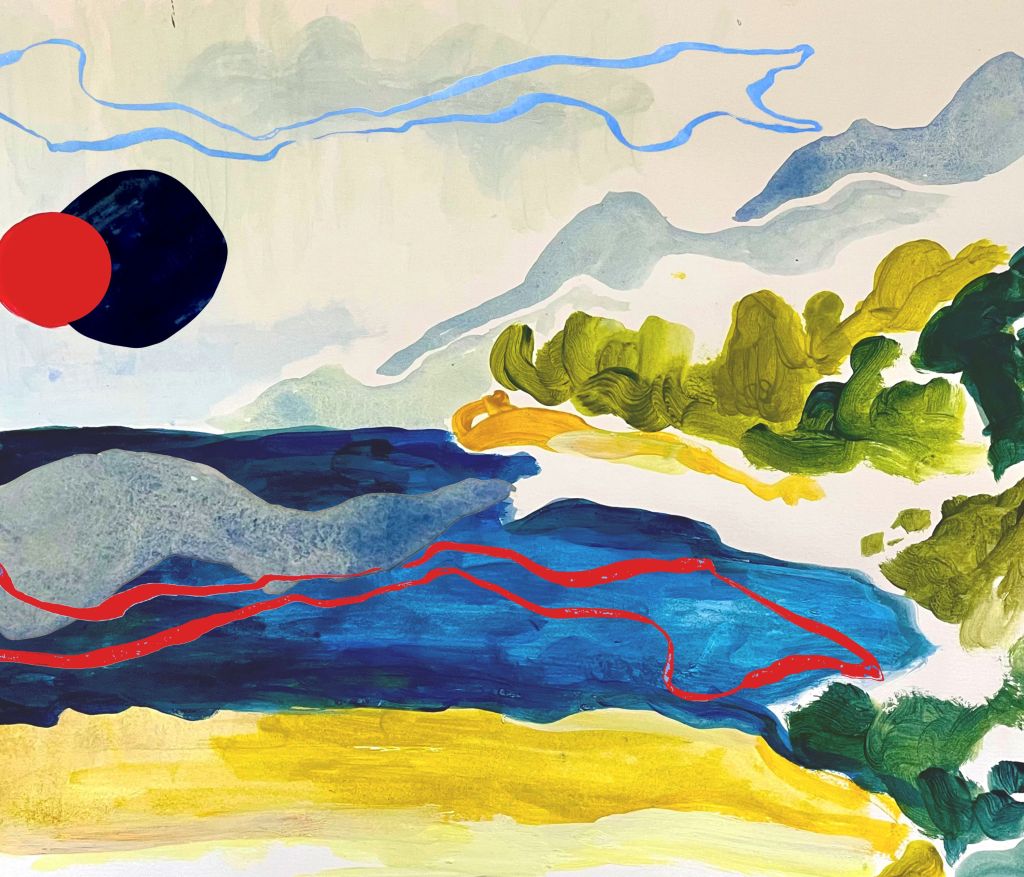
Art by Iris Bowdler.
Sixteen years ago, Rebecca Frayn was standing outside the House of Commons with a placard: “There are lots of pictures of me — it’s usually raining — and it says, Climate Action Now.” At a time when climate activism still felt marginal, she set up a direct action group with members of her book club, fellow mothers concerned about their childrens’ futures. Yet, she admits, “I got so demoralised, I lost my hope, I got so burnt out. It became a mental health issue.” Frayn instead turned to what she labels “hope-filled solutions”, lobbying for a public wildflower meadow which I pass en route to meeting her, to discuss her recent novel, Lost in Ibiza.
We meet in her London family home, but Ibiza is where Frayn spends most of her time. Alongside her youtuber-turned-environmentalist son Finn Harries, she renovated a five-hundred-year-old ‘finca’ and formed Can Pep, a regenerative farm. When I ask what exactly regenerative means, Frayn explains how “plant-based solutions” turn carbon into an “an incredible turbocharged natural fertiliser for plants”, transforming the land into a huge “carbon sink”. It all sounds pretty magical to me and that’s even before she mentions the “eco pond” and “edible forest” open to the public.
Can Pep is nestled in the north of the island, and these rural expanses also form the setting of Lost in Ibiza. Rather than farms, Frayn focuses here on the ever-increasing construction of luxury villas: William Gibson, one of the novel’s protagonists, is involved in this enterprise. It is the arrival of his estranged daughter Alice, a twenty-one-year-old environmental activist, that brings to life the confrontation between the untouched landscape and the abrasive property development as we witness their accidental journey across the Ibizan countryside.
It is tempting to read Alice as a semi-autobiographical depiction of the author, but William Gibson certainly doesn’t recall Frayn’s father, the acclaimed playwright and novelist Michael Frayn. Instead, she draws a comparison between herself and this privileged character. She writes in full recognition that she is “part of that community” of expats, emphasising to me that “I’m sort of sending myself up as much as I am anyone else on the island.”
So father and daughter symbolise two sides of a personal conflict: “I’m both a consumer in my everyday life and I’m an environmental activist. I embody this contradiction, and therefore a continuing anxiety that I think a lot of people have now, that I feel that everything that I do is implicated in harming the planet. The novel gave me an opportunity to split that dichotomy and that internal debate into two characters who debate with each other.”
It took fourteen years to flesh out these characters and ensure that any didacticism remained in the novel’s “underbelly”. During this process, Frayn learnt to centre sympathy over judgement: “In the end we all believe that our belief systems have a rationale. So why is someone like William Gibson, the property developer, aware of the environmental issues but reluctant to meet them? How has Cressida [William’s wife], an educated woman who has had a career, got so lost in the affluence of the world? How is she so adrift? I think that’s a really interesting challenge to take on people that you might not feel very sympathetic towards in life, but really, really try and open up their worlds as powerfully and credibly as possible.”
Frayn lays bare these belief systems through snippets of internal monologue scattered throughout Lost in Ibiza. Cressida’s discursive framework consists of “artificially positive constructs” of the live, laugh, love ilk, whereas William’s “consumer thoughts” are rendered in the language of property adverts. Frayn proposes that faith in the spoils of western capitalism has come to replace religious fervour, reflecting that the constant voices telling us that “‘Our lives will be better if we buy this…’, ‘we will be admired if we buy this…’, ‘we’ll find peace of mind’” are, in her eyes, “parallel to someone with deeply religious feelings. That if they do this, then God will look on them kindly… If they do this, they will buy easier access to heaven.”
Mary, who completes the quartet of key characters, represents this religious standpoint. She works for the Gibson household to provide for her family in the Philippines, and her constant recourse to God contrasts with the italicised thoughts of her employers. Visiting affluent neighbours, Frayn was struck by the “invisible” presence of housekeepers like Mary: “you arrive and you’re not introduced to them. You’re introduced to everyone else in the room, but not this person who’s putting things on the table or cooking behind the counter.”
It took an interview process conducted “over a number of years” for Frayn to feel that she could tell a story of Filipino immigration, but she stalled “about five or six years ago”, questioning whether “I would be allowed, without getting into terrible trouble, to tell that perspective.” Yet, when she considered removing Mary, Frayn “realised that I would rather just abandon the whole story because she became the salt in the story. She leavens what would have just been about white privilege, and I don’t think that’s that interesting, so it’s a counternarrative.”
Frayn’s 2020 screenplay Misbehaviour also embraced the potential controversy of counternarratives. Centred on the disruption of the 1970 Miss World contest by the burgeoning Women’s Liberation Movement, the film simultaneously explores the success of Jennifer Hosten, the first black woman to win the competition. How did Frayn tackle these two alternative visions of progress? “I began by trying to smooth it all over. I was a bit embarrassed — I couldn’t work out how you celebrated Jennifer Hosten and then I thought, no, the contradictions are the story.”
Misbehaviour was an outlier for Frayn, who is “kind of allergic to period pieces” — “the world that we’re living in now is so extraordinary, so puzzling, so terrifying, so remarkable, that I don’t know why we would do anything other than try and capture it.” But this insistence on depicting the contemporary meant that Lost in Ibiza had to shape-shift across the fourteen years of its creation. The character of William was initially “completely and utterly oblivious” of the climate crisis, but it became “increasingly impossible to believe that anyone is not reading enough to know.” As a result, the novel is “about knowing, but still not responding”, an attitude rife in our scientifically-informed, but wilfully ignorant society.
Given the current conversation on environmental activism and apathy, it is unsurprising that the BFI have commissioned Frayn to write a screenplay of Lost in Ibiza. When Frayn and I meet, the lengthy sentences of the five Just Stop Oil activists who disrupted the M25 in 2022 have just been announced (four to five years each for non-violent protest), casting a gloomy light over the fictional Alice’s impending court trial. Recent news about Dr Michael Moseley and Jay Slater has also lent an eerily tragic relevance to the ‘getting lost’ element of the plot. Ultimately though, the novel is a thriller rather than a tragedy, and the visual riches of the Ibizan landscape will be fully exploited in a feature film format. As Frayn notes, “the cinematic beauty of the island, the intensity of the experience of being there in the heat, gives it an emotional charge that I don’t think you’d have found in rainy London.”
All the proceeds from Lost in Ibiza will fittingly go towards the farm at Can Pep, which has been mentioned throughout the press run. But Frayn also views the novel as an environmental act in its own right, hoping that “the book gently raises questions about moral myopia: How engaged are we? What are we doing? What can we be doing?”. This fictional approach must feel unfamiliar for someone previously involved in direct action and documentary-making. Before I leave, I ask Frayn if she has anything else she’d like to discuss. Her answer is a question itself, one directed somewhat desperately towards a member of Alice’s generation: “I wonder, do you think that novels have become so marginalised that it’s very utopian to think of them as a potential forum for campaigning?” I hope not.

Lost in Ibiza is published by Whitefox Publishing, released April 2024.
By Hope Nicholson.
 The Camera