
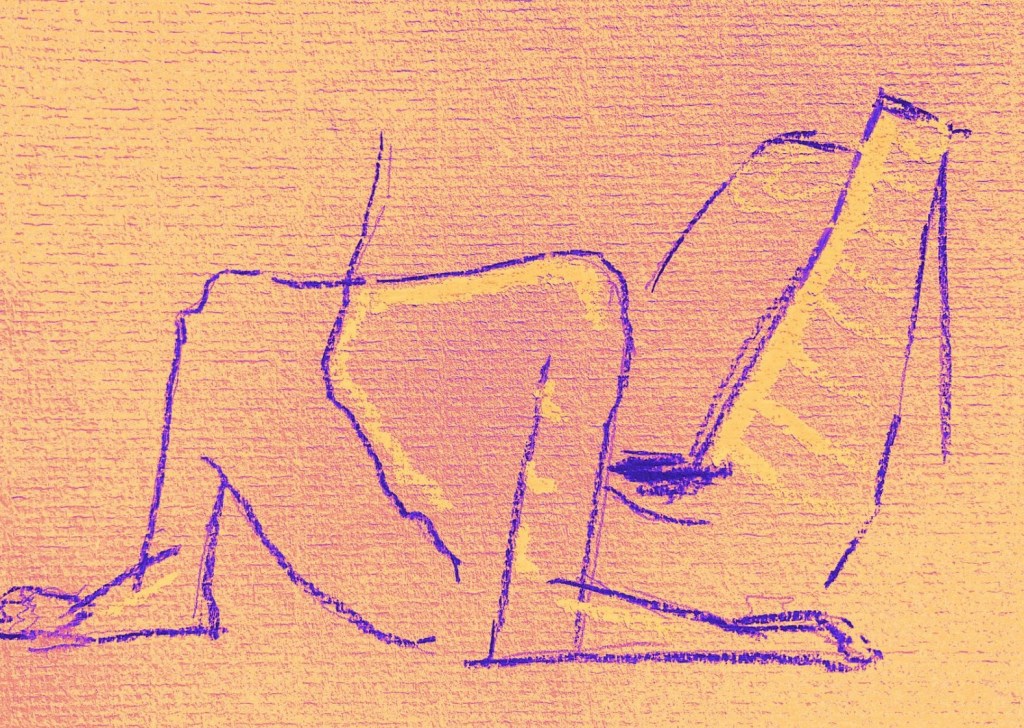
Art by Elizabeth Murphy.
The face of Botticelli’s Venus is stalking Cambridge residents. I can’t open my phone, or cycle to the concrete palaces of Sidgwick without seeing her multiple times en route. She hasn’t left the National Gallery since she was first acquired, 150 years ago, so perhaps she’s enjoying her holiday — she’ll be at the Fitzwilliam until 10 September, as part of the National Gallery’s loan scheme to celebrate their 200th birthday. While Venus is the quintessential Renaissance cover-girl — creamy skin, high forehead, impossibly intricate golden hair — there is something yearning behind her eyes that is more complex. What the posters don’t show is the object of Venus’s gaze — the lazily reclining, all-but-naked body of Mars, her lover, a skimpy loincloth draped over his lap and his Jim Morrison curls thrown back dozily. Reading the tension, or lack thereof, between the two, I can’t help but think of the orgasm gap.
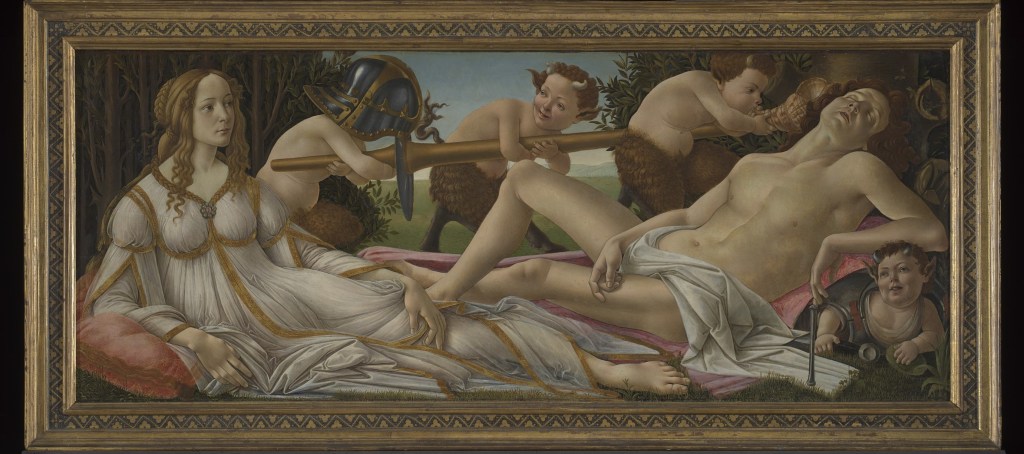
Sandro Botticelli, ‘Venus and Mars’, c. 1485, Tempera © The National Gallery London.
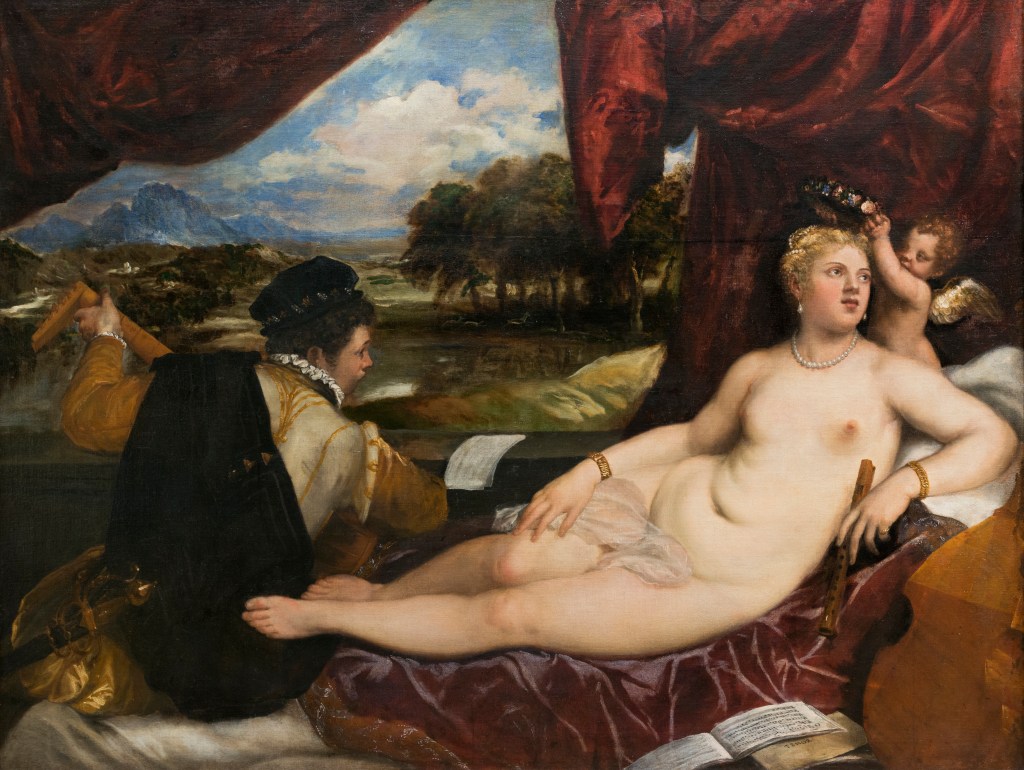
It’s not uncommon for Renaissance paintings to make use of lewd visual jokes, and I am not the first to look at the amusingly flaccid hand in Mars’s lap and think it significant. But you won’t be able to read much about the dynamics of sexual pleasure in this micro-exhibition. Instead, they’re inviting visitors to consider the broader subject of gendered nudity, selecting their own Renaissance nude as a companion piece; Titian’s Venus and Cupid with a lute-player (c. 1555-65) hangs opposite. It’s almost a century later than Botticelli’s painting, and stages the more familiar sight of the supine female naked body, littered with jewellery and theatrically enshrined amid red damask drapery. Titian’s Venus is also gazing off to the right, but it’s implied she’s lost in musical reverie, rather than niggled by sexual frustration.
Completing the immersive setting in the gallery are a couple of Maiolica dish depicting Peleus and Thetis (a sort of inverted Leda and the swan) and a bronze statuette of the Apollo Belvedere, both owned by renowned patron of the arts, Isabella d’Este. In the period between the painting of Botticelli’s and Titian’s Venuses the classicised nude became ever more present in visual culture, as the headings on the walls highlight: nudity is “at the dinner table”, “in the study”, as well as “in the bedchamber”. The curators are asking us to think about “love and looking”, in a manner that reminds me slightly too much of my 16-year-old obsession with John Berger’s Ways of Seeing: “Men look at women. Women watch themselves being looked at.”
Tiziano Vecellio (Titian), ‘Venus and Cupid with a lute-player’, 1555-1565 © The Fitzwilliam Museum, University of Cambridge.
But the more I’ve thought about the Botticelli (and I have been, all morning, rather than working on my dissertation), the more Venus’s expression seems unexpectedly contemporary, and almost poignant. The imbalance of the nudity shifts the dynamics of Berger’s male-gaze-on-female-body. Mars is not looking at his lover, Venus, at all. To all intents and purposes, he is fast asleep. Gabriele Finaldi, the Director of the National Gallery, who was welcoming the Botticelli to the Fitzwilliam at the same time as me, tells me that “the assumption must be that this is after a night of passion and he’s completely exhausted”.
I’m almost embarrassed to admit that I didn’t acknowledge the post-coital nature of the setting until he pointed it out. There’s something quite menacing about the densely cropped wooded scene, with its pot-bellied putti, and surprisingly prudish, clothed Venus, that didn’t make me think of sex. But Botticelli is evidently making a comment on the unmanning of warrior Mars: his armorial accoutrements lie all around him, his lance is about to be pilfered by one faunlet, and another fails to rouse him by blowing a conch right into his ear. Because of Mars’s pietà-like state of undress, his youthful form, gaping pink lips and evident passivity, Finaldi sees it as “a sort of subversion of the traditional theme when you see Mars and Venus together”. I suppose he’s thinking of renderings of this scene by Titian, or Veronese, where Venus is almost totally exposed and her lover (bearded and buckled in armour) is draped around her proprietorially.
Finaldi says the painting is both “high poetry… and also very much about basic instincts”. To return to Venus’s face, the nature of this “basic instinct” intrigues me. Likely commissioned as a wedding gift and intended to be placed within a bedroom, the erotic undertones are blatant (despite my initial naivety). But for me, it’s also about unfulfilled desire. Botticelli’s Venus isn’t coquettishly lustful, but more demurely expectant. Her eyebrows are ever-so-slightly raised, her posture alert, neck tilted towards Mars, while he leans back, away, and unpreoccupied by her. As the goddess of love and fertility, one of the most desirable beings in the classical world, of course she’s aware when she is not being looked at. Even if she is wearing what would be considered as an undergarment in the fifteenth century, she is too unruffled to be in a post-coital state of bliss.
Botticelli was working in a time during which it was widely accepted that mutual orgasm was necessary for conception, and when it was also believed that looking at a beautiful image during sex would magically transfer its beauty onto your future child. But what about placing a representation of a spent, emasculated god in a room meant for sexual fulfilment? The questions of erotic power dynamics also linger behind Finaldi’s brief allusion to the “high poetry” of the painting, with its acknowledged link to Lucretius’s ekphrastic opening to De rerum natura. In his long, Latin poem, he describes Mars “vanquished by the ever-living wound of love”, “gaping” at Venus, his “shapely neck thrown back”, while she bends over him. While Lucretius’s poem celebrates Venus’s power over Mars, Botticelli’s god of war is less attentive, but every bit as vanquished. His deviation from this gaping, adoring version must be intentional, and it foregrounds Venus’s unsatisfaction. Yes, Venus and Mars expresses the triumph of love over violent strife, but it leaves much to be desired for its female protagonist.
There is a complex history of female sexual pleasure in painting. Mostly this relates to the taboo of masturbation, and is raised by art critics who like to read erotic meaning into indelicately coiled fingers (there is a pervasive love of euphemism in the art world). Giorgioni’s Sleeping Venus (1510) is an early example, showing her reclining body with a hand suspiciously resting on her inner thigh. Titian’s Venus of Urbino (1534) is the most renowned instance, again because of its provocative hand placement, combined with a knowing look out towards the viewer. In 1864 Swinburne wondered how “any creature can be decently virtuous within thirty square miles of it”, and Mark Twain a few decades later dubbed it “the foulest, the vilest, the obscenest picture in the world”.
Such were the remarks of nineteenth-century men, but has much changed? I had a heated discussion recently on the subject of Billie Eilish’s revelation that she likes to masturbate in front of a mirror. In an interview for Rolling Stone, she advocates it because “[y]ou can manufacture the situation you’re in to make sure you look good. You can make the light super dim, you can be in a specific outfit or in a specific position that’s more flattering” and the result is a circumvention of body-dysmorphia. It makes her feel “empowered and comfortable”. She’s setting the scene for herself alright — a modern day Rokeby Venus admiring her reflection, a painting which, incidentally, is also part of the National Gallery’s loan scheme, in Liverpool. But how much of her self-love is narcissism, we wondered, or reflective of good old John Berger’s internalised male gaze, or Laura Mulvey’s scopophilia, for that matter?
I wonder if Botticelli’s Venus is troubled by such thoughts. Luckily or unluckily for her, she’s about to be caught with her lover in an invisible bronze net forged by her husband, Vulcan. Something about the painful way her hair is plaited into the neckline of her dress hints at this entrapment.
Not all of Botticelli’s women are this open to reading. The heroine of the Birth of Venus (painted around the same time as Venus and Mars) is apparently untroubled by the blatant spectatorship of her body. When Uma Therman imitated this painting in The Adventures of Baron Munchausen (1988), her expression is less vacant and more supercilious, as she looks down at the slimy voyeurism her shell-emergent spectacle is encouraging. There is a slightly odder expression in Botticelli’s earlier work, Allegorical Portrait of a Young Woman (c. 1475), in which the sitter looks upwards in profile, eyes glazed, as she squeezes a jet of milk from her breast. Cindy Sherman imitated it, or one very like it, in her series of photographs based on the works of old masters (this one is no. 225). Sherman captured the total unreality of this woman acting as sex-object: her vacuity is more troubling, the gravity-defying breast more bizarre, the renaissance hairstyling more improbable, when it is put to us in the textural palpability of her photography.
My point isn’t that Botticelli doesn’t know how to represent a woman’s awareness of her status as sex object, but rather that, as Venus and Mars demonstrates, he does — and he deploys this ability carefully. Unlike these other works, the Fitzwilliam Museum’s new painting is about a couple, and the intimacy that occurs between them. It’s a Renaissance ‘conversation piece’, after all, and it might be a good place to debate how this intimacy can go astray.
National Treasures: Botticelli in Cambridge is on at the Fitzwilliam Museum, Cambridge, until 10 September.
By Iris Bowdler.
 The Camera