
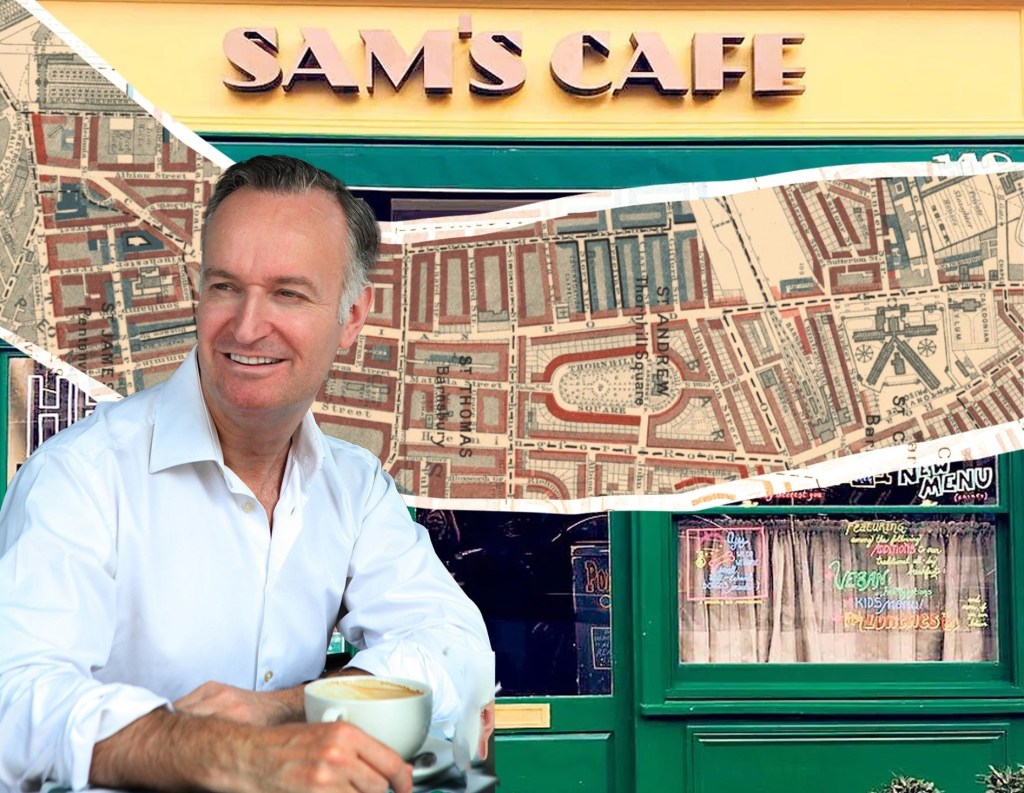
Andrew O’Hagan (photograph by Christina Jansen). Art by Elizabeth Murphy and Troy Fielder.
When I meet Andrew O’Hagan at Cambridge Station, grey clouds are looming. His optimistic sunglasses are replaced with an umbrella as the heavens open, and sleet begins to fall. The umbrella is a recent creation by the London Review of Books, the publication for which O’Hagan is editor at large. Big, blue, and emblazoned with the magazine’s logo, it’s on its first outing — and perhaps its last (it promptly turns inside out battling the elements). He jokes that he’s going to have to pass on some constructive criticism to the team.
We’re on our way to his talk at the Cambridge Literary Festival, where we continue to chat in the green room throughout sound checks, armed with lukewarm tea — “Tepid. The worst word to go with tea”. O’Hagan is in the middle of a hectic press tour for his new novel, Caledonian Road. So hectic, in fact, that we run out of time, and have to meet again a week and a half later in Sam’s Café, the Primrose Hill café he co-owns with a friend. Here the coffees are hotter, the weather not much better (“bit of a pissy day, isn’t it?”, he remarks), and O’Hagan just as elegantly rushed, ahead of a radio interview in Marylebone.
At over 600 pages, Caledonian Road has taken ten years to write (though, as he explains, in a way it’s been a project for “my whole life”). Set around the Islington road of the title, it centres on Campbell Flynn, middle-aged Scottish art historian and figurehead of the liberal London intelligentsia, as his world collapses around him. London’s institutions — the National Gallery, the Wolseley, the Old Bailey, Whitehall — are the pillars of the upper middle class world that Campbell and his peers inhabit. The city is no mere backdrop: “It’s a living character. It’s the biggest character in this book. And it will survive anything. Even Boris Johnson.”
O’Hagan grew up in Ayrshire (one of the settings of his previous novel, Mayflies), but he has lived in London for decades. “London and Scotland are in conversation every day of my life, and every page of this novel”. With London,“everything you can prove you can equally prove its opposite”, meaning “you can prove anything”. But Scotland is also ever-present, from Campbell’s roots and the titular road’s historic Scottish connections, to O’Hagan himself. He explains that as a writer, you “have your places, your favourite places”, and “you kind of dream in those places most often.” Does he dream more in London, or in Scotland? “Equally, now, in both” — and “that was the signal” for Caledonian Road.
Writing a London novel means “consorting — even if we need to refuse them — with the great London novelists”, Charles Dickens especially. Caledonian Road is “an attempt to modernise the Victorian idea of what the novel was”, examining how “the new technologies” — especially the internet and social media — “had affected community, ideology and money in a big urban setting”. Dickens’ novels might write about a society long gone, but “it’s the same picture, even allowing for nearly 200 years of development in social welfare, the NHS, feminism, technology, human rights”. O’Hagan notes that Charles Booth’s nineteenth-century poverty maps show that there are “still the same inequalities, even in the same roads.” These persisting social disparities are “an engine, morally, for a book like this.”
With its interest in ideology and inequality, Caledonian Road has a lot in common with O’Hagan’s politically-minded non-fiction writing for publications like the LRB and New Yorker. In fact, he adopted the same research approach: he went to courthouses and press conferences, speaking to street gangs in London and royalty at a polo match. But fiction offered him something those essays lacked: the ability to “go inside the characters and show the connections between them”. It also gave him a certain freedom of tone. A humorous impulse ultimately fuels Caledonian Road. It’s a “volumized comedy”: “on every page, there’s a kind of opening out to the ridiculous.”
The same impulse lies behind his love for one of his favourite literary forms, the review essay. The LRB is one of the few remaining homes for this “great British form”, as he terms it, the allure of which is that the subject under review is “only the jumping off point”. “It allows for comic and personal energy to come into a piece. And that’s the kind of energy I’ve always liked”. Essentially, “It’s an occasion for a writer to take the piss.” Unsurprisingly, then, O’Hagan’s favourite pieces of work (though “it’s like asking me my favourite record, you’d get a different answer every day”) have been the funny ones. Writing about Spare or the Daily Mail is his idea of “a perfect assignment”: “it’s just not natural to me to be morose.”
His review of Spare, titled ‘Off His Royal Tits’, is as gleefully scathing as you would imagine. And though O’Hagan is “sure Prince Harry doesn’t give a toss what I have to say”, he does light-heartedly warn me that “whether people have written their books or not, it doesn’t stop them from being vain about them”. He would know – he once started ghost-writing an autobiography for Julian Assange, the founder of Wikileaks, before the project collapsed, prompting an illuminating piece for the LRB on Assange’s vanity and ego. He wouldn’t have taken on Spare, but there is one ghost-writing opportunity he’d jump at: Donald Trump’s autobiography. “I’d love to write about him up close,” he says. Although, given his record as “the expert at failed ghost-writing”, “if I was to fuck up by actually doing one that works, that would be less satisfying.”
O’Hagan garnered most attention, however, for a far more sober piece. In his 2018 essay, ‘The Tower’, the longest piece ever published in the LRB, he attempted to assign responsibility for the failings behind the Grenfell disaster, one year on. His criticism of the pervading media narrative and local activists was controversially received, and he himself was accused of misrepresenting the facts — “mortally offensive”, but “I had to just take it on the chin”. He’s still stung by the response, not so much by the criticism itself but by, in his eyes, its uninformedness. He describes the online reaction as “four thousand people shouting at you, brandishing pitch forks, only about four of whom have actually read your piece”: “you’re kind of litigated on social media in a way that often has no real relationship with reality.”
In his eyes, the LRB’s role is “to go under the news, to tell the stories that weren’t being told, and to offer arguments that perhaps weren’t allowed to be developed elsewhere”. He’s worked at the publication for decades. “I started when I was your age, it seems like yesterday. We’ve been busy the whole time, put it that way.” When he first joined, there was only one computer, and they were still “carrying semicolons around on the back of a scalpel.” As editor at large (essentially an “ambassador” for the paper, particularly when carrying his branded umbrella), he remains fiercely proud of its “patient and inquiring” approach to journalism.
Aside from Caledonian Road’s international press tour (which sees him visit Australia, the US, and Canada), O’Hagan is preparing for upcoming LRB essays on Christopher Isherwood and the Republican National Convention in July. On top of that, he’s got “a big pile” of friends’ books to read, and tries to go to Sam’s Café every morning. He’s certainly busy, but in his eyes, “It’s lovely to live in a world where there’s so much to consider”. It’s “the most enjoyable circumstance if you’re a working writer. I mean, I’m a typical person of letters. I was a born person of letters. I write and read all day. […] The work for me is everything, and it doesn’t even feel like work anymore. Any more than breathing feels like work. It’s what I do to go on.”

Image credit: Faber.
Caledonian Road by Andrew O’Hagan is published by Faber, released April 2024.
By Rachel Rees.
 The Camera