
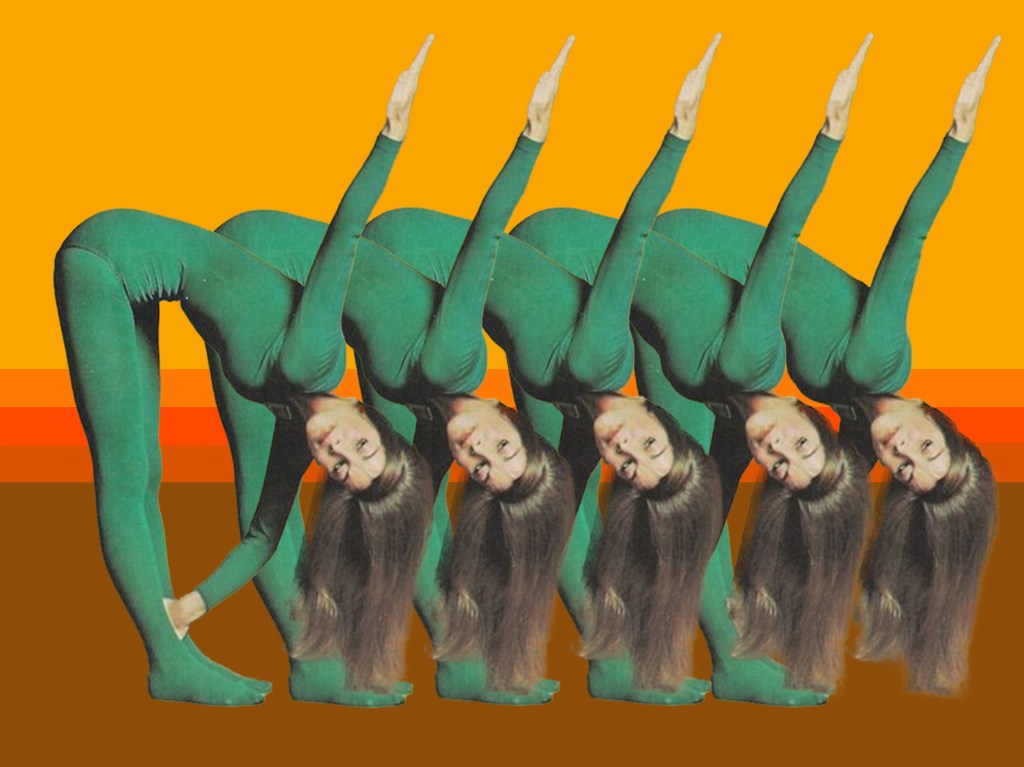
Art by Elizabeth Murphy.
The first written record of ‘wellness’ dates to 1654, in a diary entry by the Scottish statesman Archibald Johnston, where he records with relief that his daughter has recovered from a period of flu and blesses God for her present ‘wealnesse’. It is surprisingly literal – an antonym for illness. Its straightforwardness feels estranged from its modern iteration. ‘Wellness’ is now a lifestyle, an ethos, a purchasable product. It has mutated and absorbed a whole host of health-adjacent practices: ‘clean’ eating, self-care, mindfulness, stress reduction. It is an industrial commercial machine with an estimated global value of $4.5 trillion. Wellness in its present iteration is a bizarrely descended offspring of Johnston’s ‘wealnesse’.
Accordingly, then, James Riley’s new book Well Beings: How the Seventies Lost Its Mind and Taught Us to Find Ourselves begins on a wellness cruise. It is 2019, and we are on Edge, the flagship liner of the high-end travel company Celebrity Cruises. Gwyneth Paltrow’s company Goop is the guest of honour, and enamoured with the whole thing (“‘I love being on the water, I love being by the water, and I love being in the water,’ she told USA Today with a typical combination of the vague and the obvious”). Goop, the apex or nadir of modern ‘wellness’ depending on your inclinations, is the point from which Riley begins retracing his history. To recover when, where, and how ‘wellness’ made this shift from Johnston to Paltrow, the book takes us on a roaming, eclectic tour of the 1970s via film, literature, and music, and pieces together the development of the New Age health movement.
Speaking to Riley is a bit like speaking to an encyclopaedia of the 1970s, if it grew legs. In our chat, the cultural references zip and fizz from the writings of biostatisticians, to comic strips and Saturday Night Fever; the decade is eminently at his fingertips. To a degree, this is a part of the day job. As Fellow in English at Girton College, Cambridge, Riley’s research is focused on the countercultures of the mid-twentieth century. Yet Well Beings is refreshingly non-stuffy. A cultural history written with the narrative drive of a novel, there is a distinct fair-mindedness to how Riley treats the methods of wellness, trialling everything from primal screaming to flotation tanks. It is a follow up to The Bad Trip (2019), a cultural history of the late 1960s, and a hopeful precursor to a third instalment. “They are intended to be something akin to a non-fiction trilogy that covers the end of the twentieth century,” he explains. The probing question for Riley is “Why do we remember the decades in that particular way?”
Decades are convenient devices for historico-cultural critics, especially given how they form in the public psyche retrospectively. “You have the idea of the 1960s and the 1970s as being somewhat different from ‘the Sixties’ and ‘the Seventies’. One being the actual historical period, the other one being the idea, the aura, the spirit of it.” In dealing with these less strictly determined measurements, Riley finds “There is always this overlap.” Well Beings’ conclusion in 1984 is intentional. “Symbolically there’s two spectres that come to the fore this year: it is, of course, the year of George Orwell’s Nineteen-Eighty Four (1949), and brings with it all of the novel’s dystopian anxieties. But also the AIDS crisis reaches a certain level of public awareness, which had a big bearing upon wellness and what it meant, and what it was seen not to be able to do.”
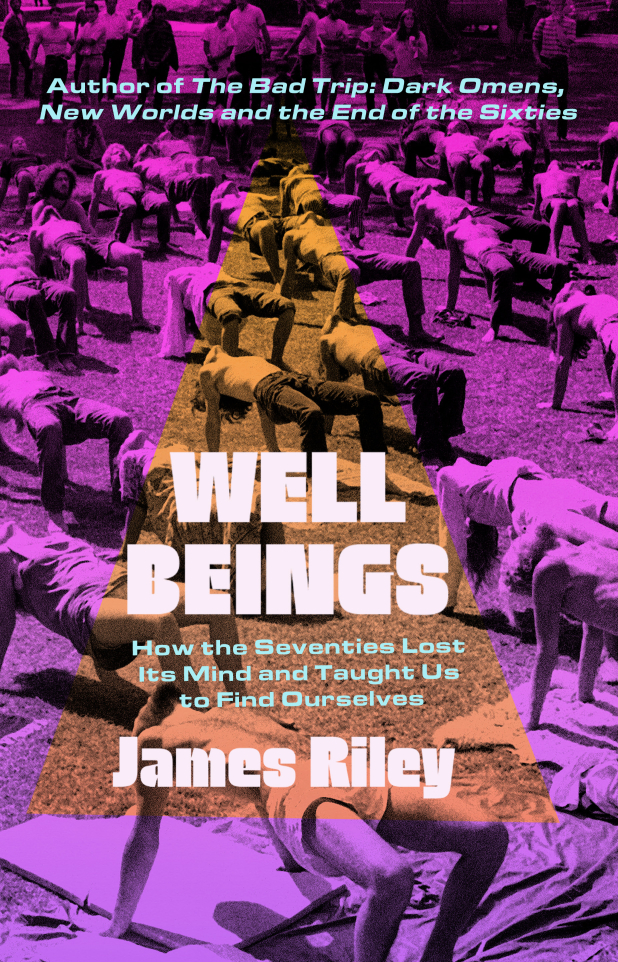
Image courtesy of Icon Books.
So, what exactly did wellness mean in the 1970s? “Wellness was much more a subset of what we might call the Human Potential Movement,” Riley says. Influenced by Aldous Huxley and associated with the Californian end of the alternative health spectrum, this strain of thinking constellated around Big Sur’s Esalen Institute, a sort of geographical epicentre of the movement today. The seminal text is Halbert L. Dunn’s High Level Wellness (1961), which advocates a similar, but more practical, set of ideas. Wellness in Dunn’s thesis is a way of realising one’s health-related potential on the basis of being more than ‘not ill’ in one’s life. Crucially for Dunn – and for Riley – this conception of wellness was connected to a vision of a better society: it pertains to a politically motivated, altruistic agenda. “He talked about the human individual and their health as part of a much bigger ecology at the same time. So, investment into individual health is inevitably going to be an investment into social health.”
This social dimension of wellness is for Riley where there is the biggest disconnect to our modern day. “It’s not just that wellness has become commercialised. It always needed financial impetus. Commodification and commercialization are not the problem here. It’s the ideological shift from thinking about the individual as connected to everybody else, to being seen as a necessarily solitary, exclusive, if not elite, pursuit. And that I think is ultimately socially corrosive.”
It became apparent that what wellness meant in the 1970s was increasingly pertinent to the realities of lockdown in 2020: “you’re having to adapt to that new atomized social structure. Social links became very important.” Historical writers often like to hook their studies to the present day, a justification of their subject’s influence and relevance. Riley had the strange experience of his subject matter becoming an urgent zeitgeist. The context of the pandemic undeniably had a bearing upon the polemic of Well Beings. (“Semi-apocalyptic possible extinction events do tend to focus the mind,” he quips.) It takes something like a pandemic to indicate how our patterns of working were making us ‘unwell’. But despite this raise in profile, Riley sees no change. For wellness to do the work that people in the 70s were hoping for, he argues, it needs institutional support: “It ultimately needs to be top down.”
We speak in the week following Prime Minister Rishi Sunak’s complaints about Britain’s ‘sick note culture’, arguing people are not “three times sicker than before he came to power”. Riley critiques this as a policy borne from “chronic misunderstanding”. “What causes people to go off sick is not their laziness. It’s the fact that the job is so precarious, very difficult, and there’s no surrounding structure to go with it.” He returns to this idea of the ecology of wellness: “You’ve got to sort out all the issues that are connected to it. We need to end zero-hour contracts and no-fault evictions. We need to serious consider the provision of a universal basic income. We need a parallel, fully functioning National Mental Health Service. When all that’s sorted out, then we can talk about cutting sick days.”
Riley’s diagnosis of the cause of our general malaise in 2024 is the individualism of health. There is a moral obligation for – and on some level, a moral judgement of – those who are not ‘well’, and a displacement of responsibility from overarching institutions. The slippery language of wellness in part permits this, and has been readily absorbed by corporate culture. ‘Mindfulness’, for instance, is increasingly provided by employers in lieu of a host of alternative measures (more staff, better pay, less taxing hours). The onus is on the individual to deal with the stresses, rather than question why these stresses have been created in the first place. In an Amazon warehouse, for example, there are ‘AmaZen’ booths where “you can have music played and wind blown in your face, and come out completely refreshed. But they’re in full view of everyone else, so of course no one’s going to go in, because if you do you are saying. ‘Look everyone, I can’t handle it.’ So hardly anyone uses it, thus there’s no problem with stress, and so Amazon solves its own problem.”
As much as Riley’s book is about retracing the origins of a movement from which we have drifted, he is equally wary of indulging too heavily in a mode of cultural nostalgia. He is keen to point out the similar problems and patterns that persist from the 1970s to today. “I see this [nostalgia] in terms of mental health help and provision at university level. There are always voices in the university community that basically say, ‘Just pull yourself together and join the rowing team. When I was a Cambridge Blue, we never worried about mental health.’” On this point, Riley becomes notably impassioned. “I’m an English Fellow, but I’m also very heavily involved in tutorial elements,” Riley explains, referring to positions responsible for pastoral support in Cambridge colleges. “I’m very critical of those viewpoints that say tutorial support services are somehow indulgent or unnecessary.”
In the course of his research for Well Beings, Riley learnt of the first specifically dedicated university counselling service in the UK. In 1971, Leicester Polytechnic (now De Montfort University) appointed a dedicated ‘Welfare Officer’. Jean Clark soon established one of the first British student counselling services, influenced by some ideas coming out of California. Unsurprisingly, she was quickly overwhelmed by people seeking help. The main concerns? Financial problems, discontent with university services, culture shock, and anxiety over future careers. In other words, Riley says, “If you look at today’s extremely overburdened, oversubscribed university counselling service, the problems they are dealing with are exactly the same as those of the first University Counselling service. It’s simply not the case that the prior generation who were at university in the 1970s just didn’t worry about this stuff.”
From universities to cruise ships, Riley deftly shows how far we have drifted from the socially grounded culture of wellness that was prominent in the ‘70s. Recovering an idea of ‘wellness’ which depends not only on utopian visions of health, but also on rapidly evolving conceptions of community and the self, seems to have an urgency in our modern day. Originally scheduled for August 2020, the eleven-night Mediterranean Goop cruise cost $4,200 – with the option of paying a further $750 for one day of ‘goopy perks’. Perhaps some things are best left at sea.
Well Beings: How the Seventies Lost Its Mind and Taught Us to Find Ourselves is published by Icon Books, released April 2024.
By Elizabeth Murphy and Troy Fielder.
 The Camera