In the Studio with John Tordoff

Troy Fielder visits the studio of Cambridge-based artist John Tordoff and speaks about routine, gardening, and creating art.

I can help you get your content back! This sounds like it could be a theme issue or a display problem rather than your content actually being deleted. First, let’s check if your content is still there – go to your dashboard and click on “Pages” to see if your pages are still listed there. Are you seeing your pages in the dashboard, or are they completely missing?

Got it! So your posts are still in your dashboard but the content isn’t showing when you view the individual articles on your site. Let’s check one thing – when you go to Posts in your dashboard and click “Edit” on one of your articles, can you see all the content there in the editor? This will help me figure out if it’s a display issue or something else.

Perfect! So your content is safe in the editor – this is likely a template issue where the Content block got removed from your post template. Go to Appearance → Editor → Templates and look for “Single Post” or “Post” template. Click on it and check if there’s a Content block in the template. If it’s missing, that’s why your article content isn’t displaying on the live site. Do you see the Content block in your post template?

From your WordPress.com dashboard, look for “Appearance” in the left sidebar menu – it should be listed along with other options like Posts, Pages, and Media. If you don’t see it there, you might be in wp-admin instead. Try going to thecamerapublication.com/wp-admin and look for “Appearance” in that left menu. Can you find it now?

Great! To confirm it’s a Content block, click on the block and look at the block toolbar that appears above it. You should see “Content” as the block name, or in the right sidebar it will say “Content” at the top of the block settings. The Content block usually shows placeholder text like “This is the Post Content block, it will display all the blocks in any single post or page” when you’re editing the template. Does that match what you’re seeing?

Perfect! So you do have the Content block in your template. Since your content shows in the editor but not on the live site, this might be a caching issue or the changes haven’t been saved properly. Try clicking the “Save” button in the top-right corner of the template editor, then visit one of your articles on the live site to see if the content appears now. Does that fix it?

Howdy The Camera 

I’m your personal AI assistant. I can help with any questions about your site or account.

All of our published text on the website has disappeared from our pages. How do we get it back?

I can help you get your content back! This sounds like it could be a theme issue or a display problem rather than your content actually being deleted.

First, let’s check if your content is still there – go to your dashboard and click on “Pages” to see if your pages are still listed there. Are you seeing your pages in the dashboard, or are they completely missing?

MoreSources

↗

They’re all still there – also, I meant to say from individual articles rather than pages.

Got it! So your posts are still in your dashboard but the content isn’t showing when you view the individual articles on your site.

Let’s check one thing – when you go to Posts in your dashboard and click “Edit” on one of your articles, can you see all the content there in the editor? This will help me figure out if it’s a display issue or something else.

MoreSources

↗

yes

Perfect! So your content is safe in the editor – this is likely a template issue where the Content block got removed from your post template.

Go to Appearance → Editor → Templates and look for “Single Post” or “Post” template. Click on it and check if there’s a Content block in the template. If it’s missing, that’s why your article content isn’t displaying on the live site.

Do you see the Content block in your post template?

MoreSources

↗

How do I go to Appearance?

From your WordPress.com dashboard, look for “Appearance” in the left sidebar menu – it should be listed along with other options like Posts, Pages, and Media.

If you don’t see it there, you might be in wp-admin instead. Try going to thecamerapublication.com/wp-admin and look for “Appearance” in that left menu. Can you find it now?

MoreSources

↗

I thinl there are content blocks… how do I know for sure?

Great! To confirm it’s a Content block, click on the block and look at the block toolbar that appears above it. You should see “Content” as the block name, or in the right sidebar it will say “Content” at the top of the block settings.

The Content block usually shows placeholder text like “This is the Post Content block, it will display all the blocks in any single post or page” when you’re editing the template. Does that match what you’re seeing?

More

Art by Iris Bowdler.

Behind an unassuming garden fence, there stand four keyhole arches painted in a sun-bleached ochre. Flashing yellow through a short trellis, they peer out onto a row of terraced houses and, walking up the street, I catch their gaze. I have arrived at John Tordoff’s home and studio. 

After moving to Cambridge in 2009, John has become a well-established figure in the local cultural scene. A painter and artist who works mainly with collage and acrylic, he is an active member of the Cambridge Drawing Society. His art has been displayed in the Grafton Centre, the Cambridge branch of the University of the Third Age, and, most recently, the Locker Café. Alongside painting, he is a prolific gardener and, in 1996, his home garden (he was then living in Hackney) won the BBC Gardeners’ World competition. 
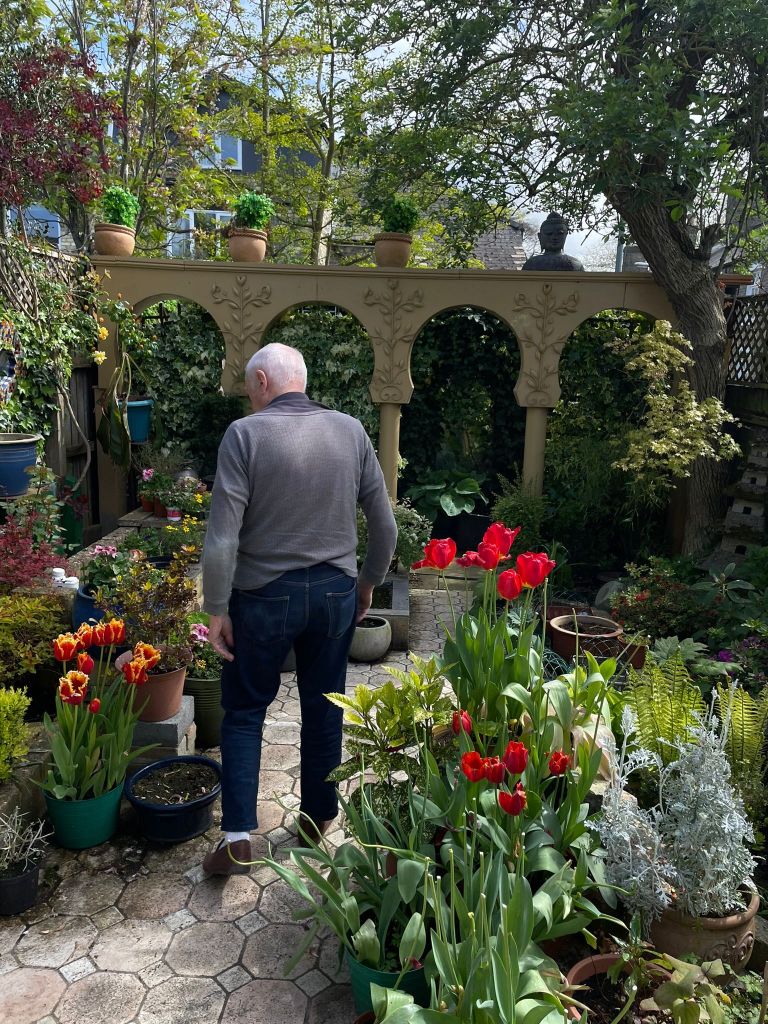
John Tordoff in his garden. Image: Troy Fielder.

After offering me a cup of tea – which I accept, taking a ginger nut for safe measure – John walks me around his home. We begin our tour at the end: looking at some recent paintings that John has (almost) completed and hung on the living room wall. He will let these hang here for a few weeks, under the surveillance of quotidian life, and decide if they need some finishing touches or if they’re safe to go out into the world.

One of the paintings, taking inspiration from Manet, places the viewer in a café overlooking a conversation between a customer and a person working behind the bar. Just in front of the viewer are the remnants of a meal that, though not labelled, is clearly from Pret a Manger – the streets of Paris are both close and far. In the studio at the top of his house, Manet’s influence continues. John shows me his interpretation of Le Déjeuner sur l’herbe: replacing the image of the once scandalous naked woman, picnicking with two men, is a young man lying prone and bare, facing two fully-clothed women. The dark woods of Manet’s original are replaced by the light surroundings of a public park. In both of these paintings, we are invited as voyeurs into a world that is at once public and intimate – John’s smile, typically warm, turns mischievous as he tells me about both of these works.
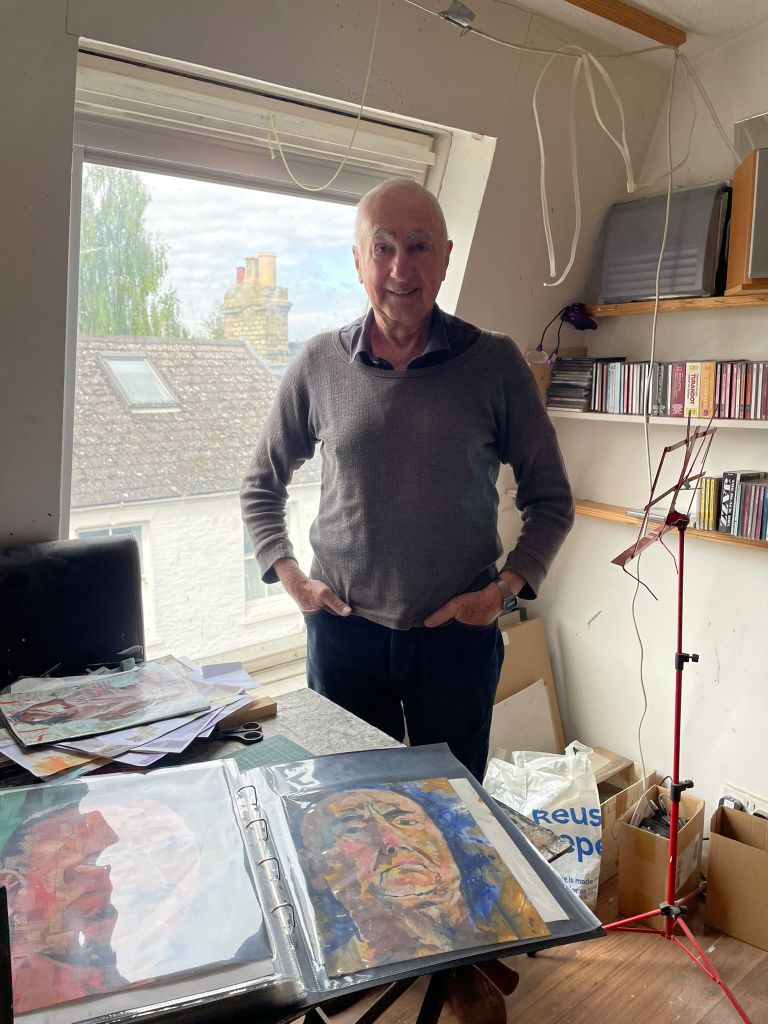
Tordoff with some of his works. Image: Troy Fielder.

“I prefer to work quickly,” explains John as we sit in his studio, “and I’m interested in lines and grids.” Using fragments from newspapers and magazines as a base, the subjects of John’s multimedia pieces range from the buildings and landscapes of Cambridge, to portraits of friends, to comments on contemporary politics. In one uncharacteristically forthright painting, made following the invasion of Ukraine, Putin stands in front of a wall that is emblazoned with the words ‘Thou art weighed in the balance’. Moving between political seriousness and voyeuristic humour, John’s work as an artist seeks to bear witness to a world full of both light and dark.

Sun shines into the high-ceilinged studio as John reflects on the realities of earning a living as an artist: “I’m fortunate that I don’t have to keep body and soul together with my art”. Having worked as an actor for over 50 years – with appearances in Coronation Street and Doctor Who – John’s career in painting only really began to burgeon after his move away from Hackney to Umbria in 2004. Despite its relative novelty, John traces his love of art – and his talent in it – back to his father, who taught him about drawing and the use of perspective. How has he nurtured his talent since then? “I try to paint every day. Even on the darkest days, it’s important to get up and paint.”

Walking downstairs, John shows me a set of maquettes that he made out of aluminium sheets a few years ago. Inspired by Cubism, Picasso’s work in particular, the figures depict kings and acrobats. Next to a miniature replica of the Venus de Milo, one of these maquettes is painted in bright blocks of colour and balances on a decoupaged plinth: lines and grids combine in dynamic harmony. His mantelpiece – like the rest of his home – dances with a lifelong fascination with art, form, and play.
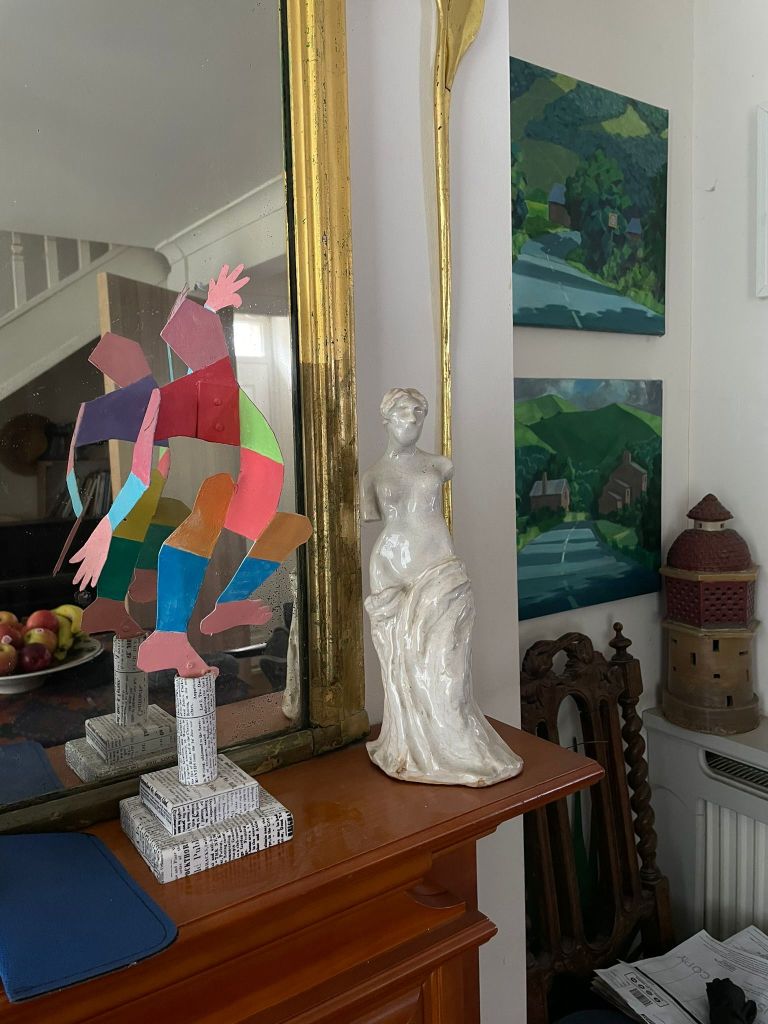
One of Tordoff’s maquettes, beside a miniature replica of the Venus de Milo. Image: Troy Fielder.

John Tordoff’s paintings are currently on display at the Locker Café. In July, he will be participating in Cambridge Open Studios 2024.

By Troy Fielder.