

Siobhán McSweeney. Photograph: Phil Sharp. Art by Iris Bowdler.
“I think you caught me on a grumpy day”, Siobhán McSweeney says wryly, halfway through our conversation. We’re in the Wellcome Collection, one of her favourite places in London, chatting over tea and attempting to eat carrot cake — we spend more time dropping it on the floor. I’m the first to do so, prompting McSweeney’s conspiratorial confession: “My friends always say they know where I’ve been by what I’m wearing”, pointing to an imaginary food stain.
The self-declared grumpiness seems fitting, given that McSweeney’s most recognisable role remains her appearance as the disdainful nun, Sister Michael, in Lisa McGee’s multi-award-winning comedy Derry Girls. McSweeney had previously worked with McGee and Liz Lewin, Derry Girls’ executive producer, on a comedy called London Irish. “It’s sort of a hidden gem. … I still maintain some of the scripts are even funnier than Derry Girls.” The show was poorly received, and only one season was made. Nonetheless, it meant that McSweeney was “on [McGee’s] radar” when writing Sister Michael’s character. The only hurdle was persuading the production company that the grumpy nun didn’t have to be old, but could be played by “a baby-faced beautiful young Cork woman in her mid to late 30s”.
Sister Michael’s age wasn’t the only thing that broke the mould. The schoolteacher simply “doesn’t give a shit. She just doesn’t follow any social mores whatsoever. I wish I was the same.” It was a welcome relief after the kinds of roles McSweeney had previously encountered. She trained as an actor in London and Paris, the latter under the legendary French clown, Philippe Gaulier. But after drama school, she became frustrated at the paucity of good female roles beyond love interests that were a mere “satellite for the male storyline”. “I’m many things, but I’m not an accessory, which means I didn’t work a lot. And certainly not on screen.”
The show came to an end in 2022, but its immense popularity continues today. The role “changed my life. In every room I walk into, that nun walks in with me.” Does she ever try to channel Sister Michael herself? “I think there’s something in playing her that I do try to keep with me, which is the fact that she is a large woman who isn’t scared of taking up space. And I’m a large woman that historically has tried to make myself as small as possible, physically or psychologically.”
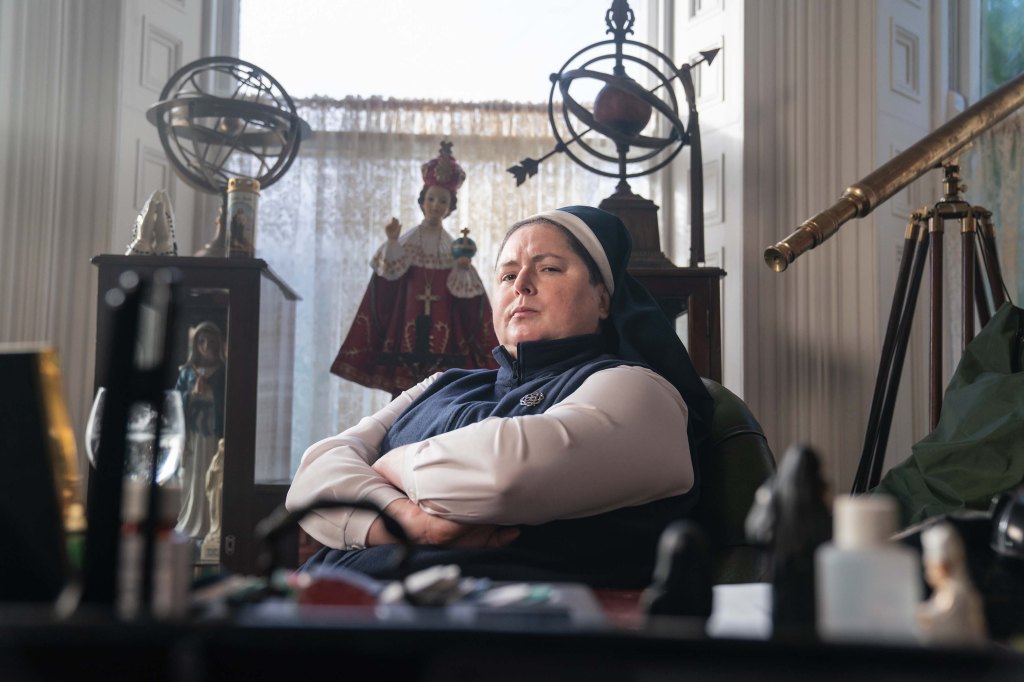
Siobhán McSweeney as Sister Michael in Derry Girls. Photograph: Peter Marley/Hat Trick Productions/Channel 4.
As Derry Girls concluded, McSweeney was cast in the Disney+ superhero comedy, Extraordinary (its second season premiered in March this year). Going from the “regional budget” of Derry Girls to the international conglomerate Disney was a huge shift. “Suddenly the Yanks are in town. It’s the first television set I’ve been on where there’s craft services. And I’m like, ‘When is this guy going?’ And they’re like, ‘Oh no, he’s here all day’. Wowww! Wow!” Plus, now “people talk to me as much about Extraordinary as they would about other stuff, which is really lovely”.
Throughout 2023, McSweeney played lead roles in stage productions of Brian Friel’s Dancing at Lughnasa and Samuel Beckett’s Happy Days (reprising a 2021 role). She fondly remembers working with the late Friel, always “the smartest one in the room”. Returning to theatre means returning to her roots. As much as she likes the “paycheck” and “quickness” of television work, “your soul doesn’t get the fuse with the character [in] the same way” as it does on stage. “Theatre is just magical. Badly paid. Very hard work. Nobody comes to see us. A lot of it is shit. But it’s the best.”
McSweeney’s most recent venture, however, has taken her behind the camera. She’s made her directorial debut with Spud (2024), a short comedy film for the BBC, about a woman in rural Ireland caring for her elderly father. She blushes when I praise it: “I feel like somebody has seen my diary or something”. The project (which she also starred in and wrote) was deeply personal, following the deaths of her father and aunt. “I know these women. In another timeline I would have been Spud”.
In making Spud, McSweeney resolved to give a voice — “even if she doesn’t say much, and most of it is beep beep” — to a character often unseen and unheard. She doesn’t mince her words on the responsibility she feels as an artist. “Quite often, the stories we’ve told have been nothing but propaganda. They’ve perpetuated one viewpoint and one viewpoint only, which has placed comedy at the bottom, women at the bottom, people of colour or of any kind of minority at the bottom, and [where] the primary and only story worth telling is a white, middle-class, middle-aged, male story.”

Siobhán McSweeney in Spud. Photograph: BBC/Lookout Point/Olly Courtney.
She calls out individual shows (Downton Abbey, The Crown, and the upcoming House of Guinness), as well as institutions like the RSC and the Olivier for the “inherent racism, classism, and huge sexism within the British tradition”. Her Cork accent means she’s been cast as “plenty of milkmaids”, and when she played the lead in Ben Jonson’s The Alchemist in 2016, “one cunt in wellies” asked if the production was deliberately “misusing Jonson’s language”. Reductive characterisations based on regional accents are all too common in the theatre. “It perpetuates this mythology of class that everybody here seems to be so masturbatorily in love with. Tour trips to Downton Abbey, please. Tickets for two.”
This is part of the reason why she loves comedy. The hard-hitting, emotional subject matter of Spud — like Derry Girls — speaks for itself. “For me, comedy is where we fully experience our humanity. The impulse to laugh is a far more honest human impulse than to cry, with one solitary tear going down my beautifully chiselled, perfectly lit cheekbone, sighing out a window, waiting to go to Moscow.” She’s adamant that for all its lightheartedness, comedy is a serious medium: “I’ve ended up doing a lot of comedy, and not because I’m a trivial person”.
McSweeney is just as vocal about political issues. She explains, “I feel a need to do something with my so-called platform because to have a platform is mortifying, and to do something with it makes it less mortifying”. In 2022, she campaigned against the government’s proposed privatisation of Channel 4. She remains fiercely protective of the channel, emphasising the importance of its free access to “more diverse voices” and its “incredible” cultural output. When she won a Bafta for her performance as Sister Michael in 2023, the BBC faced criticism for removing the end of her speech — where she criticised the British, Northern Irish, and Irish governments — from its live broadcast of the event.
Like many Irish artists, she’s also been involved in events in support of Palestine for multiple years. “Historically,” she explains, “there is a huge spiritual connection between the Palestinian struggle and the Irish.” (After Ireland’s independence in 1922, many Black and Tans — British soldiers notorious for their ruthless violence against Irish civilians — were redeployed to Palestine, then a British mandate.) She’s frustrated at the actions of both the Israeli government and Hamas, and the impact on ordinary lives. “If Derry Girls has told us anything, it’s that in every case, the normal, ordinary people are the real ones who suffer the most.” Ultimately, none of this is separate from her work as an actor. “All art is political. The fact that I exist is political.” Besides, “people laugh at things that I say, so I might as well slip in something else as well.”
So, what’s next? In a month, she’s going to Spain to film a new project. She can’t tell me the title, but says she has to practise her accent. After that, she’s filming another series of Channel 4’s The Great Pottery Throw Down, her “one true love”, which she presents. “My work is my work, but Pottery is the best job ever. I get to hang around with people who create all the time, and people love the show.” She’s also “trying to write a few things”, after Spud, although “Writing’s boring and lonely. And you’re all lunatics for doing it.”
She doubts she’ll be reprising her role as Sister Michael — after all, you’d have to rename the show. “Those kids are Derry menopausal women now.” One thing’s for certain, though. She won’t be going anywhere any time soon, luckily for audiences. “My success is in spite of the status quo, rather than because of it.” And “now that I’m in the room … I’m going to super glue or chain myself to the floor. Yeah, I’m not leaving unless I’m dragged out.”
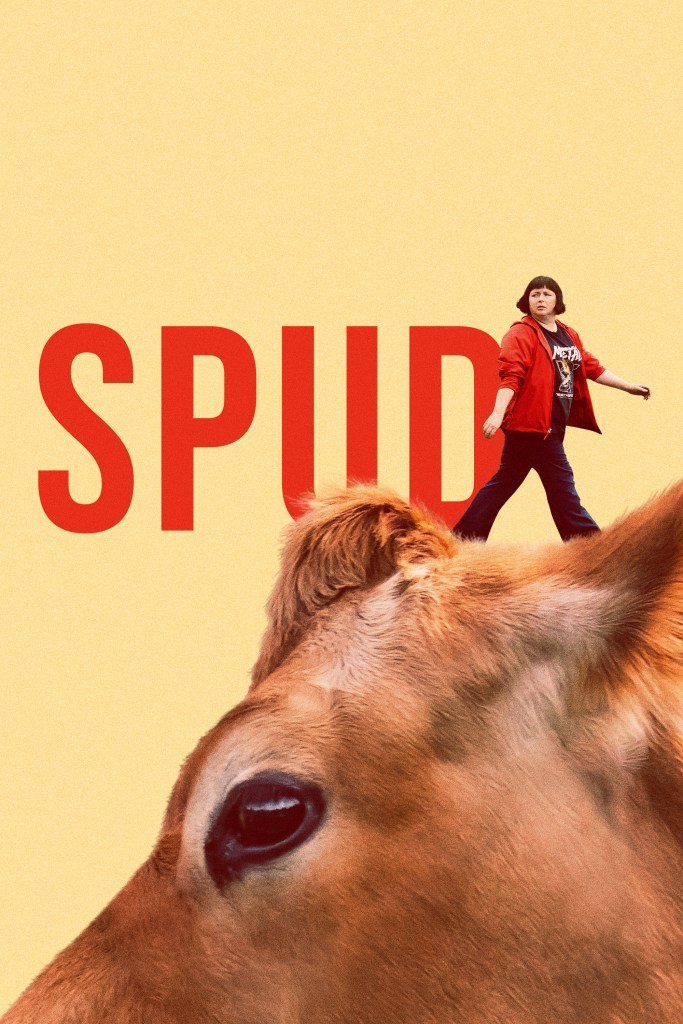
Promotional poster for Spud, featuring Siobhán McSweeney. Image: BBC/Lookout Point/Olly Courtney.
Spud is on BBC iPlayer now.
By Rachel Rees.
 The Camera