

Art by Iris Bowdler.
The bicentenary of Lord Byron’s death — 19 April 1824 — is being commemorated somewhat quaintly for a poet who is probably just as famous today for his playboy reputation as for his literary output. This weekend, Trinity College, Cambridge (where Byron was a student, along with his pet bear) are hosting a two-day “festival”; in February they held a twenty-four-hour reading of his poetry dubbed the “Byrothon”, selections of which will be played “in the presence of Byron’s ghost” during the festival. And tonight, Byron mega-fans have the chance to attend a dinner at the House of Lords in his memory. Things have changed since the sentimental trip to Harrow, Byron’s old school, in 1924, where Byronites were shown a selection of “relics” which had belonged to him, before attending a memorial service in the school’s chapel which praised the poet as the school’s most celebrated old boy.
The cult of Byron reliquaries was alive and well long before the hundredth anniversary of his death. In his lifetime, Byron was accustomed to receiving locks of hair from admirers. Lady Caroline Lamb, in one of literature’s most infamous love-letters, sent him cuttings of her pubic hair, with some of her own blood thrown in for good measure. She asked him to reciprocate her grand gesture, noting “I asked you not to send blood but yet do — because if it means love I like to have it”. His reputation then, as now, was imbued with his physicality — his good-looks, his preoccupation with his physique, his scandalous sexual exploits, his disability. Obtaining a piece of this enticingly embodied celebrity was highly desirable, and his hair found its way into several mourning rings on his death. In 2021, one sold at auction for over £30,000.
Mementos which Byron himself collected were often equally corporeal. After the Battle of Waterloo in 1815, Byron avidly sought souvenirs, purchasing a cuirass, a helmet and sword, as well as sourcing by somewhat dubious means the bones of Burgundian soldiers from the chapel at Morat. Closer to home, when a skull was dug up in the grounds of his family seat, Newstead Abbey, Byron had it made into a drinking vessel. He joked it was the remains of a particularly large-headed monk that had fallen victim to Henry VIII’s policy of dissolution. It was so large it could hold the contents of an entire bottle of Claret, and Byron habitually passed it round to guests after dinner.
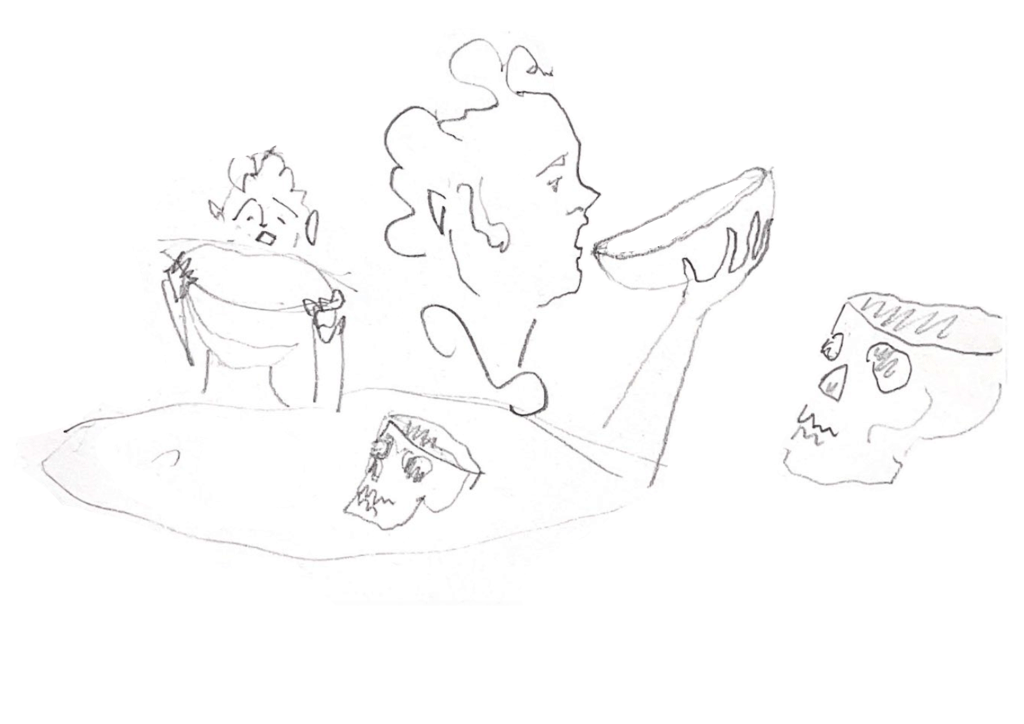
Upon his death aged 36 in Missolonghi, Greece, there were more pressing, personal questions as to what should be done with Byron’s remains. Though he eventually received a plaque in Poets’ Corner in 1969 (not far from fellow libidinist DH Lawrence, incidentally), in 1824 a burial at Westminster Abbey was out of the question — the Dean was still appalled by the accusation that Byron had forced his wife to commit “unnatural acts” which had been circulating since 1816. The Greeks, whose independence Byron had been championing at the time of his death, wished to bury him in Athens, and he plunged the local town into mourning. It was decided, however, that his body be sent for burial at Newstead, after his vital organs had been removed in something of an Egyptian manner. Byron’s larynx and lungs were left behind in Greece, while his heart and brain went into a separate urn and came back to England. The Times said his sudden death had caused “profound and unmingled mourning”, and his body was visited in huge numbers over the few days it lay in state in London, a ticketed event according to some, before being interred in the family crypt at Hucknall church.
It is thought Byron died from malaria contracted in Missolonghi, his death hastened by over-bleeding by his doctors. But his death was suitably unexpected to warrant an autopsy, apparently performed against Byron’s wishes, which found a much-abused liver and the cranium of a man “much advanced in age”. Feeding the Byronic legend, the report also claimed that his club foot was the “only blemish of his body, which might otherwise have vied with that of Apollo”. Leigh Hunt was less convinced; his eyes were too close together, and only his “mouth and chin fit for Apollo”, while his body tended “towards fat and effeminacy”. Nevertheless Byron remained for many a Greek god even in death, and his body was preserved in 150 gallons of spirit in order to make the journey to England. It was so successfully embalmed that when the coffin was broken into in the 1930s, it was in “as perfect a condition as when it was placed [there] a hundred and fourteen years ago” his “features and hair [were] easily recognisable from the portraits”, while there was an unnervingly “serene, almost happy expression on his face”. Unfortunately for the thriving community of thirsting Byronites, there have been no more recent exhumations to ascertain the current state of his beauty.
Biographical preoccupation characterised Byron’s fame throughout his life, and perhaps because of this, Byron’s friend John Murray burnt the poet’s own memoirs which he had left behind in 1824. In the decades following his death, anything connected with the poet was liable to be collected. A museum in Byron’s former home in Southwell was opened in 1854; even scraps of fabric from his wedding bed and rulers he used at school have made their way into auctions over the years. An old carriage of his was reportedly found in a shed in Australia in the 1880s, while the Albanian dress he wore in the famous portrait by John Philips is still displayed in Bowood House in Wiltshire.
There are some more poignant relics, too. While he was a student at Cambridge, Byron fell in love with a chorister, John Edelstone, who gave him a pin decorated with a carnelian heart in 1806. Though the relationship fizzled out and the heart was re-gifted, when Edelstone died in 1811 Byron requested it be returned. The heart subsequently broke, becoming the subject of a poem that praises “each shatter’d part” as reflective of the poet’s melancholy state. The vivacity of mementos was something Byron understood, and is even more apparent and appropriately bacchanalian in a poem he wrote inspired by his monk-skull drinking cap:
Start not—nor deem my spirit fled:
In me behold the only skull
From which, unlike a living head,
Whatever flows is never dull.
I lived, I loved, I quaff’d, like thee:
I died: let earth my bones resign;
Fill up—thou canst not injure me;
The worm hath fouler lips than thine.
Better to hold the sparkling grape,
Than nurse the earth-worm’s slimy brood;
And circle in the goblet’s shape
The drink of Gods, than reptiles’ food.
Where once my wit, perchance, hath shone,
In aid of others’ let me shine;
And when, alas! our brains are gone,
What nobler substitute than wine?
It doesn’t come as a surprise that a skull cup much like the subject of this poem was auctioned as Byron’s for over £3,000 in 2017. Those on a smaller budget can purchase their own Byronic carnelian hearts from Etsy for £40. Or, for just £15 you can attend Trinity’s own Glastonbury for Byronites.
By Iris Bowdler.
 The Camera