

Detail from William Blake’s Laocoön [or יה & his two Sons Satan & Adam] (c.1826-27). Image credit: © The Fitzwilliam Museum, Cambridge.
Walking into William Blake’s Universe, you are met by two faces. On the left, the German artist Philipp Otto Runge broods, handsome and melancholy in an oil self-portrait from 1802; on the right sits William Blake, his magnificently bulbous head preserved in a life cast from 1823. Turn and you find yet more faces, numerous self-portraits of Blake’s contemporaries, including Henry Fuseli, John Flaxman, Caspar David Friedrich, and Samuel Palmer. Blake is often thought of as an esoteric and isolated figure. But here, curators David Bindman and Esther Chadwick place him in conversation with his British and German contemporaries. They make the claim for Blake as a European, though he never left England.
These faces belong to some of the great artists of the early nineteenth century. Flaxman, Fuseli, and Palmer were also close friends of Blake, as Friedrich was for Runge. Our main protagonists – Blake and Runge – were born twenty years apart, and shared a deep fascination with Christian spiritualism. For Chadwick, “one of art history’s greatest missed connections” is the fact that they never actually met. Blake’s social and intellectual links with all these artists are the “constellations” which build the Universe that the exhibition promises.
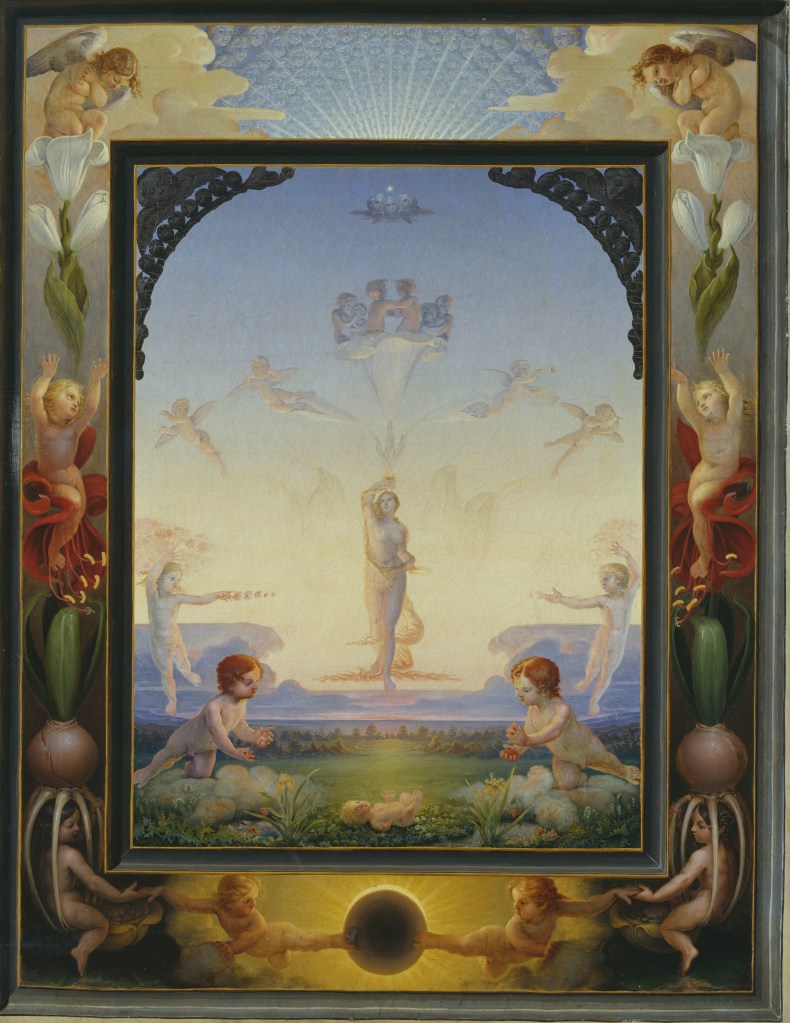
Philipp Otto Runge’s The Large Morning (Der Grosse Morgen) (1808-9). Image credit: © Hamburger Kunsthalle/bpk Photo Elke Walford.
These connections are tantalising, but in the exhibition itself they are underdeveloped. At times, the so-called “constellations” read more as lone stars. For example, the idea behind including Samuel Palmer’s unnervingly contemporary self-portrait remains elusive, unless you know your art history (or watch the video hidden away behind a wall).
Runge suffers most from this lack of clarity, which is particularly noticeable because of his co-starring role. His work is rarely shown in the UK; all of his art in this exhibition comes from the Hamburger Kunsthalle, where the exhibition will travel to next. Even when his work is foregrounded, the connections between him and Blake are left unresolved.
This is frustrating, because the precision of the curation is evident when listening to the curators speak or reading the catalogue (which will set you back £35). Even down to the choice of wall colouring, the pairing of the two has been considered. The shades of red, blue, and yellow are taken from Blake’s Albion rose (though this artwork itself is awkwardly tucked away in a corner), and are also the three pillars of Runge’s colour mythology. Yet none of this intricacy is explained in the exhibition itself, where captions are minimal and information is lacking.
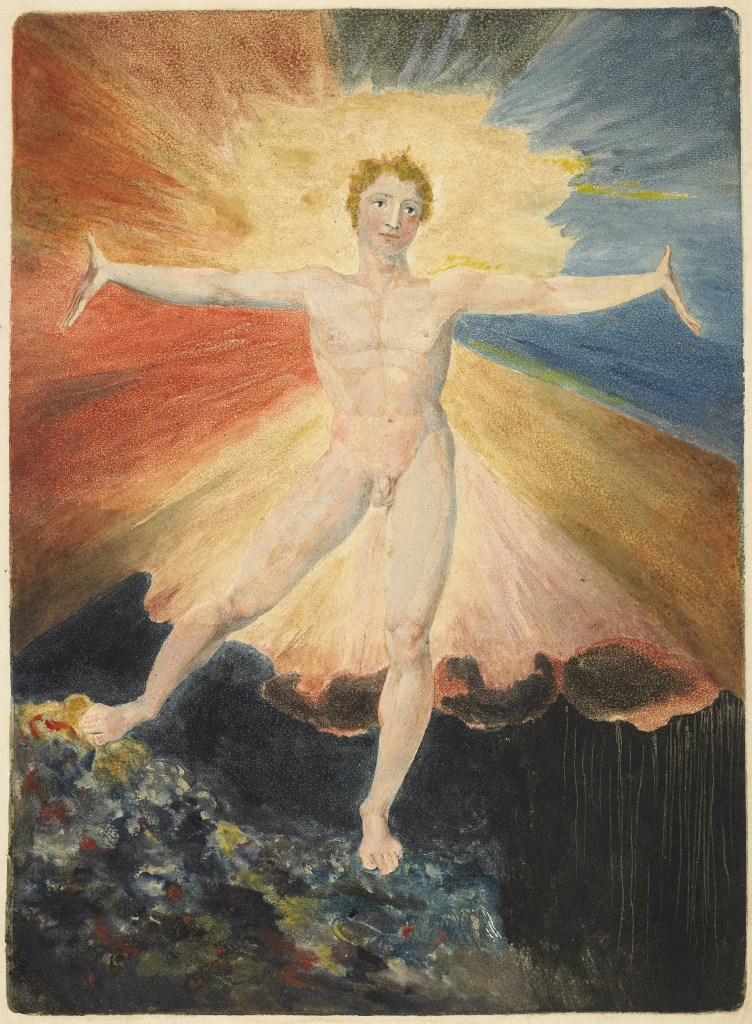
Blake’s Albion rose… (“Glad Day” or “The Dance of Albion”) (1794-96). Image credit: © The Trustees of the British Museum.
When we meet Dr Sarah Haggarty, one of several academic advisors for the exhibition, she acknowledges this critique. In a review for the Telegraph, Alastair Sooke described it as “an academic exhibition, fit for a university town”. “I wouldn’t want to dismiss it as ‘academic’,” Haggarty responds, “because I don’t like that word being used as a slur”.
Part of the difficulty in any Blake exhibition, Haggarty explains, is Blake himself. Despite his artistic network, he remains “original, different, contrarian, and countercultural”. His art is often “allegorically dense”, with his unique characters like Los and Urizen, and sometimes his ideas risk outrunning their own execution. The small size of the text-ridden illuminated manuscripts, originally bound as books, only adds to the challenge.
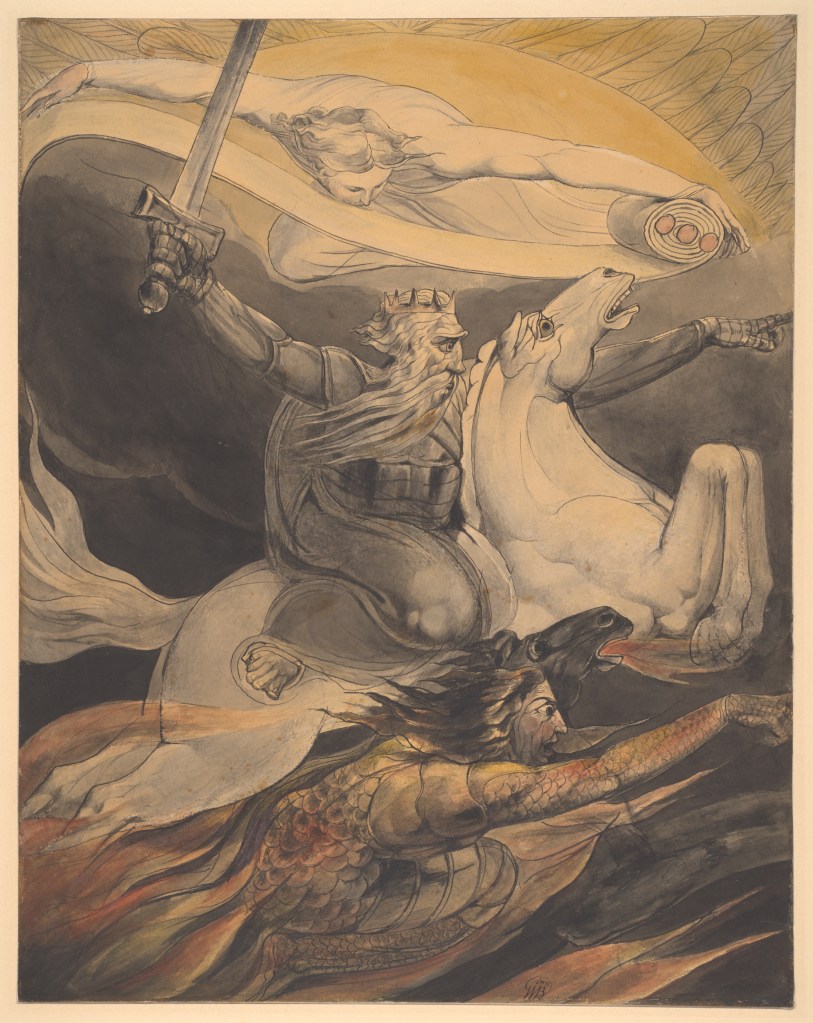
Blake’s Death on a Pale Horse (c.1800). Image credit: © The Fitzwilliam Museum, Cambridge.
So Haggarty offers us advice: rather than reaching for facts and historical detail, attend to the visual. She talks about Blake’s Albion rose, and the parallels with Runge’s Aurora that emerge through a particular “kind of looking”. She points out that the exhibition’s design encourages this, from the colour-coded walls to the windows providing glimpses between rooms, which invite us to peek through and make our own links.
And looking is worthwhile. The exhibition contains some gems, reconstructing the classically imbued world in which Blake and his contemporaries were operating. Crisp Grecian lines dance from paper to plaster, and are flanked by Gothic and Michelangelesque bodies from Blake and Runge. Blake’s Laocoön engraving shows the complexity of his relationship with this tradition. Filled with scribbled graffiti it features provocations like “Where any view of Money exists, Art cannot be carried on, but War only”. This radicalism continues, with rooms filled with depictions of revolution, flames, and tortured bodies.
In the final room, Runge and Caspar David Friedrich dominate. This is the exhibition’s most unfamiliar territory: references to Jakob Böhme’s sixteenth century philosophy are made, but the nuances of this influence are lost in the exhibition’s brevity. After Blake’s concoction of muscular yet ethereal, supple yet violent bodies that filled the earlier rooms, Friedrich’s unpeopled, sepia-toned sketch series Times of Day feels like a downbeat place to end.
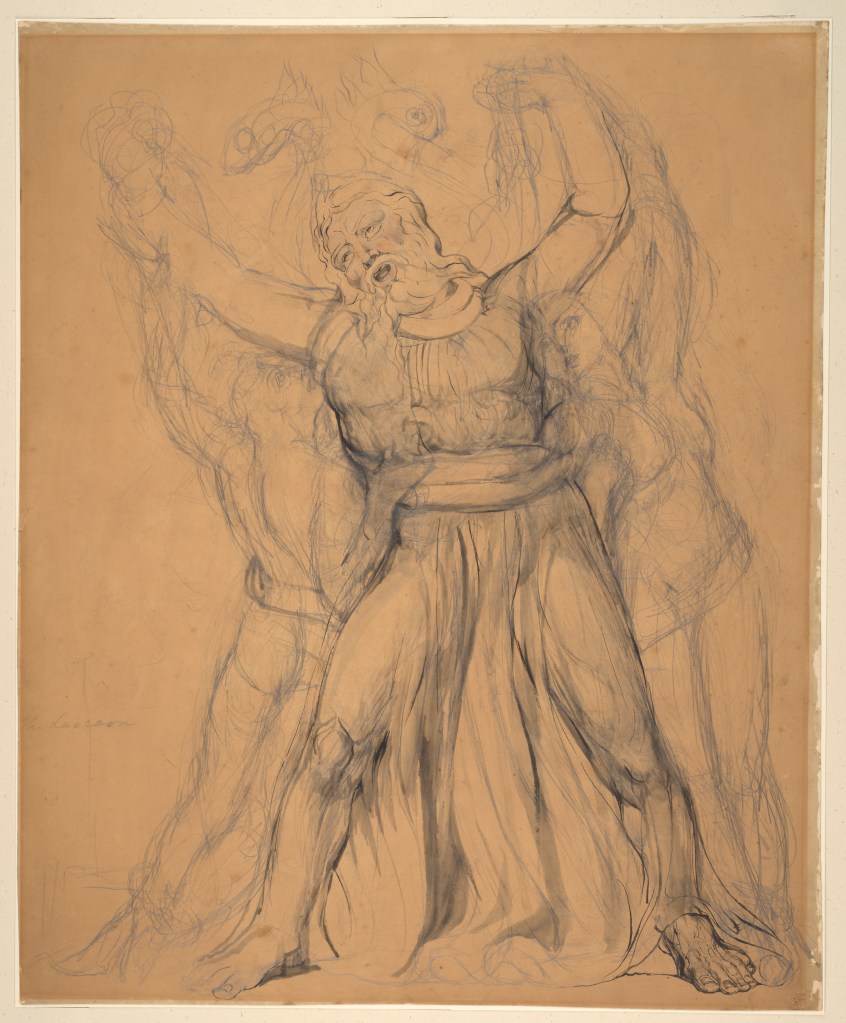
Blake’s Free Version of the Laocoön (c.1825). Image credit: © The Fitzwilliam Museum, Cambridge.
At the end of the day, though, as Haggarty reminds us, the exhibition is “full of beautiful works”, many of which are rarely exhibited in the UK. The trial frontispiece of Jerusalem and the Free Version of the Laocoön are both on show for the first time, only recently acquired by the Fitzwilliam as the final part of a mammoth bequest from Sir Geoffrey Keynes. When so much art is kept hidden away in museum archives, “there’s something to be said about the importance of just bringing these works up and showing them”.
So, despite some shortcomings, it’s worth going for the art. Take Haggarty’s advice: take your time, make your own connections, and look.
Quotations have been edited slightly for clarity.
William Blake’s Universe is on at the Fitzwilliam Museum until 19 May.
By Iris Bowdler and Rachel Rees
 The Camera